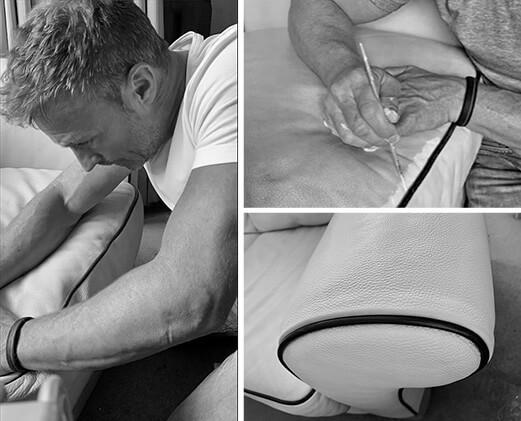
A worn car seat bolster is the most common leather problem we see in cars, and in most cases it can be repaired rather than replaced. The outer edge of the driver’s seat takes a scrape from a belt buckle, a pocket or a coat zip every single time you get in and out, and after a few years of commuting it goes shiny, then pale, then cracked. Because the damage is usually confined to one strip of leather, a good repair can make it disappear.
We repair car seat bolsters for drivers across Essex and London, from everyday Fords and Vauxhalls to Range Rovers, Mercedes and BMWs whose owners want them right before they sell or hand them back. Our leather car seat repair page covers the service in general. This post is about the bolster in particular: why it wears, what does not work, and what a proper job looks like.
Why the driver’s bolster always goes first
Car seat bolsters are the raised side sections that hold you in place when cornering. On the driver’s seat, the outer bolster (the one nearest the door) sits exactly where your hip and thigh slide across as you climb in and out. Multiply that by two or three thousand journeys a year and you can see why it suffers.
Several things make it worse. Higher, sportier seats with pronounced bolsters take more of a scrape. A low car that you drop down into, or a tall SUV that you haul yourself up into, both add friction. Jeans with rivets, keys in a back pocket, a tool belt, a high-vis jacket with a stiff zip: all of them act like sandpaper on the same few inches of leather. Heated seats dry the leather out from underneath, and once the surface loses its flexibility it cracks under that constant rubbing.
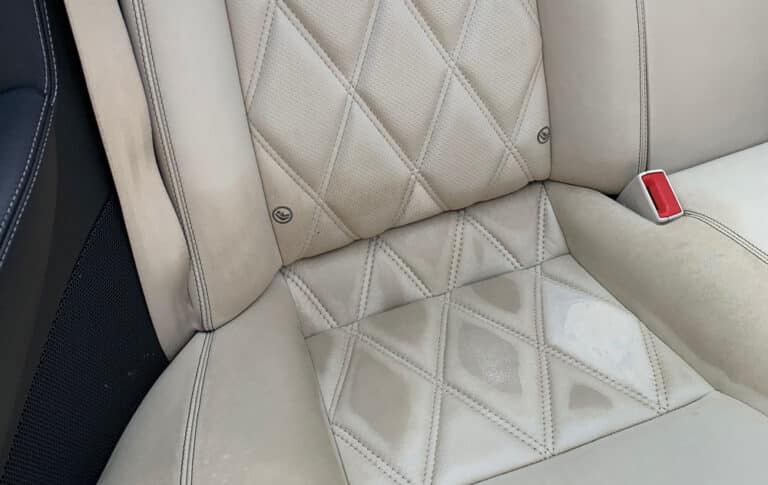
Automotive leather is nearly always pigmented, meaning it has a coloured coating on top of the hide. That coating is tough, but once it wears through, the bare hide underneath scuffs and darkens quickly. The pale, rough patch you can see on a worn car seat bolster is the coating gone and the hide showing through.
The stages of a worn car seat bolster
Bolster wear follows a fairly predictable path, and where yours is on that path decides what kind of repair it needs.
Stage one: shine and colour loss
The grain flattens and the leather looks polished. The colour starts to lighten along the top edge. At this stage the coating is thin but still there, and the repair is mostly a matter of cleaning, re-pigmenting and sealing.
Stage two: surface cracking
Fine lines appear in the coating, usually running along the length of the bolster. Dirt gets into the cracks and makes them look darker and more obvious. The leather underneath is still sound, so this is filled, smoothed and recoloured.
Stage three: worn through
The coating has gone completely across a patch and the hide is scuffed, sometimes with the surface fibres torn. This needs more filling and rebuilding of the grain before it can be recoloured, but it is still very much repairable if the hide has not split.
Stage four: split or holed
The leather has actually opened up, often along the seam where the bolster meets the seat base, or the foam is showing through a hole on the crest of the bolster. Here a straightforward surface repair will not hold, and we start talking about sub-patching, re-stitching or a replacement panel.
What people try first, and why it rarely lasts
Car seat “leather repair kits” are everywhere, and we understand why people buy them. Most contain a small pot of coloured filler and a generic colour that is supposed to be black, grey, cream or tan. The trouble is that car interiors come in hundreds of shades, and the wrong shade of black is very obvious on a seat you look at every day. The filler in these kits also tends to be stiff, so it cracks again within weeks on a bolster that flexes every time you sit down.
Shoe polish, boot dye and leather “balms” from the supermarket are the other favourites. Polish rubs off on trousers. Dye soaks unevenly into the worn patch and sits on top of the intact leather, so you end up with a dark smear surrounded by a tide mark. Conditioners and oils make bare hide darker and softer, which accelerates the wear. And anything applied over dirt and old product simply peels off, taking a bit more of the original coating with it.
We are not saying this to sell you something. Jon, our founder, has repaired plenty of bolsters where the kit had made a fairly simple job harder, because the first thing we have to do is strip out the failed filler and colour before we can start.
How we repair a worn car seat bolster
Every job begins with an assessment of what stage the wear has reached and what the leather is. Then the process goes roughly like this.
Cleaning and preparation
The bolster is thoroughly cleaned to remove years of skin oils, conditioners and silicone dressings. This matters more in cars than anywhere else, because most car owners have used some kind of interior spray at some point and pigment will not bond over it. Loose, flaking coating is removed and the edges are feathered so there is no step.
Filling and rebuilding the surface
Cracks and worn-through areas are filled with a flexible compound in thin layers, each one smoothed back so the finished surface follows the shape of the bolster. Where the grain has been rubbed away we re-create a grain texture so the repaired patch does not look flat and plastic under the light coming through the door window.
Colour matching
This is the part that separates a good repair from an obvious one. We mix pigment by eye to match your seat, testing it on a hidden area until it is right, and we check it in daylight because car interiors are seen in sunlight far more often than sofas are. Manufacturers’ colour names are a starting point at best. A ten-year-old “Oyster” or “Dakota Black” interior has faded and darkened in ways the swatch never shows.
Sealing and finishing
The colour is sealed with a lacquer matched to the sheen of the rest of the seat, usually a satin finish in cars. This layer is what gives the repair its durability against the daily scrape from your hip, and it is the thing the kits leave out.

When the bolster needs stitching or a new panel
If the seam between the bolster and the seat base has split, the thread has usually failed rather than the leather, and it can be re-stitched, in much the same way we handle leather sofa stitching. Where the bolster leather has actually torn or worn into a hole, we can sub-patch behind it for a small tear, or replace the bolster panel with new leather matched in colour and grain for anything bigger. A replacement leather panel on a bolster is a bigger job because the seat cover has to come off, but it is still a fraction of the cost of a new seat cover or a full retrim.
We also see a lot of perforated leather on bolsters in German cars, and a lot of contrast stitching. Both can be dealt with; they just need to be discussed at the quote stage rather than discovered on the day.
Why it is worth doing before you sell or return the car
A worn driver’s bolster is one of the first things a buyer or a lease inspector looks at, because it is the clearest sign of a hard-used car. Repairing it is nearly always cheaper than the deduction you would take on a part-exchange or the recharge on a lease return, and it changes the impression the whole interior gives. The Leather UK trade body is a good place to read about how automotive leather is made and finished, and why a coated hide can be restored where a fabric seat cannot.
We work on cars at your home or workplace across Essex, from Basildon and Thurrock to Colchester, and into east and central London. Most bolster repairs are done in a single visit, with the seat left to cure before you drive.
Get a quote for your car seat bolster
Take two photos in daylight with the door open: one close-up of the worn area and one of the whole seat so we can see the colour and the seam layout. Tell us the make, model and year, the interior colour name if you know it, and roughly where you are. If there is a split or a hole, a photo with a coin next to it for scale helps. You can see similar jobs in our gallery.
Call Jon on 07967 216250 or fill in the enquiry form below this post, and we will send a free quote for our leather car seat repair service.