The best way to protect a leather sofa from sun damage is to keep direct sunlight off it, keep the leather properly conditioned and protected, and deal with the first signs of fading before the surface starts to crack. That sounds obvious, but we visit homes across Essex and London every week where a good sofa has been quietly bleached by a bay window, a conservatory roof or a set of patio doors, and nobody noticed until one arm was two shades lighter than the other. This post explains what the sun actually does to leather, what genuinely helps, and what can be done once the damage is there.
What Sunlight Does to Leather
Leather is skin, and it reacts to sunlight much as ours does. Ultraviolet light breaks down the dyes and pigments that give the sofa its colour, so the exposed areas fade. At the same time, the warmth of direct sun draws the natural oils and moisture out of the hide. The leather becomes drier, stiffer and less able to flex, and the protective lacquer on top starts to break down.
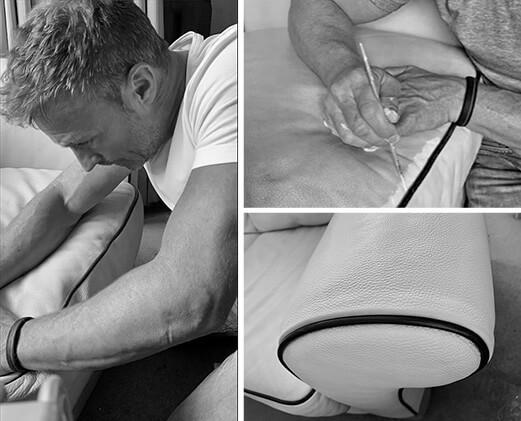
The two effects feed each other. Faded leather has lost some of its protective finish, so it dries faster. Dry leather cracks along the creases where you sit, and every crack lets in more light and more grime. Jon, our founder, has seen this hundreds of times over 26 years, and the pattern is always the same: a pale, dull patch on the top of a back cushion or the arm nearest the window, followed a year or two later by fine cracking and then splits.
It does not take a heatwave. The Met Office publishes UV data for the UK and the level in Essex through spring and summer is more than enough to fade a sofa sitting in a south or west-facing window over a couple of seasons. Conservatories and rooms with large glazed areas are the worst, because the glass lets UV through and traps the heat.
How to Protect a Leather Sofa From Sun Damage in Everyday Life
None of this is complicated, and none of it involves products from the internet. The single most effective thing you can do is manage the light.
Position and shading
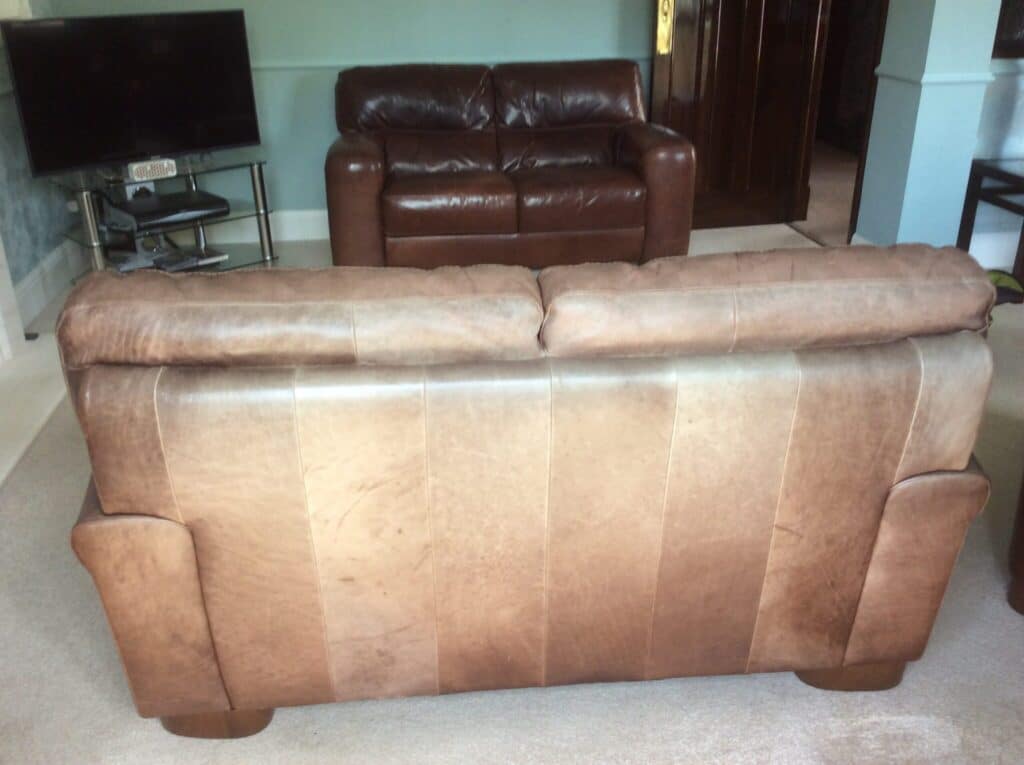
If the sofa can be moved so it is not in the direct path of the afternoon sun, move it. If it cannot, blinds, curtains or a UV film on the glass make a real difference during the hours when the sun is strongest. Many of our customers in Leigh-on-Sea and Southend have sofas facing the estuary for the view, and the compromise is usually a blind that comes down between late morning and mid-afternoon in summer. Turning and rotating loose cushions so that the same side is not always facing the window also spreads the exposure.
Keep the leather protected
A leather sofa leaves the factory with a protective finish, but that finish wears with use and does not last forever. Having the sofa professionally cleaned and re-protected periodically keeps the surface sealed against both UV and grime, and keeps the hide conditioned so it can cope with the drying effect of a warm room. Sofas that have been looked after this way fade far more slowly than sofas that have been left alone, and when they do fade they are much easier to restore.
Watch the heat as well as the light
Sun damage rarely acts alone. A sofa in a sunny window is often also next to a radiator, and the combination of daytime sun and evening heating dries leather out faster than either would on its own. A little distance from the radiator, or a shelf above it to deflect the heat, helps more than people expect.
Products That Promise Protection and Usually Disappoint
Search for how to protect a leather sofa from sun damage and you will be offered sprays, creams and balms that claim to block UV and restore colour. We are asked about these a lot, and our honest view is that most of them are best avoided.
The “feeding” products, such as oils, waxes and conditioning creams sold for shoes and saddles, do not restore colour and rarely soak into a pigmented sofa at all. They sit on the surface, attract dust and go sticky in the sun, and the sofa ends up darker in patches and still faded underneath. Olive oil and coconut oil, which get recommended on forums with alarming confidence, are worse still.
Colour balms and “leather renew” sprays are essentially thin paint. On a sun-faded sofa they can look acceptable for a few weeks, but they have not bonded to the worn finish, so they wear off onto clothing and leave a patchy mess that has to be stripped before a proper recolour can be done. If you have already used something like this, do not try to remove it. Just let us know when you get in touch.
The one thing that does work is a proper protective finish applied to clean, conditioned leather, which is exactly what we do as the final stage of every clean and every restoration.
What We Do When the Sun Has Already Got There
If your sofa is already faded, the good news is that sun damage is one of the most rewarding things we restore. Our sun bleached and faded leather repair service brings back the original colour and, just as importantly, puts the protection back so the fading does not simply start again.
In broad terms the work starts with a deep clean to remove everything sitting on the surface, including any balms or oils that have been tried. Any dryness is addressed with proper conditioning so the leather is supple before colour goes anywhere near it. Fine cracking on the faded areas is filled and smoothed. Then the colour is matched by eye to the unfaded parts of the sofa, usually the underside of a cushion or the back of a panel, and applied in thin coats until the faded areas blend in completely. A clear sealant and lacquer finish the job and give the sofa a fresh layer of protection.
Where the whole sofa has faded evenly, or where a customer would rather take the opportunity to change the shade, a full leather sofa recolouring is the better route. If you would like to see what that looks like on a badly faded sofa, our case study on reviving a sun-faded leather sofa shows the process from start to finish.
When Fading Has Gone Too Far
We will always be honest about the limits. Colour can be put back on almost any faded sofa as long as the leather underneath is still sound. Where the sun and heat have gone on long enough for the hide itself to become brittle, with deep cracks that go right through and leather that tears when you press it, recolouring alone will not hold. In those cases we would talk about replacing the worst panels or, on a sofa worth the investment, reupholstering the affected seats.
Aniline and semi-aniline leathers, which are dyed through rather than coated, fade differently and are a little more involved to restore, but it can still be done. Bonded leather, which is not really leather at all, is the one material where sun damage is usually terminal, because it peels rather than fades.
The earlier we see a faded sofa, the simpler and cheaper the fix. A sofa that has lost a little colour on one arm is a quick visit. A sofa that has been cooking in a conservatory for a decade is a bigger job. Both are worth asking about.

Get a Free Quote to Restore and Protect Your Sun-Faded Leather Sofa
If you want to protect a leather sofa from sun damage that has already started to show, send us a photograph of the sofa in its usual position so we can see where the light falls, a close-up of the faded area, and if possible a shot of an unfaded part such as the underside of a cushion for colour reference. Let us know roughly where you are in Essex or London. We will come back with an honest view on whether it needs a sun fade repair, a full recolour or simply a clean and protect.
Call Jon directly on 07967 216250, or fill in the enquiry form below this post and we will be in touch with a free quote.