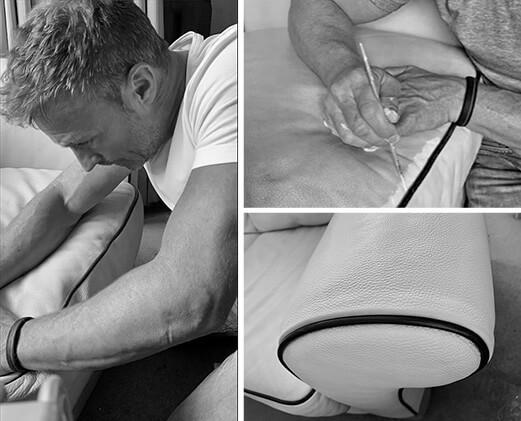
Having your leather sofa professionally cleaned is one of the least expensive things you can do for it, and one of the most effective. Most sofas we visit in Essex and London have never been cleaned properly since they were delivered, and the owners are genuinely surprised at how much of the “wear” turns out to be years of grime sitting on top of perfectly good leather. This post walks through what a professional clean actually involves, what it can and cannot fix, and how to tell when cleaning alone will not be enough.
What Builds Up on a Leather Sofa Over the Years
Leather looks solid, but the surface finish on a typical pigmented sofa is slightly porous and it holds on to everything that lands on it. Skin oils and hair products from heads and hands. Sweat on hot evenings. Dust from the room. Grease from fingers after a takeaway. Dog and cat oils on the seat nearest the window. Sun cream in summer, hand cream in winter, and the residue of every wipe that was ever used on it.
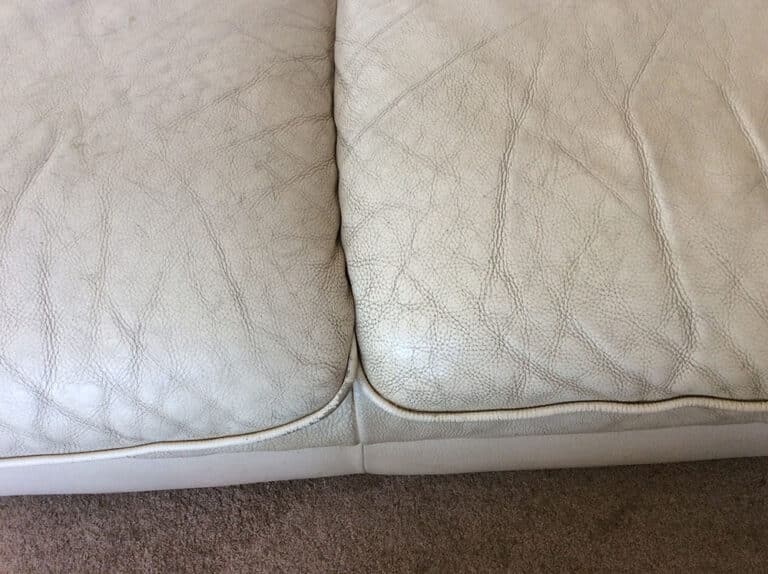
Over time that mixture works into the grain and darkens. On a cream or light grey sofa it shows as a grey tide mark on the seat cushions and a dark band along the front of the arms. On a tan or brown sofa it is subtler, but the headrests and armrests go noticeably darker and slightly sticky. Jon, our founder, calls this “head area darkening” and it is one of the most common reasons people call us thinking their sofa needs recolouring when in fact it needs a deep clean and, occasionally, a small amount of colour on the worst areas.
Left alone, the grime does more than look unpleasant. The oils slowly soften and break down the lacquer, which is why headrests and arms are always the first places to crack and peel. A regular professional clean stops that process before it starts.
What Happens When a Leather Sofa Is Professionally Cleaned
Our leather sofa cleaning service is not a quick wipe over with a branded spray. In broad terms, here is what you can expect when we arrive.
Identifying the leather
The first thing we do is work out what we are dealing with. Pigmented leather, semi-aniline, full aniline, waxed pull-up, nubuck and bonded leather all react differently to moisture and to cleaning products. Using the wrong approach on the wrong leather is how a sofa ends up with water marks, dull patches or lifted colour. Twenty-six years of doing this means we can usually tell at a glance, and we test on a hidden area regardless.
Deep cleaning
The sofa is then cleaned panel by panel with professional leather cleaners that lift the grease and dirt out of the grain without stripping the finish. Cushions come off, the frame is done, and areas people forget about, such as the backs of the seat cushions and the inside of the arms, are cleaned as well. Heavily soiled headrests and armrests are given extra attention. This stage is where the transformation happens, and it is often more dramatic than customers expect.
Conditioning and protection
Once clean, the leather is conditioned so that it stays supple, and then a protective finish is applied that makes the surface easier to keep clean and slows the next build-up. On a light coloured sofa this protection makes a real difference to how quickly the seats grey up again. We can also advise you on how to look after it between visits, which is a genuine conversation rather than a sales pitch for products.
Why Home Cleaning Often Does More Harm Than Good
We understand the temptation to reach for whatever is under the sink. But most of the damage we are asked to repair on otherwise healthy sofas was caused by well-meaning cleaning, and the culprits are always the same.
Baby wipes are the biggest offender. They feel gentle, but most contain alcohol or detergents that break down the lacquer, and because they seem harmless people use them every week for years. The result is a sofa where the colour has been slowly wiped away on the seats and arms while the back looks brand new. Washing-up liquid, multi-surface sprays and glass cleaner do the same thing faster. Vinegar and bicarbonate of soda, which the internet loves, are acidic and abrasive respectively, and neither belongs anywhere near leather.
Then there is the other extreme: olive oil, coconut oil, Vaseline and furniture polish, applied to “feed” the leather. These do not soak in and nourish anything. They sit on the finish, attract dirt, go rancid, and leave a sticky darkened patch that has to be professionally stripped before anything else can be done. Steam cleaners, hired or borrowed, force heat and moisture into the hide and can shrink, stiffen and crack it.
If any of this sounds familiar, please do not try to undo it yourself. Tell us what has been used and we will take it into account. We have seen it all before and nobody is judged.
What Professional Cleaning Can Fix and What It Cannot
A leather sofa professionally cleaned by us will be free of general soiling, greasy headrests and arms, dull and tacky patches, light surface marks, odours from pets and smoke, and the grey film that makes a pale sofa look ten years older than it is. In a great many cases, that is all the sofa needed.
What cleaning will not do is put colour back. If the grime has already eaten through the finish, or the surface has been wiped down to the base leather with years of baby wipes, the sofa will come up clean but pale in those areas. At that point we would talk you through a light recolour of the affected panels, which is a straightforward follow-on job. Equally, cleaning will not remove ink, dye transfer from jeans, or stains that have soaked into an unprotected aniline hide. Those come under leather stain removal, which uses different techniques and is quoted separately.
Cracked, peeling or torn leather is a repair job rather than a cleaning job. If the sofa has reached that stage we would recommend a full leather restoration, which includes the clean as its first step, followed by repair, recolouring and sealing. We will always tell you honestly which category your sofa falls into from your photographs, so you are not paying for a clean when it needs more, or for more when a clean would do.
How Often Should a Leather Sofa Be Cleaned?
It depends entirely on how it is used. A sofa in a formal front room in Billericay that is sat on at Christmas can go many years between professional cleans. The same sofa in a busy family home in Basildon with two teenagers, a Labrador and a south-facing patio door will benefit from a professional clean every year or two, and a light wipe with a proper leather cleaner in between.
Light colours need attention sooner than dark ones because the grime shows earlier. Sofas near radiators or in conservatories dry out faster and benefit from more regular conditioning. If you want an independent view on looking after furniture, Which? publishes consumer advice on sofas and their care that sits well alongside what we see in customers’ homes every week: the sofas that last are the ones that were looked after.
A good rule is to have it done before it looks like it needs it. Once the arms are dark and the seats are grey, the finish is already under attack.
What a Professional Clean Costs and How Long It Takes
Most two and three seater sofas are cleaned and protected at your home in a couple of hours, and can be sat on again the same day. Larger corner suites and full three-piece suites take longer. We cover the whole of Essex, from Southend-on-Sea and Canvey Island up to Colchester and Chelmsford, and travel into east and central London regularly.
Price depends on the size of the sofa, the type of leather, how heavily soiled it is, and whether any minor colour work is needed on headrests or arms. A professional clean is one of the cheapest services we offer and it is a fraction of the cost of recolouring, let alone replacing a sofa. Every job is quoted individually, and quotes are free.

Book Your Leather Sofa Professionally Cleaned in Essex or London
If you would like your leather sofa professionally cleaned, send us a photograph of the whole sofa in daylight and a close-up of the worst area, usually a seat cushion or an arm. Tell us roughly where you are and how the sofa is used, and we will let you know honestly if a professional clean is all it needs or if a little colour work would be worth adding while we are there.
Call Jon directly on 07967 216250, or fill in the enquiry form below this post and we will get back to you with a free quote.