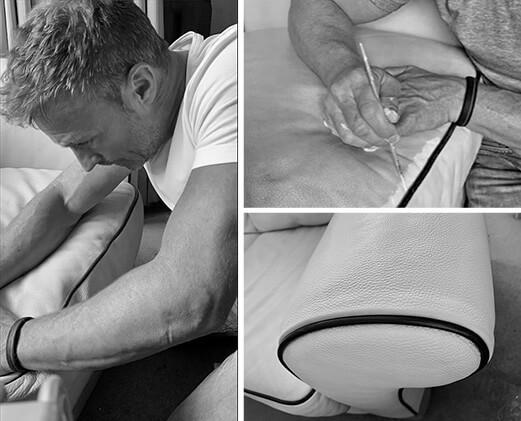
If you are searching for how to repair a tear in a leather sofa, the honest answer is that a proper, lasting repair is not a job for a kit off the internet. A tear in leather is a break in a material that is under tension every time someone sits down, and the way it is fixed decides whether it disappears for years or opens up again within weeks. At The Leather Expert we have repaired thousands of torn sofas across Essex and London, and this post explains what actually works, what makes things worse, and when it is time to give us a call.
Why Leather Tears in the First Place
Most tears we see start with something ordinary. A dog jumps up and catches a claw on the seat cushion. A child drags a toy car along the arm. Someone sits down with a set of keys or a phone in their back pocket. The leather itself may have been weakening quietly for years before that happens, usually because it has dried out from central heating, sunlight through a bay window, or simply never having been cleaned and protected since the day it left the showroom.
Dry leather is brittle leather. Once the surface coating has worn thin and the fibres underneath have lost their moisture, an everyday knock that would once have bounced off leaves a split. Jon, our founder, has looked at hundreds of torn sofas over 26 years, and in most cases the tear is the symptom rather than the cause. That matters, because a repair that ignores the condition of the surrounding leather will not hold.
Seat cushions, the front edges of arms and the top of the back are the areas we are called out to most. They take the most rubbing, the most weight and the most sun. Sofas from good makers such as Natuzzi, DFS, John Lewis and Ercol are all repairable, and even a fairly modest sofa is often worth saving if the frame and cushions are still sound.
How to Repair a Tear in a Leather Sofa: What Actually Happens

People imagine a tear repair as gluing the two edges back together. It is nothing like that. A professional leather split and tear repair is closer to rebuilding a small section of the hide from the inside out, and every stage depends on the one before it.
Assessment first
Before anything is touched, we look at what kind of leather it is, how it has been finished, how the tear runs against the grain, and how strong the leather is either side of it. A clean, straight cut in firm leather is one job. A ragged tear in soft, dry, worn leather is a different job entirely, because there is nothing solid to anchor the repair to. This is why we always ask for photographs before quoting.
Support from underneath
A tear is then supported from behind with a sub-patch, a flexible backing that sits beneath the leather and takes the strain off the damaged edges. Without this, any surface repair is simply sitting on a gap and will crack the first time the cushion flexes. Getting the backing in flat and secure is fiddly work and it is where most home attempts go wrong before they have even started.
Filling, colour and finish
With the tear supported, the gap is built up in fine layers with a flexible compound, shaped and textured so it matches the grain around it. Then the colour is matched. Not “brown” or “cream”, but the exact shade your sofa has faded to over the years, mixed by eye and by test patch. Finally the repaired area is sealed and lacquered so it wears, flexes and feels like the leather around it. Done well, you will struggle to find where the tear was.
Why Home Repair Kits Usually Make It Worse
We are not against people having a go at things. But search for how to repair a tear in a leather sofa and you will be offered a dozen kits and videos, and we see the results of them every single week. The same problems come up again and again.
The first is the glue. Superglue and most “leather adhesives” go rock hard. Leather is meant to move, so the glued line stays stiff while everything around it flexes, and within a short time the leather cracks along the edge of the hard glue instead. The tear is now longer, with a ridge of adhesive that has to be cut away before a proper repair can begin.
The second is colour. Kits come with a handful of little pots that are meant to be mixed by trial and error. Almost nobody gets a match, and a patch of slightly wrong brown in the middle of a seat cushion is far more noticeable than the tear ever was. Worse, some of these colours are not compatible with the original finish and will not bond to it, so they peel and flake with use.
The third is the filler. Kit fillers tend to shrink as they dry, sink into the tear, and leave a dent. Applied thickly to compensate, they crack. We have also seen nail varnish, shoe polish, marker pen and even fabric plasters used on torn sofas. All of them leave residue that makes the eventual professional repair harder and more expensive.
Jon’s rule of thumb is simple: if it has come out of a tube or a spray can, it has probably not helped. If you have already tried something, do not worry, just tell us what you used so we can plan around it.
Tears, Splits, Seams and Holes Are Not the Same Thing
It helps to know what you are looking at, because the right fix depends on it.
- A tear is a break across the surface of a panel, often with a flap of leather still attached. These respond very well to the sub-patch and fill method described above.
- A split usually runs along a line of wear, such as the front edge of a seat where the leather has dried and cracked through. Splits often need the surrounding area treated as well, otherwise the next split appears an inch along.
- A failed seam is not a tear at all. The leather is intact but the thread has worn through or pulled out. This calls for leather sofa stitching rather than filler, and it is a mistake to glue a seam shut.
- A hole with a piece of leather missing, such as a cigarette burn or a chunk taken out by a dog, needs the gap rebuilt rather than closed, and larger holes may be better served by replacing the panel.
If you are not sure which you have, a couple of photographs will tell us in seconds.
What Affects the Cost and How Long It Takes
Every repair is priced individually, but the same factors come up each time. The size and shape of the tear, obviously. The type of leather, because a pigmented leather from a big retailer is generally more forgiving than an aniline or waxed hide that shows every mark. The colour, since a black or dark brown sofa is easier to blend than a pale cream, a light grey or a two-tone finish. And the condition of the leather around the damage, because if that has gone dry and thin we may recommend a wider leather restoration so the repair has something sound to sit in.
Most single tears are repaired at your home in a single visit, usually within a few hours, and the sofa can be used again the same day once the finish has cured. We regularly do this in Southend-on-Sea, Rayleigh, Basildon, Brentwood, Chelmsford and across east and central London. Where there are several areas of damage, or where cushions need to come apart, we may take the affected parts back to our workshop in South Benfleet.
A small localised tear repair almost always comes in well under the cost of a replacement cushion cover, never mind a new sofa. If the sofa was bought recently and the leather has torn without any obvious cause, it is also worth knowing your position with the retailer. Citizens Advice has clear guidance on your rights when furniture turns out to be faulty, and we are happy to give an honest independent opinion on whether a tear looks like a manufacturing fault or ordinary wear.
When a Tear Repair Is Not the Right Answer
We will always tell you if a repair is not worth your money. If the leather across a whole seat has gone papery and is splitting in several places, patching one tear only buys you a few months. In that situation we would talk about replacing the panel, or in some cases reupholstering the seat, rather than chasing tears one at a time.
Bonded leather, the cheap composite material used on some budget sofas, is another case where we will be straight with you. It is not really leather and it does not accept repair the way a hide does. Once it starts to peel or tear, the honest advice is usually to spend the money elsewhere.
Everything else, from a single claw mark to a seat cushion torn from front to back, is well within what we do every day.

Get a Quote to Repair the Tear in Your Leather Sofa
Rather than working out how to repair a tear in a leather sofa yourself, send us two or three photographs: one close up of the tear, one of the whole sofa so we can see the colour and the type of leather, and a note of roughly where you are in Essex or London. From that we can usually give you a clear idea of what the tear repair involves and what it will cost.
Call Jon directly on 07967 216250, or fill in the enquiry form below this post and we will come back to you with a free, no-obligation quote.