If you are asking yourself why is my leather sofa cracking, the honest answer is that the leather has dried out, the protective top coat has worn through, or both. Leather is skin, and skin that loses its natural oils and gets flexed thousands of times a year will eventually split along the lines where it bends most. The good news is that most cracked leather sofas we see across Essex and London can be brought back with proper leather restoration, and in the vast majority of cases it costs far less than a replacement.
Below we go through the six causes Jon, our founder, sees most often after 26 years in the trade, what people tend to try at home (and why it usually makes matters worse), and what a professional repair actually involves.
Why Is My Leather Sofa Cracking? The Six Usual Suspects
Cracking rarely has a single cause. It is usually two or three of the following working together over a few years, until one winter the surface finally gives up.
1. Dry air and radiators
This is the big one. A sofa pushed up against a radiator, or sat in a room with the heating on from October to March, is slowly being baked. The heat drives moisture and oils out of the hide, the fibres stiffen, and the finish on top loses its flexibility. Jon has lost count of the number of tan and cream sofas from houses in Rayleigh, Billericay and Brentwood where one arm is perfect and the other, the one nearest the radiator, is a web of fine cracks.
2. Sunlight through a window or conservatory
Ultraviolet light breaks down both the dye and the top coat. A sofa in a south-facing bay window in Leigh-on-Sea, or in a conservatory anywhere in Essex, takes a hammering in summer. Colour fades first, then the surface goes brittle, then it cracks. The Met Office publishes UV data for the UK, and it is higher for longer than most people assume.
3. Body oils, sweat and hair products
Head and arm areas darken and go shiny before they crack. Skin oils soak into the grain, mixed with the residue of hand creams and hair products, and over time they break down the finish from underneath. This is why the cracking on a well-used family sofa is almost always on the seat cushions, the front edge of the arms and the spot where the same person rests their head every evening.
4. Wrong cleaning products
Baby wipes, kitchen sprays, furniture polish and general household cleaners are all far too harsh. They strip the protective layer from the leather a little more every time they are used. For a year or two the sofa looks clean. Then the finish starts to lift and crack, and the damage is far more expensive to put right than it would have been to have the sofa professionally cleaned in the first place.
5. Poor quality or bonded leather
Not everything sold as leather is a full hide. Bonded leather is essentially leather fibres glued to a backing with a plastic top layer. It peels and cracks within a few years no matter how carefully it is treated. Bi-cast and some cheaper corrected-grain leathers sit somewhere in between. If your sofa is only three or four years old and the surface is flaking off in sheets rather than cracking in fine lines, this is usually the reason.
6. Simple age and use
Even a beautifully made sofa from Natuzzi or John Lewis will crack eventually if it is sat on every day for fifteen years and never fed. Leather flexes at the same points every time someone sits down and stands up, and those hinge points wear first. That is not a fault in the sofa. It is simply what happens to a natural material that has been used and loved.
Fine Surface Cracks or Deep Splits? It Matters
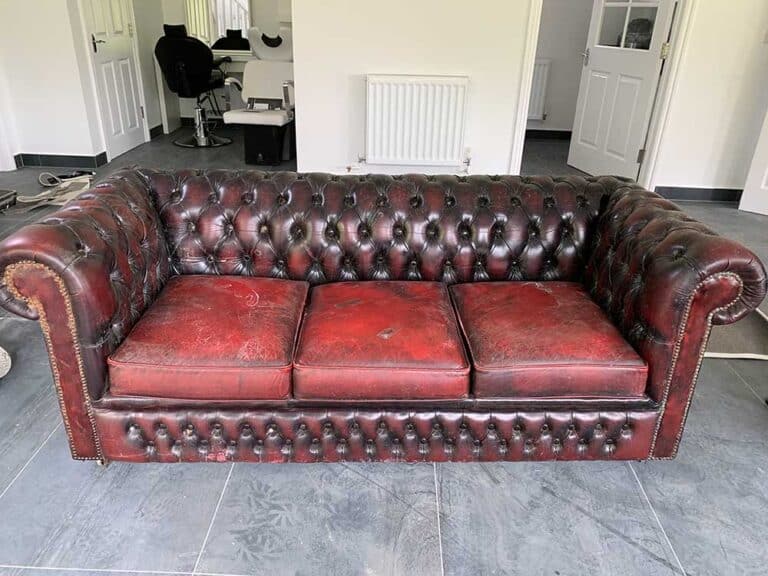
When customers send us photos, the first thing Jon looks for is how deep the cracking goes. Fine, crazed lines that you can feel with a fingernail but that have not opened up are usually confined to the finish and the very top of the grain. These respond well to cleaning, conditioning and a fresh pigment and sealant.
Deeper cracks, where you can see paler fibres inside the split or where the leather has actually torn along a crease, are a different job. Those need the crack stabilised and filled before any colour goes on, and in the worst cases a section of the panel needs replacing. Neither is a disaster, but the sooner we see the sofa the cheaper and simpler the work tends to be.
Home Remedies for a Cracked Leather Sofa (And Why They Backfire)
We understand the temptation. A tin of something from the supermarket costs a few pounds and the internet is full of tips. In practice, the sofas that end up costing the most to restore are the ones that have had a home remedy applied first.
Olive oil and coconut oil are the most common. They darken the leather unevenly, go rancid over time, and leave a tacky surface that attracts dirt. Worse, they soak into the fibres and prevent professional dyes and sealants from bonding, so we have to strip them out before we can begin. Shoe polish sits on top and rubs off on clothes. Vaseline and hand cream do much the same.
Repair kits from the high street or online are the other common problem. They come with a filler, a small pot of colour and a set of instructions that make it look easy. The colour almost never matches, the filler is applied too thick, and the result is a stiff, shiny patch that draws the eye more than the original crack did. Jon spends a good part of every month removing kit repairs before he can start the real work.
What Professional Leather Restoration Involves
Every job starts with an honest assessment. We look at the type of leather, how deep the damage goes, whether the colour is original or has been recoloured before, and whether the cracking is confined to a couple of areas or spread across the whole piece.
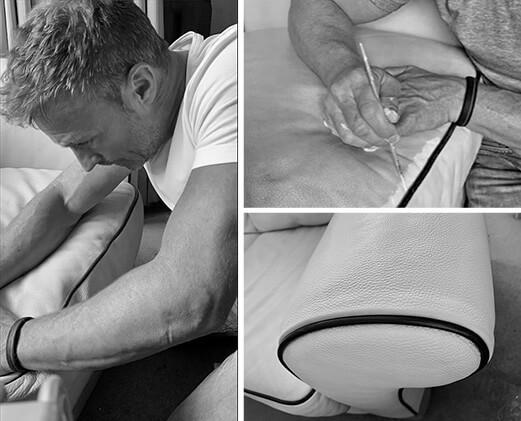
The sofa is then deep cleaned to remove years of oils, silicone and old products, which on its own often makes a surprising difference. The cracked areas are stabilised and any open splits are filled and smoothed by hand, built up in thin layers rather than one heavy coat. The leather is then conditioned so it flexes properly again.
Colour is the part that separates a good repair from a bad one. Jon mixes pigment to match your sofa in your room, under your lighting, rather than picking the nearest shade from a chart. Where the cracking has been widespread it is often better to recolour the whole seat or panel rather than trying to blend a patch, and our leather sofa recolouring service is designed for exactly that. A flexible sealant and a matt or satin lacquer go on last so the finish can move with the leather instead of cracking again.
Most of this is done in your home. Larger jobs, or anything with panels that need replacing, may come back to our workshop in South Benfleet.

Can Every Cracked Sofa Be Saved?
Nearly all genuine leather sofas can be. The exceptions are worth being honest about. Bonded leather that is peeling in sheets is not really repairable, because there is no sound leather underneath to work with. We will tell you that straight away rather than take your money for a repair that will fail in six months.
Very old hides that have gone completely brittle right through, so that they tear when you press them, are also borderline. In those cases replacing the affected panels or a full reupholstery in new leather may make more sense, and we can quote for both so you can compare.
Stopping It Happening Again
Once a sofa has been restored, a few simple habits keep it that way. Pull it a foot or so away from the radiator. Draw a blind on the sunniest afternoons if it sits in a bay window. Have it professionally cleaned and conditioned every year or two rather than reaching for wipes. Our leather sofa cleaning service is popular with customers who want to protect a sofa they have just had restored, and it costs a fraction of the repair.
None of this needs to be complicated. Leather that is kept clean, fed and out of direct heat will last decades. Most of the cracked sofas we see simply had none of those three things for a long time.
Get a Quote to Restore Your Cracked Leather Sofa
If you have been wondering why is my leather sofa cracking and whether it can be saved, send us two or three photos of the damage in normal daylight, along with a rough idea of where you are. Most of our work is in Essex and across east and central London, from Southend-on-Sea and Basildon through to Romford and the City, and Jon can usually tell from the photos what is involved.
Call Jon directly on 07967 216250 or fill in the enquiry form below this post. You can read more about our leather restoration service, and every job is quoted individually, with no obligation.