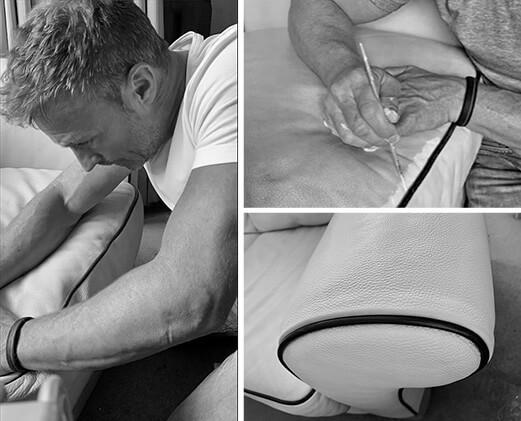
Why do sofa cushions sag? In almost every case it is because the filling inside the cushion has broken down, not because the leather has stretched. Foam loses its bounce, feathers flatten and drift, fibre wrap clumps, and the seat you sink into at the end of the day gradually stops pushing back. The leather cover is usually fine. It is the core that has given up.
The good news is that a sagging seat is one of the easiest things about a leather sofa to put right. We fit new cushion cores for customers across Essex and London every week, and it is often the single change that makes a ten-year-old sofa feel new again. You can read about our new foam cushions service, or carry on reading to understand what has gone wrong with yours.
What is actually inside a sofa cushion
Most people never see the inside of their cushions, so it helps to know what you are sitting on. A modern leather sofa seat is usually one of four things.
Solid foam. A block of polyurethane foam, sometimes with a softer layer on top, cut to the shape of the cushion. This is the most common filling on sofas from the big high street retailers and from Italian makers like Natuzzi.
Foam with a fibre wrap. The same foam core wrapped in a layer of polyester fibre inside a stockinette bag. The fibre gives a softer, plumper look when new.
Feather and down. Loose feathers, sometimes mixed with down, in a channelled ticking bag. Common on more traditional and higher-end sofas. Very comfortable, very soft, and very prone to going flat.
Feather-wrapped foam. A foam core with feather chambers around it, giving the look of a feather cushion with some of the structure of foam.
Back cushions tend to be fibre or feather, and they sag in their own way, which we will come to. When people ask us why do sofa cushions sag on one end but not the other, the answer is nearly always that one end is the favourite seat and the filling there has simply done more work.

Why do sofa cushions sag? The four usual causes
Foam fatigue
Polyurethane foam is a mass of tiny cells that compress and recover every time you sit down. Over thousands of sittings the cell walls weaken and the foam stops recovering fully. It also softens with heat and humidity, which is why the seat nearest the radiator or the conservatory window often goes first. Cheaper, lower-density foam fatigues quicker; a sofa that felt firm in the showroom and felt soft within eighteen months almost certainly had a low grade of foam in it.
Fatigued foam does not just sink. It also shrinks slightly, so the cover becomes loose and the leather starts to crease and pool on the seat. Many of the “worn leather” enquiries we get from Basildon and Southend-on-Sea turn out to be tired foam pulling the leather into creases that then crack.
Feathers flattening and migrating
Feather cushions need plumping. If they are not shaken and turned regularly the feathers compact at the front, where the weight is, and drift to the sides. The cushion ends up with a hard, flat front edge and a lumpy back. Feathers also break down over time and turn to dust inside the ticking, which is why old feather cushions weigh less than they used to and feel thin.
Fibre clumping
The polyester wrap that made the cushion look so plump in the shop is the first thing to go. It mats down into hard lumps, often within a couple of years, so the cushion looks lumpy and the foam underneath feels closer to the surface than it did. Back cushions filled entirely with fibre collapse into a soft heap that no amount of plumping brings back.
The seat platform underneath
Sometimes the cushion is fine and the sag is coming from below. Serpentine springs stretch, webbing loses its tension, and the plywood or fibreboard base on cheaper sofas can bow. If your cushion feels firm when you press it on the floor but sinks when it is on the sofa, the platform is the culprit, and new foam alone will not fix it. Part of our assessment is always to lift the cushion and check what is going on underneath.
Why the usual home remedies do not last
Once you know why do sofa cushions sag in the first place, it is easier to see why the quick fixes struggle: they add something on top of a filling that has already failed, rather than replacing it.
We do understand the temptation to try something before calling anyone. Plumping helps feather cushions for a while, and turning cushions regularly does spread the wear. But the things people buy to fix a sagging seat tend to disappoint.
Thin foam “toppers” and cushion inserts sold online are usually low-density sheet foam that fatigues even faster than the original. Stuffing extra polyester filling into a cushion gives a lumpy, uneven seat that looks worse than the sag did. Plywood boards laid under the cushions make the sofa feel like a bench and can damage the leather on the front border where it rubs against the edge of the board. And we regularly see cushion covers that have been forced open along the zip or split at the seams by an insert that was too big, which turns a foam job into a leather stitching repair as well.
None of this is a criticism. It is simply that the cushion was made as a system, with foam, wrap and cover designed to fit each other, and swapping one part for something roughly the right size never quite works.
What a proper cushion replacement involves
Jon, our founder, has replaced cushion cores in thousands of sofas over 26 years, and the process is more careful than most people expect.
Assessment and measuring
We start by opening the cover and looking at what is there. We measure the original core in all three dimensions, note whether it had a softer top layer or a fibre wrap, and check the platform underneath. We also ask how you want the sofa to feel. Some people want the firm seat they remember from the showroom; others want it a touch softer because of a bad back. Foam comes in a range of densities and firmnesses, and choosing the right one matters more than anything else.
Cutting the new core
The new foam is cut to the exact dimensions of the original, sometimes very slightly larger so the cover is properly filled and the leather sits smooth. T-shaped and curved cushions are shaped to match. Where the original had a fibre wrap we fit a new one in a stockinette bag so the cushion has the same plump appearance and the leather does not rub directly on the foam.
Feather cushions
Feather seats can be topped up and re-channelled, but many customers ask us to replace them with feather-wrapped foam instead. It keeps the soft, traditional look and feel while giving a seat that does not need plumping every evening. It is a personal choice, and we will talk it through with you rather than push one way or the other.
Fire safety
All the foam we use complies with UK furniture fire safety regulations. This is not a small point. Cheap foam bought online for a DIY refill may not, and GOV.UK sets out the requirements that upholstered furniture and its fillings must meet. Ask anyone offering to replace your cushions what they are putting inside them.

Fixing the leather at the same time
Once the seat is properly supported again, the creasing in the leather usually eases, but the damage the creasing caused does not vanish. Cracked colour along the fold lines, wear on the front edge, and the dull, grubby patch where people always sit can all be dealt with while the cushion is open. It makes sense to do it in one visit. Our leather restoration work covers cleaning, re-filling cracks and recolouring, and a customer in Rayleigh who booked new foam and a recolour together ended up with a sofa their family assumed was new.
When new cushions are not enough
There are two situations where we will tell you that new foam is not the answer. The first is a collapsed platform: broken springs or torn webbing need to be dealt with before any cushion will sit properly. The second is a cover that has gone beyond restoring, with leather that is cracked through, thin and splitting in several places. In that case new foam inside a failing cover is money poorly spent, and we would rather talk about leather sofa reupholstery, where the cushions are remade as part of the wider job.
It is also worth being realistic about very cheap sofas. If the frame is flexing and the platform is fibreboard, new foam will improve the seat but it will not turn it into a better sofa than it was.
Get a quote for new sofa cushions
Photograph the sofa from the front with the cushions in place, then take one cushion off and photograph the platform and the cushion itself, ideally with the cover unzipped so we can see the core. Let us know how many seats need doing, whether the backs need attention too, and where you are: Chelmsford, Brentwood, Canvey Island, Romford or anywhere across Essex and London.
Call Jon on 07967 216250 or fill in the enquiry form below this post. We will come back with a free quote for new foam cushions, and if the sag is coming from somewhere else we will tell you that instead.