People often ask us what types of leather can be repaired, and the short answer is that almost all genuine leather can be, from the most delicate aniline hide to the toughest pigmented sofa leather. The exception is bonded leather, which is not really leather in the sense most people mean, and which we will be honest about further down. What changes between the types is not whether a repair is possible but how it is done, how long it takes and how invisible the result will be.
This guide walks through each of the main types you will find on sofas, chairs and car seats across Essex and London, and explains how our leather restoration service approaches each one. If you are not sure what your own furniture is made of, do not worry. Most owners are not, and Jon can usually tell from a photograph.
Why the type of leather matters so much
All leather starts as a hide, but what happens at the tannery afterwards decides how it looks, how it feels and how it responds to damage and repair. Some leathers are dyed all the way through and left with a natural, open surface. Some are given a thin layer of colour and a protective clear coat. Some are heavily coated so that the original grain is barely visible. Each of those finishes needs a different approach when it is scratched, stained, faded or torn.
Jon, our founder, has worked with retailers and manufacturers including John Lewis, Harrods and Natuzzi over 26 years, and the first thing he does on every job is identify the finish. Get that right and the rest follows. Get it wrong, which is what happens with most home repair kits, and you can end up with a patch of the wrong colour, the wrong sheen and the wrong texture sitting on a sofa that was otherwise fine. The Leather UK trade body has useful background on how the different finishes are produced if you would like to read further.
What types of leather can be repaired, one by one
Pigmented (protected) leather
This is the leather on the vast majority of sofas sold in the UK, including most of what you will find at DFS, Sofology, Furniture Village and the department stores. The hide is coated with pigment and sealed with a clear top coat, which gives it an even colour and a wipe clean surface. It is hard wearing and forgiving, and it is also the most repairable type of all.
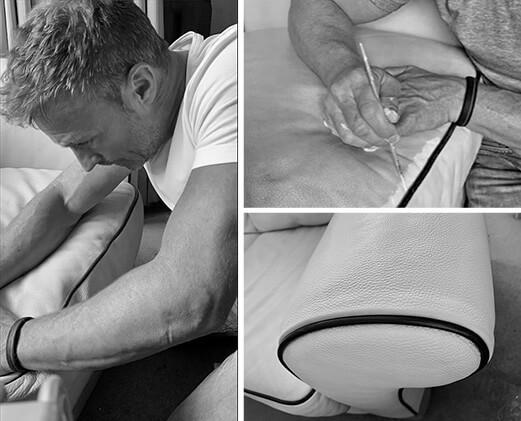
Scratches, scuffs, worn colour on the seats and arms, cat claw marks, cracked finish, fading, ink and grease stains, cigarette burns and small tears can all be dealt with. The repair involves cleaning, preparing the surface, filling any breaks in the hide, matching and applying colour, and resealing. Because the original finish is a coating, a well matched repair on pigmented leather is usually invisible.
Aniline leather
Aniline is the most natural looking leather. It is dyed right through with transparent dyes and has no pigment coating, so you can see the grain, the pores and the small marks the animal picked up in life. It is beautiful and expensive, and it is also the least forgiving. It absorbs spills within seconds, fades quickly in sunlight and darkens where it is touched.
Aniline can absolutely be repaired, but the approach is different. Colour is worked into the hide rather than applied on top, stains are drawn out rather than covered over, and there is a limit to how much can be hidden without losing the natural look that made the leather worth buying. Jon will always talk through what is realistic before starting. Very often the answer with a tired aniline sofa is a careful even up of the colour across the whole piece rather than a spot repair.
Semi aniline leather
Semi aniline sits between the two. It is dyed through like aniline and then given a very light pigment and protective coat. It keeps most of the natural look while being far more practical, which is why many higher end sofa makers use it. Repairs on semi aniline take some of the techniques from each side: the surface can take a light colour correction and a fresh protective coat, but the finish has to be kept thin so the leather does not lose its softness and depth. Faded semi aniline responds particularly well to leather sofa recolouring when it is done with a light hand.
Pull up, waxed and oiled leather
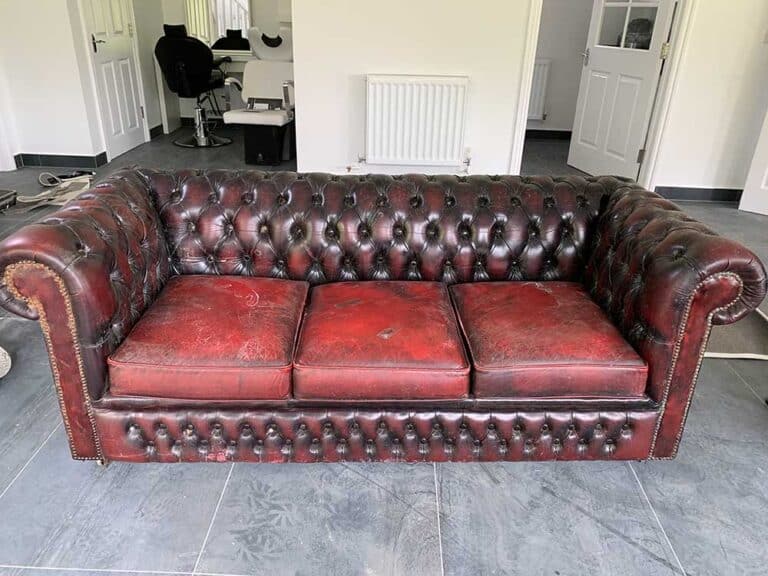
These are the leathers that lighten when you stretch or scratch them and darken again when you rub them, found on Timothy Oulton style sofas, distressed Chesterfields and a lot of “vintage” or “antiqued” ranges. The colour comes from waxes and oils in the hide rather than a surface coating. They are meant to mark, and part of their appeal is the way they age, but they can still fade badly in sunlight and wear thin on the arms and seat fronts.
Repair is done with waxes and dyes that replicate the original finish rather than with pigments, and it is one of the more specialist jobs we do. The result should keep the character of the leather, with the lighter highs and darker lows, rather than flattening it into one colour.
Nubuck and suede
Nubuck is aniline leather that has been buffed to raise a fine nap, and suede is the flesh side of the hide finished the same way. Both are soft, matt and very absorbent. Stains and grease are the usual problems, along with bald patches where the nap has worn flat on the arms.
These can be cleaned and the colour refreshed, and worn areas can be improved, but nubuck cannot be sealed the way a pigmented leather can without changing its feel. We are straightforward with customers about what a nubuck repair will and will not achieve.
Bicast and coated split leather
Bicast is a split hide (the lower layer of the skin) with a thick polyurethane coating on top, embossed with an artificial grain and usually given a high gloss. It is common on cheaper sofas and some office chairs. Because the coating is plastic rather than leather finish, the usual problems are peeling and cracking of the coating itself rather than wear of the colour. Small areas can sometimes be repaired, but once the coating starts lifting across a whole seat the honest advice is usually to replace the panel or the cover.
Bonded leather
Bonded leather is made from leather fibres and offcuts ground up, mixed with a binder and rolled onto a fabric backing, then coated with polyurethane and printed with a grain. It may contain as little as a fifth actual leather. It looks convincing in the showroom and starts flaking and peeling within a few years, usually on the seats and arms first.
We are asked about bonded leather almost every week, and the truthful answer is that once it starts peeling it cannot be repaired to a lasting standard. There is nothing sound underneath the peeling surface to repair onto. What we can do is replace the failed panels with real leather through our replacement leather panels service, which is often the difference between keeping a sofa whose frame and cushions are still good and sending it to the tip.
The damage matters as much as the leather
Asking what types of leather can be repaired is only half the question. Alongside the type of leather, Jon looks at what has actually gone wrong. Surface damage (scuffs, faded colour, small scratches, most stains) can be repaired on practically any real leather. Damage to the hide itself (tears, cuts, burns, cat claw punctures, cracking that goes through rather than just across the top coat) needs the hide to be rebuilt first with a sub patch and flexible filler before colour can go on, and the result depends on the size and position of the damage as well as the leather type.

Then there is the condition of the leather around the damage. A tear on a supple, well kept hide is a very different job from a tear on a hide that has been dried out by a radiator for ten years. In the second case the leather around the repair may be too weak to hold, and a panel replacement is the better answer. We would rather tell you that up front than do a repair that fails in six months.
How to tell what your sofa is made of
You do not need to know for certain before you get in touch, but a few clues help. A sofa that has a very even colour and a slight sheen, and on which water beads rather than soaks in, is almost certainly pigmented. One with visible natural marks, a soft matt surface and a tendency to darken where it is touched is aniline or semi aniline. Leather that lightens when you press a fingernail into it and darkens when you rub the mark away is pull up or waxed. Anything that is peeling in flakes to reveal a fabric backing is bonded or bicast.
The label under the cushion or on the frame sometimes says, but the words “genuine leather” on their own do not tell you much, and “leather match” usually means real leather on the seats and something else on the sides and back.
Get an honest assessment of your leather
Send us two or three photos in good daylight, one of the damage close up and one of the whole piece, along with a rough idea of where you are. We work across Essex and London, from South Benfleet, Southend and Canvey Island through Basildon, Chelmsford and Colchester to Romford and central London. Jon will tell you what type of leather you have, whether it can be repaired and what the job would involve. If you have been searching for what types of leather can be repaired because a retailer has told you yours cannot be, it is worth a second opinion.
Call Jon on 07967 216250 or fill in the enquiry form below this post. You can read more about our approach on the leather restoration page. Every job is quoted individually, and quotes are free.