Water stains on leather can usually be removed, but it depends on the type of leather, how long the mark has been there and, crucially, what has already been tried on it. On a pigmented leather sofa a fresh water mark is often a straightforward job. On an aniline or nubuck chair the water has soaked into the hide and the fix is more involved, though still very possible. What tends to make a water stain permanent is not the water. It is the scrubbing, the hairdryer and the “miracle” products that come afterwards.
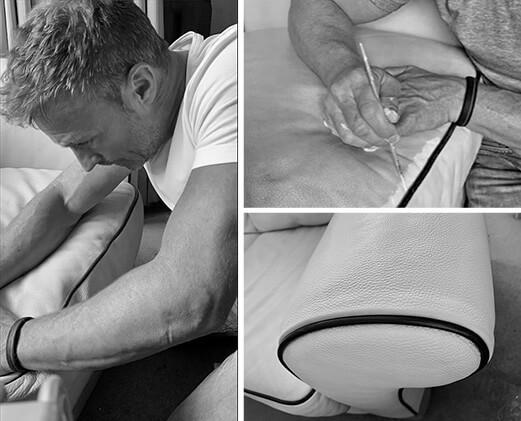
We handle water marks through our leather stain removal service across Essex and London, from a single glass ring on an armchair in Rayleigh to a whole sofa caught under a leaking radiator in a Colchester flat. Jon, our founder, has been dealing with them for 26 years, and the first thing he will tell you is to stop touching it.
Why water leaves a mark on leather at all
It seems odd that plain water would stain anything, and on a well-sealed pigmented leather it often does not. The trouble starts when water gets past the finish, or when the leather has an open finish to begin with.
Leather is full of tanning agents, oils and dyes. When water soaks in and then dries, it carries those substances to the edge of the wet patch and leaves them there as the water evaporates. That is why a water mark is usually a darker ring with a lighter centre, rather than an even patch. The leather in the middle has also lost some of its natural oils, so it can feel slightly stiff or papery.
Hard water, which is what most of Essex has, makes things worse because it leaves mineral deposits behind as well. Water from a radiator or a central heating leak is worse still: it is often rusty, sometimes carries inhibitor chemicals, and it tends to sit against the leather for hours before anyone notices.
The usual culprits
A cold drink left on the arm on a warm evening in a Leigh-on-Sea garden room. A child’s water bottle tipped over on the seat. Wet dog. Wet coat thrown over the back after a walk along the seafront at Southend. Condensation dripping from a conservatory roof onto the sofa below. A leaking radiator valve behind a chesterfield. A vase knocked over. A burst pipe in the flat upstairs. We have seen all of them, several times.

What people do next, and why it makes the stain worse
The natural reaction to a water mark is to add more water and rub. On aniline leather that spreads the ring outwards and creates a second, larger ring. On pigmented leather the rubbing wears the top coat, and a mark that was going to fade on its own becomes a permanently dull patch.
The hairdryer is the next mistake. Heat dries the leather too fast, sets the ring hard, and can shrink or crack the surface. We have seen a small drink ring turn into a stiff, cracked panel because it was blasted with a hairdryer for ten minutes.
Then come the internet remedies. Vinegar and water strips the finish and leaves its own tide mark. Baby wipes do the same and add perfume and moisturiser to the mix. Saddle soap is meant for saddles, not sofas, and it darkens the area. Leather conditioner rubbed into the ring makes the whole patch darker and greasier, and that oil then has to come out before anyone can fix the original problem.
Jon’s honest view is that fresh water stains on leather that have been left alone are a small job. The same mark that has been rubbed, dried with a hairdryer and treated with three different products from the cupboard is often a full panel restoration.
How a professional removes water stains on leather
The first step is identifying the leather. Jon checks whether it is pigmented, semi-aniline, aniline, nubuck or suede, because the same approach that works on one will ruin another. He also looks at how deep the water has gone, whether there are mineral or rust deposits, and whether the leather has stiffened.
On pigmented leather the finish is cleaned properly with products designed for it, the deposits at the edge of the ring are lifted, and the area is allowed to dry slowly and evenly. Where the finish has been damaged by the water or by earlier rubbing, the panel is recoloured and resealed so the mark disappears completely.
On aniline and nubuck leather the mark is in the hide itself. The approach here is to treat the whole panel rather than the ring, so the leather dries evenly without a tide line, and then to replace the oils that the water took out. Colour is rebalanced where needed with dyes suited to that type of leather. This is careful, slow work, which is why we do not recommend anyone tries to speed it up at home.
Where water has sat for a long time, for example a sofa left under a slow leak for weeks, the leather can stiffen and even start to rot from behind. That moves the job from stain removal into leather restoration, and sometimes into replacing a panel. We will tell you which applies once we have seen it.
Floods, leaks and insurance
If the water came from a burst pipe, an appliance leak or a flood rather than a spilled drink, it is worth checking your home insurance before you do anything else. Escape of water is a very common type of home insurance claim, and many policies cover damage to furniture. The Association of British Insurers has plain-English guidance on what is usually covered and how claims work.
We are used to providing written assessments and quotes for insurers and loss adjusters, and we can tell you honestly whether a sofa is worth restoring or should be written off. Photos taken as soon as you find the damage, before anything is moved or dried, make a big difference to a claim.
Preventing the next one
We are not going to lecture anyone about coasters. But a few things genuinely help. A sofa that is cleaned and protected properly once or twice a year sheds water far better than one with a tired finish, which is the main point of our leather sofa cleaning service. Keeping leather a hand’s width away from radiators avoids both heat damage and the slow drip from a weeping valve. In conservatories, a quick check of the roof seals before winter saves a lot of grief.
And if a spill does happen, blot it gently with a clean dry cloth, leave it alone and let it dry naturally away from heat. Then send us a photo. That is genuinely all you should do. The sofas that come out best are always the ones where the owner resisted the urge to fix it on a Sunday afternoon.
When a water mark cannot be fully removed
We would rather tell you now than after the job. A water mark on aniline leather that has been there for years, or one that has been heavily treated with oils and cleaners, may fade significantly but not disappear entirely. Rust marks from radiator water can be stubborn on pale leather. In those cases the honest options are a full recolour of the panel or a replacement panel, and Jon will explain both, with prices, so you can choose.
Get a Quote to Remove Water Stains from Your Leather
Send us a couple of photos of the mark in daylight, one close-up and one showing the whole piece of furniture, and tell us roughly where you are in Essex or London, what caused it and whether anything has already been put on it. Jon will come back with an honest assessment and a price for leather stain removal.
Call Jon on 07967 216250, or fill in the enquiry form below this post and we will be in touch.