Good vintage leather chair restoration should leave the chair looking like itself, only cared for. The aim is not to make a 1950s club chair look as though it left the factory last week. It is to stop the damage, put back what has been lost, and keep the patina, the creases and the softened colour that made you want the chair in the first place. That balance is a matter of judgement as much as technique, and it is the part of our leather restoration work that Jon, our founder, enjoys most.
This post explains how we approach an old chair, what can and cannot be preserved, where the home remedies go wrong, and how to decide whether the piece you have is worth the work.
What Counts as Vintage, and Why It Changes the Approach
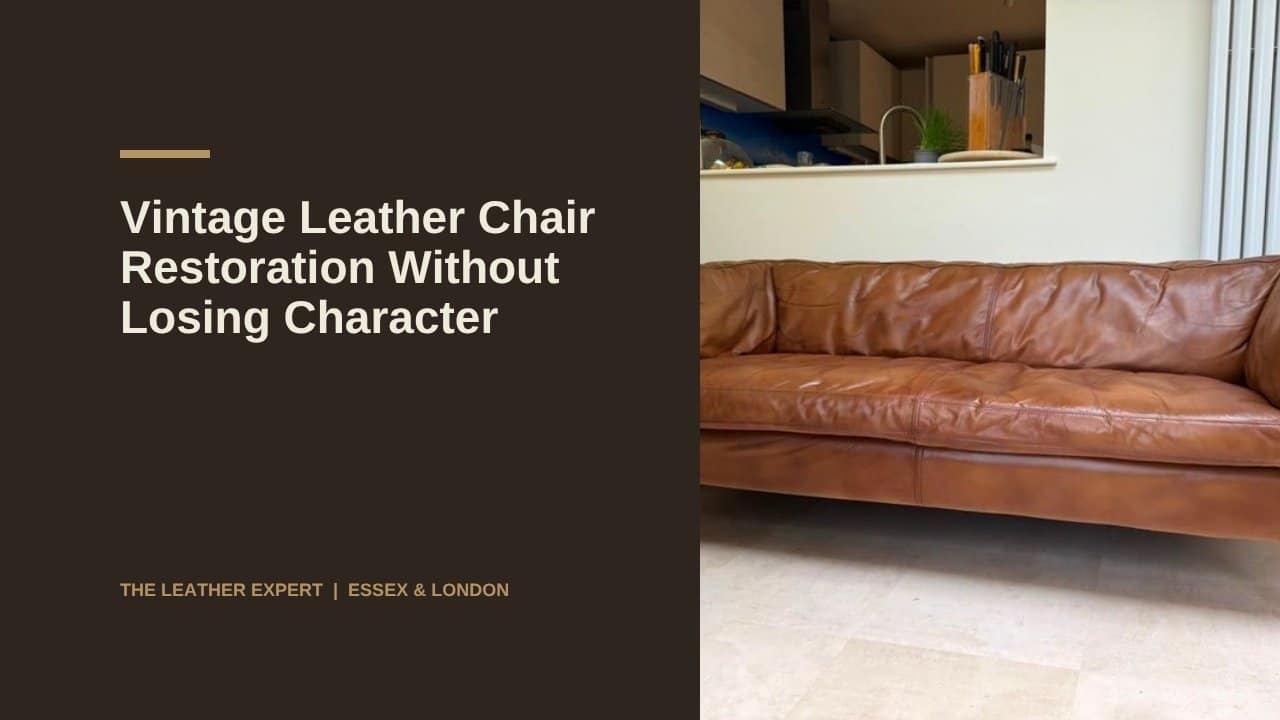
We use “vintage” loosely for anything from a pre-war library chair to a 1970s Danish lounger, and the common thread is that the leather was made and finished differently from a modern sofa. Older hides are often aniline or lightly finished, so the colour sits in the leather rather than on it. They have absorbed decades of oils, polish and sunlight. Many have been “restored” before, sometimes well and sometimes with boot polish.
That history is exactly why a vintage chair looks the way it does, and it is why you cannot treat it like a five-year-old DFS three-seater. Modern pigmented finishes are designed to be stripped back and rebuilt. On an old chair, stripping the surface takes the character with it. So the approach has to be gentler, more selective and slower.
There is also the question of what the chair is. A genuine antique with original leather may be a job for a conservator rather than a restorer, and the British Antique Furniture Restorers’ Association is the place to start if the piece is of real historical value. Most of what we see is not in that category: it is a much-loved club chair, a Chesterfield that came from a grandparent, or a set of dining chairs bought at an auction in Colchester, and those we are very happy to take on.
What Vintage Leather Chair Restoration Involves

Reading the chair first
Before anything is touched, Jon works out what the leather is, how it was finished, and what has been done to it since. That tells us how the surface will respond to cleaning and colour. It also tells us which marks are damage and which are simply age. A worn, glossy patch on the arm of a 1930s chair where seventy years of hands have rested is not a fault to be painted over. A split running through it is.
Cleaning without stripping
Old chairs carry a remarkable amount of grime: nicotine, coal dust, decades of polish, hair oil. It all has to come off before repairs can bond, but it has to come off without taking the surface colour with it. This is careful, slow work with cleaners chosen for the leather in front of us rather than a one-size-fits-all product.
Stabilising and repairing
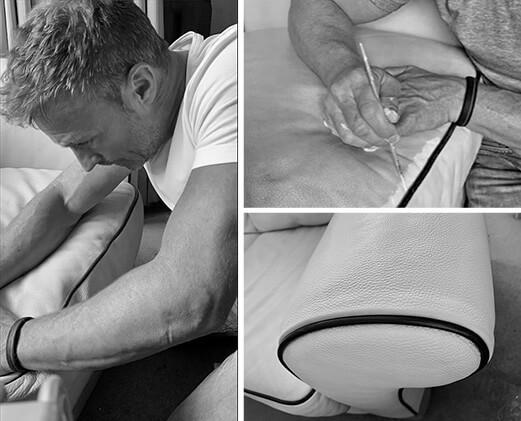
Vintage leather tends to fail in particular ways: splits along the seat front and arm tops where it has dried and flexed, cracking across the seat, broken or perished stitching, and worn-through areas where the fibre itself is exposed. Splits are backed with a sub-patch and rebuilt. Cracked areas are consolidated so they stop spreading. Where seams have gone, our leather stitching work replaces the thread and re-closes the seam by hand so it looks as it should on a chair of that age.
Feeding dry leather
Much old leather is dry to the point of being brittle. Part of the restoration is putting flexibility back into the hide so it stops cracking, using treatments that penetrate rather than sit on the surface. This is not the same as slathering it in a supermarket conditioner, which we come back to below.
Colour, applied with restraint
Here the judgement matters most. On a vintage chair we generally avoid a full, opaque recolour unless the customer specifically wants a like-new finish. Instead the colour is rebuilt only where it has been lost, blended in translucent layers so the natural variation and shading of the old hide shows through. The worn cognac highlights on a club chair’s arms stay as highlights; the pale, tired patch below them is brought back up to match. Where a chair does want a full colour refresh, our leather recolouring process can do that while keeping the surface texture and grain.
Finishing
The protective finish is chosen to suit the piece. A high-gloss modern topcoat on a matt, waxy old hide looks wrong immediately. We match the sheen to the original, so the chair looks cared for rather than refinished.
The Home Remedies That Ruin Old Leather
Vintage chairs attract more well-meaning home treatments than any other furniture, and Jon has seen the results of all of them arrive as vintage leather chair restoration jobs. The recurring ones:
- Olive oil, coconut oil and other kitchen oils. They darken unevenly, go rancid, and attract dust. Once oil is in an aniline hide it never fully comes out.
- Shoe polish. It sits on the surface, transfers onto clothing, and has to be laboriously removed before any proper work can start.
- Supermarket leather conditioner. Formulated for modern pigmented leather, it often leaves an old hide sticky and blotchy.
- Superglue on splits. Hard, brittle, and impossible to remove without taking leather with it.
- Spray dyes and recolouring kits. These paint over every trace of age in one flat, plasticky colour. It is the quickest way to turn a characterful chair into an ordinary one, and the finish rarely lasts.
If any of these have already been tried, tell us. It does not make the chair unrestorable, but it changes the plan and the time involved.
Keeping the Character: What We Deliberately Leave Alone
Good vintage leather chair restoration should still let the chair show its age in the right places. We leave the softened creases across the seat. We leave the slightly deeper tone where the arms have been handled, provided the surface is sound. We keep original stitching where it is still strong, and we match new thread to old rather than replacing everything. If the chair has brass studs or a particular edge finish, those stay.
What we do not leave alone is anything that will get worse: open splits, flaking finish, exposed fibre, cracking that is spreading, and stitching that is about to give. The test is simple. Does the mark tell the chair’s story, or is it a fault that will end the story early?
Customers sometimes ask for the opposite, a full “as new” restoration, and that is a perfectly good choice for a chair that is going to be used hard in a busy family room in Brentwood or a hotel bar in central London. We will do whichever suits you. The point is that it should be a decision, not an accident of the products used.

Is Your Chair Worth Restoring?
Nearly always, if the frame is sound and the leather is real. Old chairs were generally built with better timber and thicker hides than modern equivalents, and a properly restored one will outlast most things sold today. The cases where we would say no are rare: leather so perished it crumbles when flexed, a frame that has rotted or broken beyond an upholsterer’s help, or a chair that turns out to be a vinyl reproduction.
Where the leather on one or two panels is beyond saving but the rest is good, we can replace those panels with leather matched and aged to blend with the original, which keeps the chair in use without a full reupholster.
The cost of vintage leather chair restoration depends on the size of the chair, how much stabilising and repair is needed before any colour work, whether it is an aniline hide that needs the slower approach, and whether it can be done in your home or needs to come to our workshop in South Benfleet. Every job is quoted individually, and quotes are free.
Get a Quote for Restoring Your Vintage Leather Chair
If you are thinking about vintage leather chair restoration for a piece of your own, send us three or four photos in natural light: the whole chair, the worst of the damage close up, and if possible a shot of the underside or the back so we can see the construction. Tell us roughly where you are and how you would like it to look afterwards, kept as it is or brought back to new. Jon will tell you honestly what a leather restoration would involve for that particular chair.
Call Jon on 07967 216250 or fill in the enquiry form below this post. We work across Essex, from Southend-on-Sea and Rayleigh to Chelmsford and Colchester, and into east and central London.