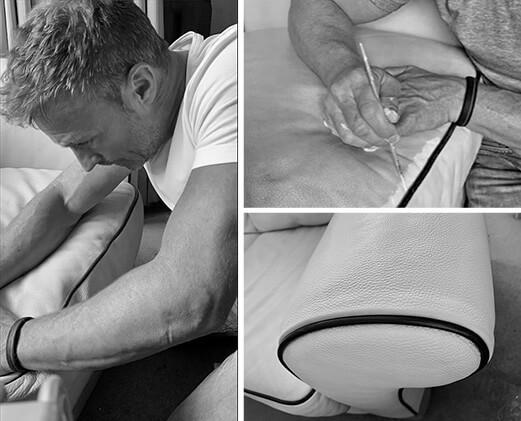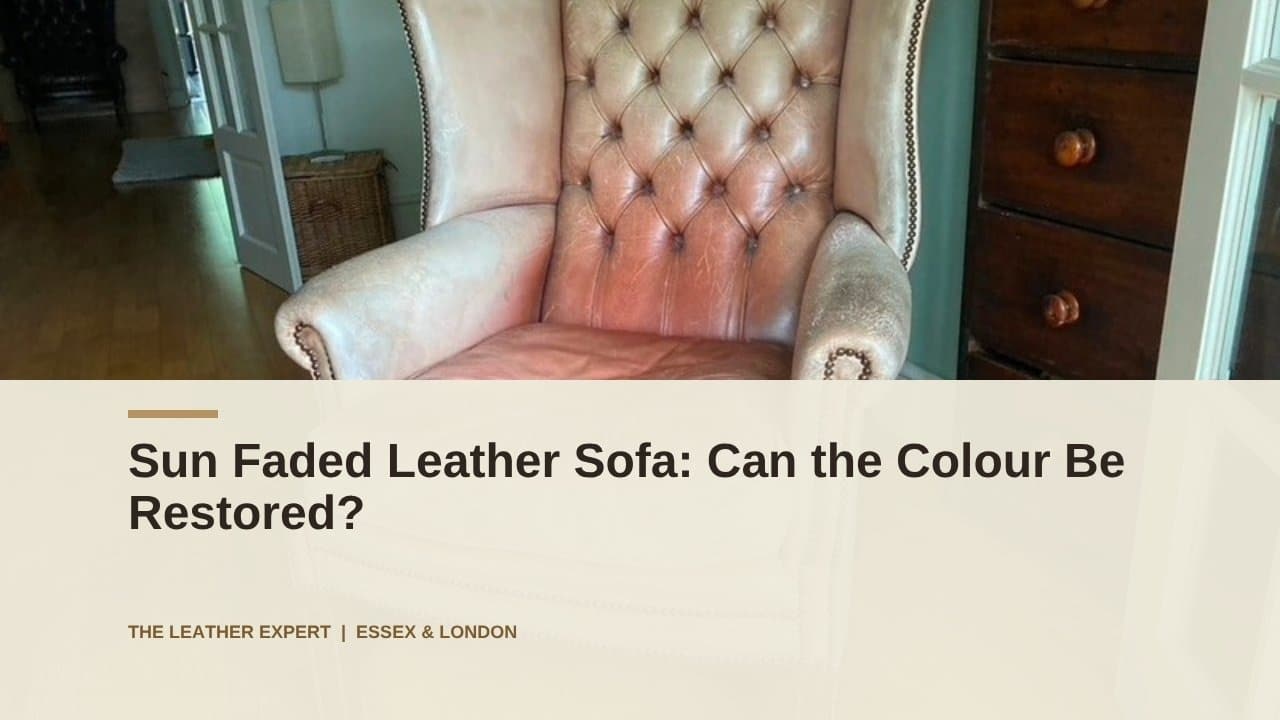
A sun faded leather sofa can, in almost every case, have its colour fully restored. Fading looks dramatic, especially when one arm has gone the colour of weak tea while the rest of the sofa is still a deep chestnut, but it is a surface problem rather than a structural one. Provided the leather underneath is still sound, we can rebuild the colour so the sofa looks as it did on the day it arrived.
We restore faded sofas every week across Essex and London, and a large share of them come from the same places: conservatories, south facing bay windows and open plan kitchen diners with bifold doors. This post explains why the sun does what it does, why the products sold to fix it rarely work, and what our sun bleached and faded leather repair service actually involves.
What sunlight does to leather
Leather is a natural material, and like anything natural it reacts to ultraviolet light. UV breaks down the pigments and dyes that give the leather its colour, and it also dries out the oils that keep the hide supple. The result is a two stage problem. First the colour lightens and shifts, usually towards orange, yellow or a washed out grey. Then, if the exposure continues, the surface dries, stiffens and begins to crack.
It does not take a heatwave. The Met Office publishes UV index forecasts throughout the year, and even on bright winter days there is enough UV coming through a window to affect leather over time. Glass filters some of it but nowhere near all of it, and a conservatory roof filters very little. A sofa that sits in the same spot for five summers has had a great deal of light on one side.
The pattern of fading usually tells the story. A sofa that faces a window fades on the back and the arm nearest the glass. A sofa under a roof light fades along the top of the back cushions and the tops of the arms. Where a throw or a cushion has been sitting, you get a sharp line between protected and exposed leather, which is often the moment people realise how far the colour has drifted.
Why a sun faded leather sofa needs more than a polish
Fading is not dirt and it is not dryness, although it is often mistaken for both. The pigment has actually broken down, so the colour is gone rather than hidden. No amount of cleaning will bring it back, and a conditioner or leather feed will only darken the surface temporarily while the product is wet. A day or two later the sofa looks just as pale as before.
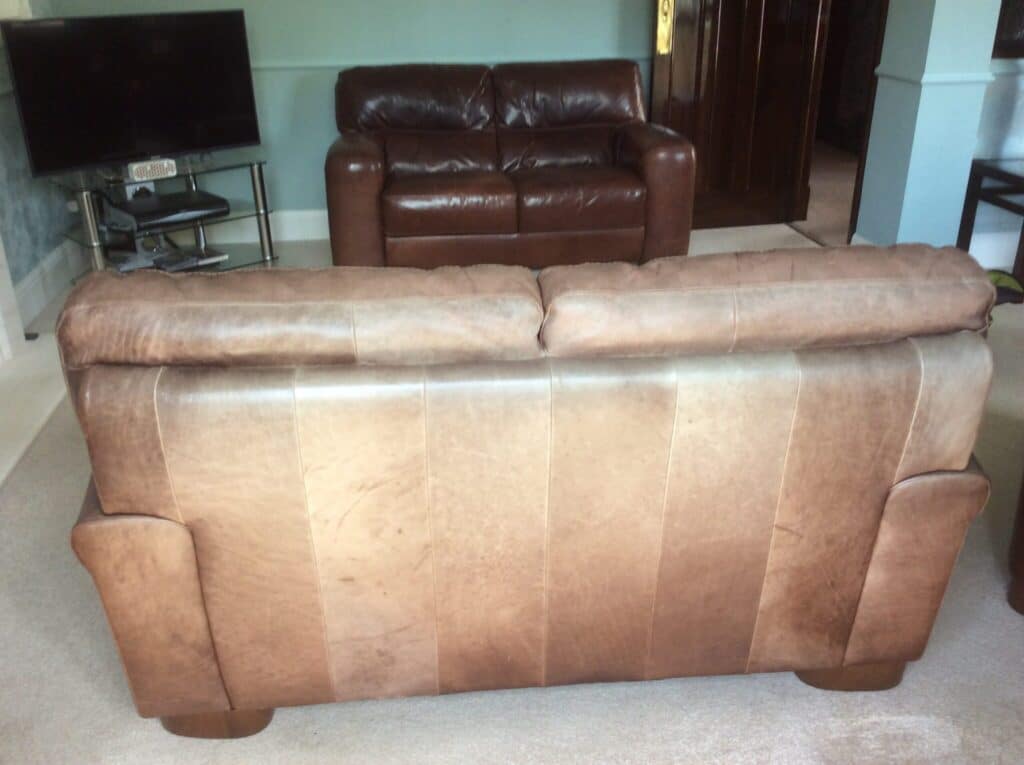
The other thing to understand is that different leathers fade differently. A pigmented leather, which is what most sofas from the big high street retailers are made from, has its colour in a coating on top of the hide. When that coating fades, the fix is to rebuild the coating. An aniline leather has its colour dyed right through the hide with no protective top coat, so it fades faster and more unevenly, and the approach to restoring it is different. Jon, our founder, checks which type he is dealing with before anything else, because getting that wrong is the reason so many home attempts go badly.
Home fixes that make fading worse
The internet is full of suggestions, and we see the results of most of them. Shoe polish is a common one. It gives an instant improvement, then it rubs off on clothing, attracts dust and leaves a patchy, streaky surface that has to be stripped before any real repair can start. Spray leather dyes from car accessory shops are another. They are designed for small trim panels, not a three seater, and they nearly always go on too heavy in some places and too thin in others, with a hard edge where the spray overlapped.
Olive oil, coconut oil and various balms are still recommended as a way of feeding faded leather back to life. They do darken the surface, but they do it by soaking into the hide rather than replacing the lost colour, and over a few weeks they go rancid, attract dirt and leave the leather sticky. We have stripped more than one Basildon sofa where the customer’s home remedy had done more damage than the sun.
There is also the problem of colour matching. A faded panel next to an unfaded one needs a colour that blends across both, not a single tin of something that looks roughly right. Getting a warm tan to sit next to a cool tan without a visible join is a skill, and it is the reason a professional job looks like nothing ever happened while a home job looks like a repair.
How we restore the colour on a sun faded leather sofa
Every job starts with an assessment, usually from photographs first and then in person. Jon looks at the leather type, how deep the fading goes, whether the surface has dried and cracked, and whether any previous products have been applied. That tells him whether the job is a straightforward recolouring or whether some preparation and repair is needed first.
The leather is then cleaned thoroughly and any old polish, conditioner or surface contamination is removed. This stage matters more than people expect. Colour will not bond properly to a surface that still has silicone or wax on it, and a rushed clean is the reason some recolouring jobs fail within months.
Where the surface has dried and started to crack, the affected areas are prepared and the cracks filled and smoothed before any colour goes on. Then the colour itself is mixed by eye to match the protected parts of the sofa, tested on a hidden area, and applied in thin coats across the faded panels and blended into the rest. On a badly faded sofa the whole piece is often recoloured so that the finish is completely even, which you can read more about on our leather sofa recolouring page.
The last stage is a protective top coat. This locks the colour in, gives the leather the right sheen and, importantly, contains UV inhibitors that slow down the next round of fading. The finished sofa is stable, wipe clean and ready to use again within a day or so.

Recolouring or dyeing?
People often ask whether their sofa needs dyeing rather than recolouring. For a pigmented leather, recolouring with matched pigments is the right approach, because that is how the sofa was finished originally. For an aniline or waxed leather, the process is closer to leather sofa dyeing, where the colour goes into the hide rather than sitting on top of it. Jon will explain which applies to your sofa when he sees it, and the outcome in both cases is the same: an even, natural colour with no visible repair.
When restoration is not the right answer
We are honest about this. Not every sun faded leather sofa is a candidate for recolouring. If the sun has been at a sofa for so long that the leather has gone brittle and is cracking through rather than just on the surface, recolouring will not hold. The leather needs to be flexible for the new finish to move with it. In those cases the options are replacing the worst panels with new leather or, on a valuable sofa, reupholstering it. We will always tell you which category your sofa falls into before you spend anything.
Bonded leather and some very cheap coated fabrics also fade, but they tend to peel at the same time, and restoring colour on a peeling surface is a waste of money. If you are not sure what your sofa is made of, send us a photo and we will tell you.
Keeping the colour once it is restored
The new protective finish does a lot of the work, but position does the rest. If the sofa can be moved even a metre out of direct light, it will last far longer. Blinds or a UV film on a conservatory or a south facing window help too, and a throw over the exposed arm during the summer months is a cheap insurance policy. We have restored sofas in Leigh-on-Sea and Southend that sit within a few metres of the sea front, where the light is particularly strong, and the ones that have stayed looking good are the ones where the owners changed the position afterwards.
Get a quote to restore your faded sofa
Send us two or three photos of the sofa in daylight, including one that shows the faded area next to a protected area, and let us know roughly where you are. We cover the whole of Essex and into London, from Canvey Island and Rayleigh through Chelmsford and Brentwood to Romford and the East End, and most recolouring work is done at your home.
Call Jon on 07967 216250 or fill in the enquiry form below this post. You can see what is involved on our sun bleached and faded leather repair page. Every job is quoted individually, and quotes are free.