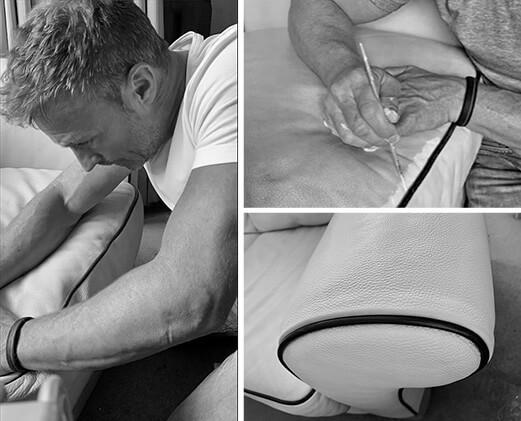
A sagging leather sofa is one of the most common things we get asked about, and the good news is that it is nearly always fixable. The leather on top is usually fine. What has gone is something underneath: the foam in the cushions, the webbing or springs in the frame, or occasionally both. Working out which one is the whole job, because the fix for each is different. Below we explain how to tell them apart, why the usual quick fixes do not last, and what we do when we fit new foam cushions or rebuild a seat for customers across Essex and London.
Three reasons a leather sofa starts to sag
People tend to assume the sofa is simply worn out. In practice, a sagging leather sofa has a specific cause, and once you know what it is the decision becomes straightforward.
The foam has lost its bounce
This is the most common one by a long way. Seat cushions are blocks of foam, sometimes wrapped in fibre or feather. Foam has a working life. Sit in the same spot every evening for eight or ten years and it slowly loses its ability to spring back. The cushion looks fine when nobody is on it, then you sit down and keep going. The tell-tale sign is that the “favourite” seat is worse than the others, and that the cushion feels lighter or crumbly when you lift it.
The webbing has stretched
Under the cushions, many modern sofas use elasticated webbing straps stretched across the frame. Over time the elastic gives up. The straps stretch, the seat base drops, and even brand new cushions would sink into the dip. If you lift the cushion off and press the base with your hand, and it gives more than a couple of centimetres or feels hammocky, the webbing is the problem.
A spring has failed
Older and better quality sofas, including most Chesterfields and a lot of the traditional pieces we see in Brentwood and Chelmsford, use coil springs or serpentine (zig zag) springs. A broken or unhooked spring produces a very localised dip, often on one side, and sometimes a creak or a clunk when you sit down. Occasionally a spring end has worked loose and is pushing up into the seat, which you can feel as a hard lump.

How to tell which one you have got
You do not need tools for this, just a minute and a bit of honesty about the sofa’s age. Take the seat cushion off and look at the base. If the base is flat and firm and the problem disappears when you put a cushion from a less-used seat in its place, it is the foam. If the base itself dips, sags or feels like a trampoline, it is the webbing. If there is one sharp low spot, a noise, or a hard point under the leather, suspect a spring.
Fixed-seat sofas, where the cushions are not removable, are harder to read from the outside. The leather sits directly over the foam and the base, so a dip could be either. This is where a quick visit or a couple of photos to us saves guessing.
It is also worth noticing whether the back cushions have gone as well. Backs are usually fibre or feather rather than foam, and they flatten rather than sag. A sofa where both seats and backs have gone is telling you it has had a full life, and that changes what is worth doing.
Why the quick fixes for a sagging leather sofa rarely last
There is a whole industry built around sofa “savers”: boards that slide under the cushions, foam toppers, inflatable inserts and bags of loose fibre to stuff into the cover. Jon, our founder, has pulled plenty of these out of sofas over the years, and we understand why people buy them. They are cheap and they promise a fix in five minutes.
The trouble is that a board under a cushion does nothing about the foam that has collapsed. You end up sitting on a plank with a thin layer of tired foam on top, which is firmer but not comfortable, and it pushes the wear onto the front edge of the cushion where the leather then creases and cracks. On a webbing failure, a board just bridges the gap and puts the whole load onto the frame rails, which is how side rails end up split.
Stuffing extra fibre into a cushion cover gives you a lumpy seat for a few weeks and then settles into exactly the same shape as before. Cutting a new block of foam yourself is a step further than most people go, but we do see it: the foam bought online is often the wrong density for seating, the wrong size for the cover, and it either bulges the leather or leaves a gap at the front. Seating foam is a specific product with a specific grade, and getting it wrong shortens the life of the leather on top.
None of this is dangerous, it is just money spent on something that does not solve the problem. And if the leather is creasing badly over a dip, every month it stays that way is another month of the finish being worked into a crack.
What a proper repair involves
This depends entirely on which of the three problems you have, so we start with an assessment. Most of the time that can be done from photos and a phone call. Sometimes we need to see the piece.
Replacing the foam
For collapsed cushions we make new foam inserts to the exact size of the existing cushion covers, in a grade chosen for seating rather than the general purpose foam sold for crafts. A good quality sofa deserves a higher density foam that will hold its shape, and where the original cushion had a fibre wrap we replicate it so the leather sits softly rather than looking over-stuffed. The leather covers are unzipped, the old foam comes out, the new goes in, and the cushion is dressed so the piping and seams sit where they should. It is the most cost-effective fix there is for a sofa where everything else is sound, and it makes a surprising difference to how the leather looks, because a full cushion pulls the creases out.
Re-webbing the base
Where the webbing has gone we strip the old straps out and fit new elasticated webbing at the right tension, or, on a traditional piece, jute webbing and hessian over the springs. This is done with the sofa upside down and the base cover off. It is more involved than new foam but still a straightforward job on most frames, and it is usually done alongside new cushions because tired webbing and tired foam tend to go together.
Spring repair
A single failed serpentine spring can often be replaced or re-clipped. On a coil sprung seat the springs may need re-tying, which is a proper upholstery job and one we treat as part of our leather sofa reupholstery work. If the frame rail the springs attach to has cracked, that is repaired first, otherwise the new springs pull it apart again.
While the sofa is apart, it is a sensible moment to deal with anything on the surface: creased and cracked leather at the front of the seats, scuffed arms or fading. We can often do that as part of the same visit through our leather restoration service, so the sofa comes back looking as good as it now feels.
When a sagging sofa is not worth fixing
We will always say so. If the frame itself has failed, for example a cheap softwood frame with a snapped rail and loose joints, the cost of putting it right can be close to the price of a replacement of similar quality, and you would be putting new cushions on a sofa that will let you down again. If the leather has also worn through in the seats and the backs have flattened, the honest advice may be to spend the money on something new, or to talk about full reupholstery if the frame is a good one.
The Furniture Industry Research Association publishes guidance on furniture standards and durability if you want to understand what a well-made frame should be. In practice, a hardwood frame with dowelled or screwed joints is nearly always worth repairing, and a lot of the sofas we see from Natuzzi, John Lewis and similar retailers fall into that category.
What affects the cost and how long it takes
New foam for a standard three-seater is usually a one-visit job at your home, and the cushions are made up on the day or brought back within a few days depending on size. Re-webbing and spring work take longer and may mean the sofa comes to our workshop in South Benfleet. Fixed-seat sofas take more time than loose cushion designs because the leather has to come off to reach the base.
What moves the price is the number of cushions, the grade of foam, whether webbing or springs are involved, and whether you want any leather work done at the same time. A two-seater in Rayleigh with two tired cushions is a small job. A large corner sofa in Thurrock with collapsed foam, stretched webbing and creased leather on every seat is a proper project. Either way, we will tell you what it needs and what it will cost before anything is touched.
Get a Quote to Fix Your Sagging Leather Sofa
Send us a photo of the sofa from the front, a photo with the seat cushion removed so we can see the base, and a photo of the worst cushion. Let us know roughly where you are, whether that is Southend-on-Sea, Basildon, Colchester or across London, and whether the cushions are removable.
Call Jon on 07967 216250 or fill in the enquiry form below this post. You can find out more about our new foam cushion service on that page. Quotes are free and every job is priced individually.