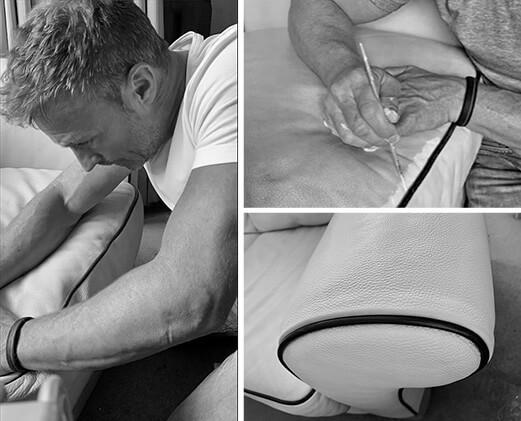
Yes, you can reupholster one sofa cushion without touching the rest of the sofa, and on a leather suite it is often the most sensible fix when a single seat has been torn, burnt, chewed or worn through while the others are still fine. The part that needs care is not the upholstery itself. It is matching a brand new piece of leather to a sofa that has been sat on, sunned and cleaned for years, so that the new cushion does not stand out like a spare from a different suite.
We do this regularly across Essex and London, usually as part of our leather sofa reupholstery work, and this post explains when it is the right answer, how the matching is done, and when a different repair would serve you better.
Why one cushion goes before the others
Sofas are rarely used evenly. There is a favourite seat, nearest the lamp or the television, and it takes most of the wear. On a three seater it is often the end seat, and on a corner suite it is the seat by the chaise. That cushion gets the jeans rivets, the dropped takeaway, the dog that curls up on it every evening and the ten thousand extra sits. So it is not unusual for one seat cushion to be cracked, bald and sagging while the middle seat, which nobody uses, still looks new.
Then there are the one off accidents. A hair straightener left on a seat in a Rayleigh bedroom, a puppy’s teeth through the front edge of a Chelmsford family’s corner sofa, a kitchen knife dropped while somebody was eating on the settee, a hot pan lid, a cat that picked one cushion as its scratching post. In those cases the rest of the sofa is genuinely untouched and the question is simply what to do about one cushion.
When you can reupholster one sofa cushion successfully
Recovering a single cushion works best when three things are true. First, the damage is on the cushion itself rather than on the fixed parts of the sofa, so the cushion can be taken away to the workshop while you carry on using the rest. Second, the rest of the sofa is in reasonable condition, because a perfect new cushion on a tired sofa makes the tired parts look worse. Third, the leather can be matched closely enough that the new panel does not draw the eye.

The third point is the one that catches people out. Jon, our founder, has been matching leather for 26 years and he will tell you that no two hides are the same, and that the leather on a sofa that has been in a living room for six years is no longer the colour or the sheen it was when it left the factory. Even if the manufacturer still uses the same leather, which they often do not, a brand new panel will be a shade darker and a touch glossier than its neighbours.
How we get the match right
There are two parts to it. The first is choosing the closest leather in the right grain, thickness and finish. A smooth pigmented hide, a heavily grained corrected leather, a soft semi aniline and a waxy pull up all need to be matched like for like, not just in colour. Jon carries sample swatches and will assess the sofa in person or from good photographs before ordering anything.
The second part is colour. Rather than accept the nearest stock colour, we will usually adjust the new panel to the sofa, or lightly refresh the surrounding cushions so that everything meets in the middle. On a sofa where the other seats have faded or worn a little, that often means a light leather sofa recolouring across the seating area at the same time. The result is a sofa that looks uniformly good rather than one very new seat next to two old ones.
What the job involves
The cushion is collected or brought to us, and the old cover is carefully taken apart. That matters because the original cover is the pattern. The seams, the piping, the zip position and the way the corners are shaped are all copied from it so the new cover fits the cushion and matches its neighbours exactly. Panels of the new leather are cut to that pattern, allowing for the way leather stretches in different directions, and stitched on an industrial machine with thread matched to the original.
While the cover is off, we look at the interior. Very often the cushion that has worn through on the outside has also gone flat on the inside, because it is the one that has done all the work. Replacing the foam at this stage costs little extra and makes a real difference to how the sofa feels, and it is one of the most common add ons to a single cushion job. You can read more about that on our new foam cushions page.
The new cover goes on, the cushion is fitted back and checked against the others for colour, sheen and shape, and any final blending is done in your home. Turnaround depends on the leather being available, but a single cushion is a much quicker job than a whole sofa.

When recovering the whole cushion is more than you need
Not every damaged cushion needs a new cover, and we would not reupholster one sofa cushion if a smaller repair would do. If the problem is a single tear, a burn, a cat scratch or a patch of worn colour on an otherwise sound cushion, a localised repair is usually the better and cheaper route. The hide is stabilised from behind, the damage is filled and the colour rebuilt and sealed, all on the existing cover. That keeps the original leather, which is by definition a perfect match to the rest of the sofa.
Where only one panel of the cushion has failed, the top face for instance, while the sides and the boxing are fine, we can replace just that panel rather than the whole cover. Our replacement leather panels service does exactly this, and it is often the middle ground between a spot repair and a full recover. Jon will suggest whichever of the three gives the best result for the money, and he is not shy about recommending the cheaper option when it is the right one.
When one cushion is not enough
Sometimes a customer asks about one cushion and, when we see the sofa, the honest advice is different. If the other seats are also cracked, if the arms have gone dark and shiny, if the leather has dried out across the whole piece, then a new cushion will simply highlight everything else. In that situation a full recolouring or a full reupholstery gives a far better outcome, and we would rather say so than take on a job that leaves you disappointed.
The same is true of bonded leather. If the peeling cushion is bonded, the other cushions will follow, and recovering one at a time is a slow way of spending more than a full recover would cost.
It is also worth checking what you are entitled to before you pay for anything. If the damage is a manufacturing fault, such as a seam that has split on a sofa that is only a year or two old, Citizens Advice sets out your rights against the retailer, and we are happy to give an independent opinion on whether the failure looks like wear or a fault.
Which sofas does this work for?
We can reupholster one sofa cushion on almost any sofa with loose or semi attached seat cushions: most DFS, Sofology, John Lewis and Natuzzi designs, most corner suites and recliners with separate seat pads, and traditional Chesterfields with loose seat cushions. Sofas with fully fixed seats, where the leather is stapled straight onto the frame, can still be repaired or repanelled, but the work is done differently and usually in your home rather than the workshop.
Back cushions, arm pads and scatter cushions from the same suite can all be recovered in the same way, and it is common for us to do a seat and its matching back cushion together so the pair ages evenly from then on.
Get a quote for a single cushion
Send us a photo of the damaged cushion close up, one of the whole sofa in daylight, and if you can, one of the label or the underside of the cushion where the leather type is sometimes marked. Tell us roughly where you are. We cover Essex and London, from South Benfleet, Southend, Canvey Island and Basildon to Brentwood, Romford and central London, and single cushion work is done in our workshop with fitting at your home.
Call Jon on 07967 216250 or fill in the enquiry form below this post. There is more on our recovering and matching work on the leather sofa reupholstery page. Every job is quoted individually, and quotes are free.