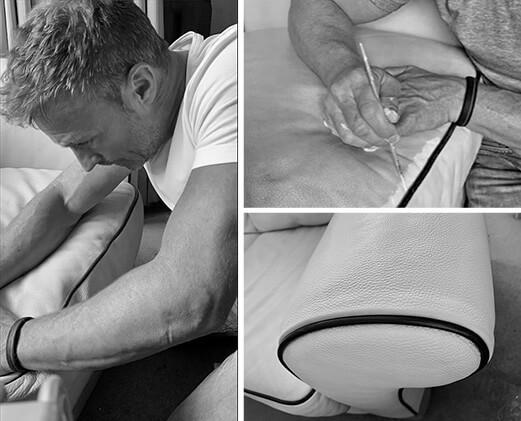
Yes, most restaurant leather seating can be repaired on site, and in the majority of cases it can be done without closing the restaurant. Split booth seats, scuffed banquettes, cracked bar stools, faded dining chairs and cigarette-era burns can all be dealt with in situ, usually in the quiet hours between services or overnight. We are The Leather Expert, and Jon, our founder, has spent 26 years carrying out commercial leather restoration for restaurants, bars, hotels and clubs across London and Essex.
What happens to leather in a busy restaurant
A domestic sofa might be sat on for a few hours a day by the same family. A booth in a Shoreditch brasserie is sat on by two hundred different people a day, seven days a week, each of them sliding in and out, dropping keys, spilling red wine and dragging a handbag across the seat. Nothing in furniture takes more punishment, and it shows.
The first sign is usually the front edge of the seats and the outer ends of the booths, where guests slide in. The finish wears through, the colour goes and the leather starts to look grey and tired. Then come the splits, usually along the piping or where the seat meets the back. In older restaurants we still see burn marks from the days when people smoked at the table. Add grease from the kitchen air, cleaning chemicals used by the night team and the odd knife slip from a fidgeting child, and a set of seats that looked superb on opening night can look shabby within two or three years.
The frustrating part for owners is that the frames and the foam are usually fine. It is only the surface of the leather that has failed, and that is exactly the part we can restore.

Restaurant leather seating: what can be repaired in situ
Almost everything that involves the surface of the leather can be done where the furniture stands. Colour wear, scuffs, scratches, light cracking, small splits, burns, ink and stains, and general fading all fall into this category. Jon brings everything with him: cleaning products, fillers, colour, sealants and lacquers, plus the lights needed to check a colour match in a dimly lit dining room.
Fixed banquettes and booths are the classic on-site job because they cannot go anywhere. A typical booth repair involves cleaning the seat back to bare finish, sub-patching any splits from behind where access allows, filling and smoothing the damaged area, then recolouring the whole seat panel so there is no visible patch. If the seats are simply worn rather than damaged, a full recolour of every seat in the room brings the whole place back to a consistent, matching finish. We describe the process in more detail on our leather recolouring page; the method is the same, only the scale is different.
Loose dining chairs and bar stools are just as easy on site. We line them up in a back room or an empty section and work through them in batches, which is often faster than working on a fixed booth.
Splits and tears in booth seats
A split along the front edge of a booth is the most common structural fault we are asked about. If the leather either side of the split is still sound, it can be backed, filled and colour matched in place. Our split and tear repair approach for sofas transfers directly, although in a restaurant we usually reinforce more heavily because the seat will be slid across thousands of times before we see it again.
Colour changes and rebranding
A refit does not always mean new furniture. If the seating is sound but the tan leather no longer fits the new interior, it can be recoloured to a darker or different shade on site. This is a popular option in London restaurants where the seating was built into the fit-out and replacing it would mean ripping out joinery.
What has to go to the workshop
There are a few jobs that are better done at our workshop in South Benfleet. If a seat panel is so far gone that it needs replacing with new leather, the cover usually has to come off the frame, be unpicked, used as a pattern, re-cut and re-stitched. That is a workshop job. Full reupholstery of loose chairs, replacement foam where seats have collapsed, and any work that needs an industrial sewing machine also come back with us.
Even then, we rarely take everything at once. Restaurant leather seating that is loose rather than fixed gives us options. For a run of twenty dining chairs we would normally collect them in batches so the restaurant keeps trading, and fixed booth seats can often have their cushions removed and replaced while the base stays in place.
Working around service, not through it
Nobody wants a tradesman with a spray gun in the dining room at lunchtime. Jon plans commercial work around your trading hours. In practice that means early mornings before the kitchen opens, the dead time between lunch and dinner service, closed days, or overnight for venues that run seven days a week. Products are chosen to cure quickly so that seats repaired at 7am can be sat on by the evening, and we section the room so that part of the seating is always available.
For larger jobs, such as recolouring every booth in a two-floor restaurant in the City, we agree a schedule in advance and work through the room in zones over several visits. The manager knows exactly which tables are out of action and when they will be back.
One point worth raising early: any commercial seating in the UK must meet the furniture fire safety regulations, and those rules cover the fillings and covers used in reupholstery. GOV.UK sets out the requirements for businesses. Surface repairs and recolouring do not change the seat’s fire performance, but if we replace foam or covers we use materials that meet the standard for contract use, and we will tell you which ones.
Why the night cleaner’s spray bottle is not the answer
Restaurant seating suffers from two things at once: neglect and over-cleaning. The leather is wiped every night with whatever degreaser the cleaning contractor has to hand, which strips the finish, and then nobody does anything about the wear until a guest complains. Trying to hide the damage with shoe polish, a tin of leather dye from a trade counter or a colour restoration kit only makes the eventual repair harder, because it all has to come off before proper work can start.
We have restored booths in Romford and Chelmsford where a well-meaning manager had painted the seats with something out of a can the week before. The colour rubbed off on customers’ clothes within days. Removing it took longer than the repair.
How the cost is worked out
Every commercial job is quoted individually after Jon has seen photographs or, for larger venues, visited. The main factors are the number of seats or booths, how much of each needs work, the leather type, whether anything has to come back to the workshop, and the hours we can work. Out-of-hours work in central London costs more than a daytime job in a Leigh-on-Sea café, but it is nearly always a small fraction of the cost of new contract seating, and there is no disruption from a refit.
Most owners find that restoring existing restaurant leather seating pays for itself quickly, because worn seats are one of the first things a guest notices and one of the easiest things to fix.
Request a quote for your restaurant seating
Send us a few photographs of the seating in normal lighting, ideally one wide shot of the room and a couple of close-ups of the worst areas, along with the number of seats or booths and where the restaurant is. If you would rather Jon came to see it, we can arrange a visit at a quiet time. You can read about the other venues we work with on our corporate leather restoration page.
Call Jon on 07967 216250 or fill in the enquiry form below this post. We work across London, Essex and the surrounding area, and quotes are free.