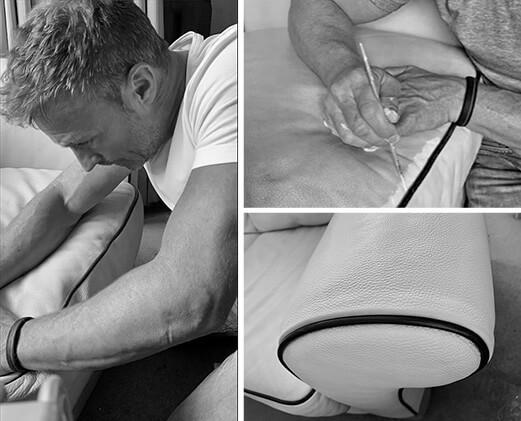
Deciding whether to repair or replace a leather sofa usually comes down to three things: is the frame sound, is the leather still good underneath the damage, and is the sofa something you would actually choose again if you were buying today? If the answer to all three is yes, repair is nearly always the better use of your money. If the answer to the first is no, nothing we do to the leather will make the sofa feel right again.
We have been having this conversation with customers across Essex and London for 26 years, and we are quite happy to tell someone in Brentwood or Leigh-on-Sea that their sofa is not worth saving. This post walks through how we judge it, so you can make the decision with your eyes open. If you would like a second opinion on your own sofa, our leather repair and restoration service covers everything from small tears to full recolouring, and quotes are free.
Start with the frame, not the leather
Most people look at the surface first because that is what they see every day: the cracked seat, the scuffed arm, the faded back. But the frame is what decides whether the sofa has a future. Push down on each arm and see whether it flexes. Sit on each end and listen for creaks. Lift the front edge a few inches and let it drop gently; a good hardwood or well-made engineered frame lands solid, while a tired one rattles.
A sofa with a broken frame member, loose joints or a collapsed spring platform is not a candidate for a leather repair on its own. Frame work is possible, but it changes the sums. A sofa with a solid frame and shabby leather, on the other hand, is exactly the kind of thing we restore every week.

Then look at what the leather is actually made of
This is where the decision most often swings. Two sofas can look identical from across the room and be completely different underneath.
Full grain and top grain hides
Good quality pigmented, semi-aniline or aniline leather is thick, strong and responds beautifully to restoration. It can be cleaned, re-filled, recoloured and sealed, and once it is done it will usually give you many more years. Sofas from the likes of Natuzzi, DFS’s top ranges, John Lewis, Laura Ashley and most Chesterfield makers fall into this group. When customers ask us whether to repair or replace a leather sofa like this, the honest answer is almost always repair.
Bonded and bicast leather
Bonded leather is made from ground-up leather offcuts pressed onto a backing and coated with a polyurethane skin. Bicast is a thin split hide with a thick plastic film on top. Both look fine when new, and both fail the same way: the surface peels, flakes and lifts, often within a few years. Once peeling starts it spreads, and there is no long-term fix because the problem is the material rather than the damage. If your sofa is peeling in sheets rather than cracking in lines, we will tell you straight that it is not worth repairing.
How to tell the difference
Peeling that reveals a fabric-like backing points to bonded or bicast. Cracking, fading or wear that shows a suede-like fibre underneath points to real hide. A quick photo is usually enough for Jon, our founder, to tell you which you have.
Weigh up the type and extent of the damage
Once we know the frame is good and the leather is genuine, the next question is what has actually gone wrong and how much of the sofa it affects.
Damage that repairs well
Cat scratches, small tears and splits, cigarette burns, worn and faded seat cushions, ink and food stains, darkened head and arm areas from hair products and skin oils, colour loss from sunlight, and cracked or dry patches on high-wear areas all repair well. So does general fading across a whole sofa, which is handled by recolouring rather than patching. These are the bread and butter of our leather restoration work.
Damage that needs more than a surface repair
A large tear across a seat, a panel that has been chewed by a dog, or leather that has dried out and split in several places may need a replacement panel rather than a patch. That is still a repair, just a bigger one, and the sofa still keeps its frame, its cushions and its shape.
Damage across everything
If every panel is cracked, the seams are failing all over, the cushions have collapsed and the colour has gone, then you are into full reupholstery territory. A full leather sofa reupholstery replaces all the leather on a good frame. It is a serious job, and it only makes sense on a sofa that was well made in the first place.
Do not forget the cushions
A surprising number of “worn out” sofas are nothing of the sort. The leather is fine but the foam has gone soft and the seats have sunk, so the sofa feels tired and the leather creases badly because it is no longer supported. New foam cores cut to the original shape transform how a sofa sits, and they are far cheaper than replacing the sofa itself. If your sofa feels worse than it looks, this is often the answer, and our new foam cushions service is worth reading about before you go near a showroom.
Repair or replace a leather sofa: the cost question
We do not publish fixed prices because no two sofas are the same, but the shape of the decision is usually clear. Localised repairs (a tear, a scratch, a burn, a stained cushion) come in well under the cost of a new cushion, let alone a new sofa. Recolouring a whole sofa or replacing a panel is a larger job but still usually a fraction of what you would pay to replace a good quality sofa with something of the same standard.
The things that move the price are the size of the damage, the type of leather, how difficult the colour is to match, how many panels are involved, whether the work can be done at your home or needs the workshop in South Benfleet, and access (a fourth-floor flat in central London with no lift is a different proposition from a bungalow in Rayleigh). Every job is quoted individually, and quotes are free.
It is also worth being honest about what “replace” really costs. A cheap new sofa is cheap for a reason, and a lot of the peeling bonded leather sofas we are asked to look at are under five years old. Replacing a good sofa with a poor one to save the cost of a repair is a false economy that tends to come round again quite quickly.
A few questions to ask yourself
When Jon visits a customer in Chelmsford or Colchester to look at a sofa, these are the questions he is really asking, and you can ask them of yourself before you get in touch.
- Does the sofa still fit the room and the way you live, or have you been wanting to change it anyway?
- Is it a shape or size you would struggle to find again (a corner unit that fits an awkward alcove, a sofa bed, a pair that match)?
- Is the damage in one or two places, or everywhere?
- Is the leather genuine hide, or is it peeling in sheets?
- Does it sit well, or have the cushions gone?
- Was it a good sofa when it was new?
If the sofa was good, still fits your life, and the damage is real hide with a sound frame, repair it. That is the short version of how we decide whether to repair or replace a leather sofa. If it was cheap, you have gone off it, and the surface is coming away in your hand, replace it. Most sofas fall somewhere in between, and that is where a proper assessment helps.
When the sofa is nearly new
One more thing before you pay anyone. If your sofa is only a year or two old and the leather is cracking, peeling or fading unusually early, that may be a fault rather than wear, and you may have rights against the retailer. Citizens Advice explains what you can ask for when goods turn out not to be of satisfactory quality. We are always glad to help, but we would rather you did not pay for a repair that the shop should have covered.
Why people trust us with the decision
We do not sell sofas, so we have no reason to talk you into a new one. We also do not benefit from persuading you to repair something that will not last, because a repair that fails reflects on us. Our reviews are full of customers who were told by someone else that their sofa was finished, and who are still sitting on it years later. They are also full of customers we sent away with an honest “not worth it”, which is why they came back when the next sofa needed attention.
Get an honest opinion on your leather sofa
Send us three or four photos: the damaged areas up close, the whole sofa from the front, and the underside or back if the frame feels loose. Tell us the make if you know it, roughly how old it is, and where you are, whether that is Southend-on-Sea, Basildon, Romford or east London. If you are not sure whether the leather is genuine, a photo of the peeling or cracking will usually settle it.
Call Jon on 07967 216250 or fill in the enquiry form below this post. We will tell you plainly whether to repair or replace, and if repair is the right call we will send a free quote for our leather repair and restoration work.