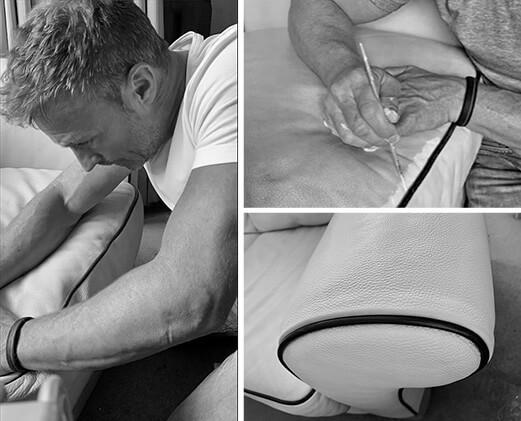
Yes, in almost every case we can repair a leather recliner, and it is usually far cheaper than replacing one. Recliners get harder use than any other seat in the house: the same person, in the same position, every evening, with the footrest going up and down a couple of thousand times a year. The wear shows in predictable places, and because we have seen those places so many times, the repairs are well understood. This post covers the problems we are asked about most, from worn headrests to split seat panels, and how our leather restoration service deals with each of them.
Why Recliners Wear Out Differently From Sofas
A three-seater sofa spreads its wear across several seats and several people. A recliner concentrates all of it. Dad sits in the same chair in Rayleigh every night, head against the headrest, hands on the arm fronts, heels on the footrest. The leather in those spots takes hair oil, skin oil, friction and heat night after night, while the rest of the chair stays pristine.
The mechanism adds its own strain. Every time the chair reclines, the leather over the seat front, the footrest hinge and the back stretches and relaxes. Over a decade that flexing fatigues the finish and eventually the hide, which is why recliners crack and split along fold lines where a static chair would not.
Finally, recliners are often positioned for the television, and that tends to mean near a radiator or in the corner of a conservatory. Heat dries leather out. Sun fades it. Both make the finish brittle long before the frame or motor is anywhere near the end of its life, which is why it usually makes sense to repair a leather recliner rather than replace it.
Common Problems When You Need to Repair a Leather Recliner
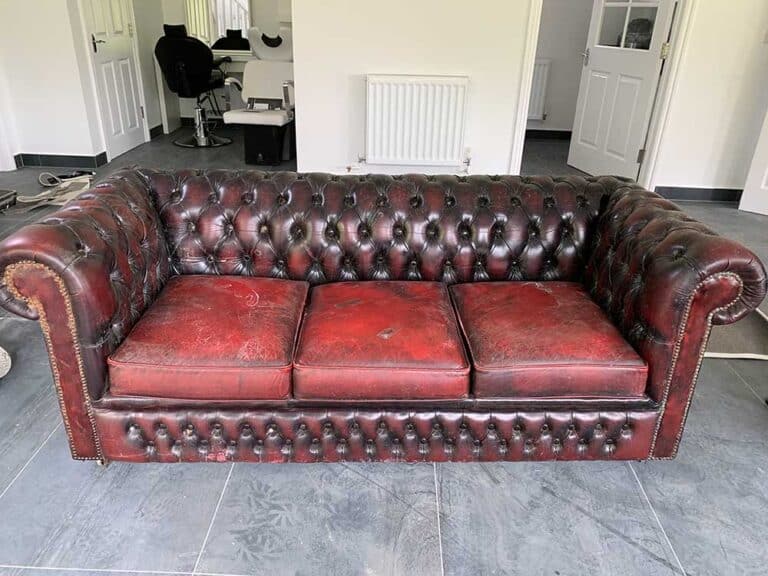
Darkened, shiny headrest
This is the number one recliner complaint. The headrest goes dark, slightly sticky and glossy, and no amount of wiping brings it back. What you are looking at is years of hair product and scalp oil that have soaked through the topcoat and into the pigment. Wiping spreads it. Household cleaners strip the finish around it and make the patch more obvious. The fix is a proper degrease, then rebuilding the colour and topcoat on that panel so it matches the rest of the chair, which is what our leather head area restoration process is designed for.
Worn colour on the arm fronts and seat edge
The front curve of each arm, where hands push down to get out of the chair, and the front edge of the seat where legs rub, are the next to go. The topcoat wears through, the pigment follows, and the pale base of the hide shows. On a brown or black chair this looks grey and scruffy. It is entirely repairable: the worn areas are cleaned, prepared, recoloured and resealed, and blended into the surrounding leather so there is no visible edge.
Cracking across the seat
Fine lines across the seat cushion and the footrest are the finish drying out and fracturing under repeated flexing. Caught early, the cracks are in the finish only, and the surface can be stabilised, filled and recoloured. Left for years, the cracks go down into the hide itself and become splits. If your recliner has a network of fine lines but the leather still feels soft, now is a good time to get it looked at.
Split leather on the seat or footrest
Where a crack has opened into an actual split, or the stitching along the seat seam has let go, we repair it through our leather split and tear repair process: a sub-patch is fitted behind the split to hold it, the gap is filled and textured, and the area is recoloured and sealed. Seam splits are re-stitched. On a recliner we pay particular attention to how the panel will flex afterwards so the repair does not simply reopen at the fold.
Cat and dog scratches
Recliners are warm, they smell of their owner, and the footrest is at exactly the right height for claws. Light scratches in the topcoat are simple to refinish. Deeper scratches that have lifted fibres from the hide need a little more work to fill and smooth, but come up very well.
Sagging seat cushion
Sometimes the leather is fine and the chair just feels tired. That is usually the foam, which compresses over years of the same weight in the same place. Restoring the leather without addressing the foam gives you a smart chair that is uncomfortable to sit in. We can fit new foam cushions cut to the original shape, and it is often the single change that makes an old recliner feel new again.
Faded panels on the window side
A recliner that sits beside a patio door in Leigh-on-Sea or Canvey Island will often fade on one side only. The colour can be rebuilt across the affected panels and matched to the unfaded ones, then sealed with a topcoat that gives better UV resistance than the original.
What About the Mechanism?
We repair leather, not motors, cables and ratchet mechanisms. If the footrest will not lock, or the electric recline has stopped working, that is a job for the retailer or an upholstery engineer. In practice the leather and the mechanism often need attention at the same age, and customers sometimes arrange both. If your chair is still within its guarantee period and the mechanism has failed, Citizens Advice has clear guidance on your rights when furniture develops a fault.
Where a mechanism is beyond repair, the chair is sometimes worth keeping as a fixed armchair. We can still restore the leather and it becomes a very good static seat, which for many older customers is exactly what they wanted anyway.
Why DIY Recliner Repairs Rarely Hold
The internet is full of kits and tips on how to repair a leather recliner, and Jon, our founder, spends a fair amount of his time putting right the results. The recurring themes are the same as with sofas, but the recliner’s movement makes them worse. Glue on a split seat cracks the first time the chair reclines. Filler applied without a sub-patch pops out along the fold line. Spray dye on a headrest goes on over grease that was never properly removed, so it never bonds and rubs off onto the back of the next person’s head.
Then there are the cleaning attempts. Baby wipes, washing-up liquid, furniture polish and “leather conditioner” from the supermarket all get used on greasy headrests. None of them removes the oil, and several of them soften or strip the finish, so the dark patch becomes a dark patch surrounded by a pale halo. If your recliner has had one of these treatments, tell us when you get in touch. It does not stop us repairing it, but it does change how we approach it.
How the Repair Is Done
In most cases we repair a leather recliner at your home in a single visit, which is easier than getting a heavy, mechanised chair into a van. Jon arrives, confirms the leather type and the extent of the damage, and works through the stages in order: deep clean and degrease, repairs to any splits or worn-through areas, colour matching and application, and finally a new protective topcoat cured in place.
Where a chair needs more extensive work, for example a full colour change or replacement panels on the seat and footrest, it comes back to our workshop in South Benfleet. Either way, you will know before we start exactly what is being done and what it will cost.

When It Is Not Worth Repairing
We will always tell you if a chair is not worth the money. The usual cases are bonded leather recliners where the surface is peeling in sheets (the material cannot be rebuilt, only replaced), chairs where the frame has cracked, and very cheap imports where the “leather” is a vinyl that has gone hard. Good quality recliners from brands such as Ekornes, La-Z-Boy, Parker Knoll and Natuzzi are almost always worth restoring, sometimes more than once over their life.
Get a Quote to Repair Your Leather Recliner
If you would like us to repair a leather recliner for you, send us two or three photos in daylight: one of the whole chair and a couple of close-ups of the worn or damaged spots, with the footrest up if that is where the problem is. Let us know roughly where you are. Jon will tell you what the repair would involve and give you a free quote for a leather restoration that puts the chair back to how it should be.
Call Jon on 07967 216250 or fill in the enquiry form below this post. We cover South Benfleet, Southend, Basildon, Chelmsford, Brentwood, Romford and across east and central London.