Red wine on a leather sofa is one of the most common phone calls we get on a Sunday morning. Someone had friends round on Saturday night, a glass went over on the arm or the seat, and by the time anyone noticed there was a dark purple patch that would not wipe away. The good news is that in most cases it can be sorted properly, but what you do in the first hour matters a great deal. Our leather stain removal service exists precisely for moments like this, and this post explains what is happening to the leather, what not to do, and what we can do about it.
What Red Wine Actually Does to Leather
Red wine is a mix of water, alcohol, sugar, acid and strong plant pigments called tannins and anthocyanins. Those pigments are the same ones that stain your teeth and your tablecloth, and they are very good at bonding to organic material. Leather is organic material.
How badly the wine takes hold depends on the type of leather. Most modern sofas from the big retailers have a pigmented finish, which is a thin coloured coating with a clear lacquer on top. On that kind of leather, wine usually sits on the surface for a while before it finds a way through worn patches, seams, cracks or scuffs. On aniline or semi-aniline leather, which is dyed all the way through and has little or no protective coating, the wine soaks straight in like ink into blotting paper. That is why one person’s spill wipes off with a cloth while their neighbour in Leigh-on-Sea is left with a stain the size of a dinner plate.
The wine also carries acid and sugar into the leather. The acid can disturb the finish, and the sugar leaves a tacky residue that attracts dirt. So even when a spill looks like it has mostly gone, there is often a faint shadow or a stiff patch left behind that gets darker over the following weeks.
Red Wine on a Leather Sofa: What to Do in the First Few Minutes
The honest answer is: do less than you think. Lift as much of the liquid off as you can with a clean, dry, colourless cloth by pressing gently, then stop. Do not scrub, and do not reach under the sink. If the leather has a protective finish, gentle blotting removes most of the problem. If the wine has already soaked in, nothing you have in the kitchen will get it back out, and most of what people try makes the eventual professional repair harder.
Then take two or three clear photos in daylight and send them to us. Jon, our founder, has looked at hundreds of wine spills over 26 years and can usually tell from a photo whether this is a cleaning job or a recolouring job, and what it is likely to involve.

Why the Internet’s Favourite Remedies Backfire
Search for red wine on a leather sofa and you will find the same advice repeated on a dozen sites: white wine, salt, bicarbonate of soda, washing-up liquid, vinegar, baby wipes, hairspray, even nail varnish remover. We have seen the results of every one of these on sofas across Essex and London, and they range from disappointing to disastrous.
Salt and bicarbonate of soda
The theory is that the powder draws the wine out. In practice it draws out the leather’s natural oils along with the moisture, leaving a pale, dry, slightly rough patch that is often more noticeable than the original stain. On aniline leather it can also push the pigment deeper as it dries.
White wine, vinegar and washing-up liquid
Adding more liquid to a stain spreads it. Adding acidic or alkaline liquid to a pigmented finish can soften it, and once the finish is compromised the wine goes straight through into the hide. Washing-up liquid also leaves a residue that dries sticky and collects grime, so the patch turns grey and dull over time.
Baby wipes, hairspray and solvents
These are the ones that break our hearts. Baby wipes contain mild cleaning agents and moisturisers that slowly strip the lacquer off a sofa. Hairspray and nail varnish remover are solvents and will lift colour along with the stain, so you end up with a light ring where the wine used to be. That is no longer a stain problem. That is a recolouring problem, and a bigger bill.
There is one more thing worth saying. Off-the-shelf “leather wine stain remover” kits sold online are generic products that have no idea what finish your sofa has. Consumer groups such as Which? regularly point out that miracle cleaning products rarely live up to their claims, and in our experience leather is the worst place to gamble on one.
How We Remove Wine Stains Professionally
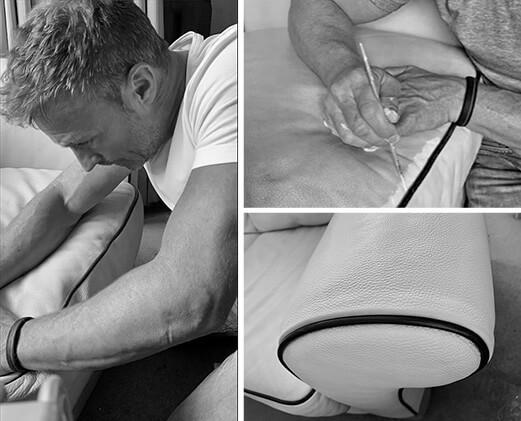
A professional approach starts with identifying the leather and the finish, because that decides everything else. Jon tests an inconspicuous area to see how the surface reacts, then works out whether the wine is sitting in the finish, has stained the hide beneath, or both.
Where the stain is in the finish, we use specialist leather cleaners designed for that exact type of coating, worked in carefully rather than scrubbed, and then neutralise and condition the area so it does not dry out. Many spills on pigmented leather are resolved at this stage and the sofa simply looks clean again. You can read more about how we approach this on our leather sofa cleaning page.
Where the pigment has gone into the hide, no amount of cleaning will remove it without damaging the leather, so we take a different route. We clean the area, gently prepare the surface, and then colour match the exact shade of your sofa by eye and by test patch. The affected area is recoloured with flexible leather pigment, blended out so there is no hard edge, and sealed with a lacquer that matches the original sheen, whether that is matt, satin or gloss. Done well, the stain simply is not there any more. Have a look at our leather sofa recolouring service for what that looks like on a whole sofa.
On aniline leather, which has no coating to hide behind, the options are more limited and honesty matters. Sometimes we can reduce a wine stain considerably and even it out so it reads as part of the natural patina. Sometimes the best answer is to convert the affected panel to a semi-aniline finish, which changes the look slightly but removes the stain entirely. Jon will tell you which applies before any work starts.

How Long You Have Before It Becomes Permanent
There is no exact cut-off, but the general pattern is clear. A fresh spill on protected leather is a small job. A spill that has been left for a week, or worse, treated with three different remedies, is a medium job because there is now a stain plus a damaged finish to deal with. A spill on a sofa that was already worn, with cracks on the seat or bare patches on the arms, tends to soak in at those weak points and needs recolouring across the whole panel to look right.
We also see a lot of wine spills on light coloured sofas in conservatories and south-facing lounges around Southend-on-Sea and Chelmsford, where years of sun have already dried and faded the leather. That leather is thirsty and absorbs wine fast. If your sofa is in a bright room, it is worth acting quickly.
The other factor is whether anyone has rubbed the area. A rubbed stain is spread over a larger area and driven deeper, and often the surrounding finish has been abraded too. Blotting and leaving it alone really is the best thing you can do for us and for your sofa.
Is It Worth Repairing or Should You Replace the Sofa?
Almost always it is worth repairing. A single wine stain on an otherwise good sofa is a localised job, usually done at your home in Essex or London in a single visit, and the cost is a small fraction of replacing a decent leather suite. Even where the stain has gone through and a full seat cushion needs recolouring, the result is a sofa that looks new again rather than one that goes to the tip.
The only time we suggest thinking about replacement is when the wine stain is the least of the sofa’s problems: when the leather is peeling, the frame is broken or the cushions have collapsed. Even then, many customers prefer to have the whole sofa restored rather than buy something new of lower quality, and we are happy to talk that through.
Get a Quote for Red Wine on a Leather Sofa
If you have red wine on a leather sofa right now, take a couple of clear photos of the stain in daylight, one close up and one of the whole sofa, and let us know roughly where you are, whether that is Basildon, Brentwood, Romford or central London. Jon will tell you honestly whether it is a clean, a recolour or something in between, and what it is likely to cost. Quotes are free and there is no call centre, just Jon.
Call Jon on 07967 216250 or fill in the enquiry form below this post, and read more about our leather stain removal service before you reach for the baby wipes.