Recolouring antique leather is a different job from recolouring a modern sofa. The whole point of an old Chesterfield, a club chair or a Victorian library chair is the depth of colour that has built up over decades: the darker glaze in the creases, the lighter high points where hands have rested, the slight variation from panel to panel. Flood that with a single flat colour and you have a piece that looks new, cheap and wrong. Done properly, recolouring brings the leather back to life while keeping every bit of that character.
We do a lot of this work from our workshop in South Benfleet, for private customers across Essex and London and for antique dealers and interior designers who need a piece brought up to standard before it goes into a room. Jon, our founder, has spent 26 years learning how old leather behaves, and in this post he explains what is involved, what to avoid, and what a good result should look like.
What Makes Antique Leather Different
Most antique upholstery leather was finished very differently from the pigmented leather on a modern sofa. It was often aniline or semi-aniline, dyed through with the colour rather than coated on top, and then hand-finished with waxes, oils and coloured glazes. Over time the surface develops what dealers call patina: a soft sheen, darker tones in the folds, and lighter areas where the finish has been polished away by use.
That same open structure is what makes old leather vulnerable. It absorbs spills, sun bleaches it unevenly, central heating dries it out, and eventually the surface starts to crack, flake and lose colour completely. A Chesterfield that has sat in a south-facing drawing room in Leigh-on-Sea for thirty years will typically have a back that is several shades lighter than the seat, arms that are worn through to the bare hide, and buttoning that still holds the original deep colour inside every diamond.
The challenge in recolouring antique leather is to deal with the damage without erasing the story. A modern sofa gets a uniform colour because that is how it left the factory. An antique piece needs a finish that varies deliberately across its surface.

Why Home Recolouring Goes Wrong on Old Leather
We are regularly asked to rescue antique pieces that someone has already had a go at. It is understandable: the leather looked tired, a spray dye or a tin of coloured leather balm was cheap, and the video made it look easy. Old leather does not respond the way the video suggests.
Spray dyes and single-colour recolouring kits produce exactly what they promise, one colour. On a piece whose beauty depended on two or three tones playing against each other, that is a loss. The finish also tends to sit on the surface of aniline leather rather than bonding into it, so it wears off on the arms and seat within months, leaving a patchy mess that is harder to fix than the original fading.
Shoe polish and coloured waxes are the other common attempt. They darken the leather and hide the worst of the wear, but they never fully dry on absorbent old hide. They transfer onto clothing, attract dust, and build up into a sticky layer that has to be stripped before any proper work can begin. Furniture oils and conditioners applied heavily to “feed” dry leather often go rancid in the fibres and can turn the surface dark and blotchy.
Then there is the leather itself. Antique hide that has been drying for decades is brittle. Aggressive cleaners, solvents and vigorous rubbing can lift the surface completely, taking the original finish with it. Once that is gone, there is no getting it back; the best anyone can do is rebuild an imitation of it.
How We Approach Recolouring Antique Leather
Every antique piece is assessed before any product goes near it. Jon looks at the type of leather, how it was originally finished, how deep the damage goes and, just as important, what the customer wants. Some people want their Chesterfield to look as it did when it was new. Most want it to look like a well-kept hundred-year-old sofa, which is a subtler brief.
Cleaning and stabilising
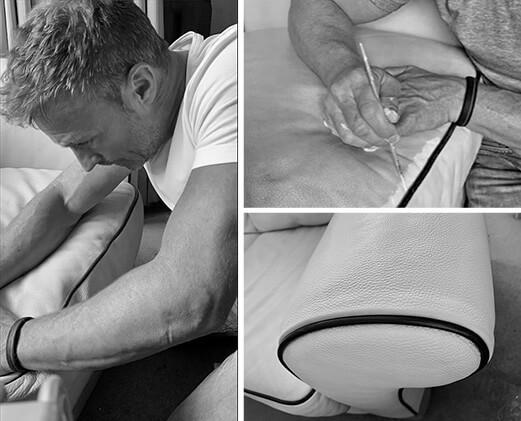
The leather is cleaned gently to remove decades of polish, wax, skin oils and dirt without stripping the surviving finish. Dry, brittle areas are conditioned so they can take the work that follows. Cracks and flaking are stabilised, and any tears or worn-through patches are sub-patched from behind and filled so the surface is sound. On a buttoned piece this is slow, careful work done diamond by diamond.
Building the base colour
Rather than one shade sprayed over everything, the base colour is matched to the lightest surviving areas and applied in thin, translucent layers. This keeps the grain visible and avoids the plastic look that puts people off recoloured leather. Where an arm has worn through to bare hide, it is built back up in stages so it ends up at the same depth as the surrounding leather rather than looking like a patch.
Recreating the two-tone and aged effect
This is the part that separates recolouring antique leather from ordinary recolouring. A darker glaze is worked into the creases, the buttoning and the low points by hand, then softened back on the high points so the piece reads as aged rather than painted. The amount of contrast is judged by eye against untouched areas, photographs of the piece when it was younger, or the customer’s description of how it used to look. On a Chesterfield the pleats around each button get individual attention, because that is where the eye goes first.
Sealing and finishing
Once the colour and glaze are right, a sealant and topcoat lock the work in place and give the correct sheen. Antique leather rarely wants a high gloss; it usually looks best with a soft, waxed lustre. We can finish with a wax layer where that suits the piece. You can read about a similar approach on a modern piece in our post on wax leather recolouring, which shows how dye and wax work together.
Our leather sofa recolouring service covers all of this, and for buttoned antiques we combine it with our Chesterfield sofa repair work so that loose buttons, split seams and flat seat pads are dealt with at the same time.

Pieces We Are Often Asked to Recolour
Chesterfields are the most common, both the genuine Edwardian and Victorian ones and the good quality reproductions made from the 1960s onwards. Club chairs, particularly the French and Art Deco styles with their distinctive worn cognac finish, come to us regularly from dealers in central London and from homes in Brentwood and Chelmsford. We also see Captain’s chairs, library and office chairs, leather-topped desks and writing tables, and the occasional church or school bench.
Not all of them are genuine antiques, and not every job that arrives as recolouring antique leather turns out to involve an antique. Many are distressed or antiqued modern pieces, made to look old from the start. The techniques are similar, though modern antiqued leather is usually more robust and takes the work more easily. If you are not sure what you have, send us a photograph and we will tell you.
When Recolouring Is Not the Right Thing to Do
There are antique pieces where the best advice is to leave the leather alone. A piece of real historic value, or one that a collector might want with its original surface intact, can lose value if it is recoloured, however well the work is done. If you own something like that, we would suggest talking to a conservator before anything else. The British Antique Furniture Restorers’ Association can point you towards accredited specialists.
There are also pieces where the leather has gone too far. If the hide has rotted, torn in multiple places, or dried to the point where it crumbles under a fingernail, recolouring will not hold. In that situation replacement panels or full reupholstery, matched to the original style, may be the honest answer. We will tell you which we think applies before quoting.
Where We Work and How Long It Takes
Simple colour refreshes on a single chair can sometimes be done in your home. Most recolouring antique leather comes to the workshop, because the layered approach needs proper drying time between stages and good, consistent light to judge the tones. We collect and return across Essex, including Southend-on-Sea, Rayleigh, Billericay and Colchester, and across east and central London. A full recolour on a large Chesterfield usually takes a number of days from collection to return.
Get a Quote for Recolouring Your Antique Leather
If you have an antique or antiqued leather piece that has faded, worn or been badly touched up, send us a few photographs: one of the whole piece, one or two close-ups of the worst areas, and if possible one of an area that still shows the original finish, such as the inside of a buttoned diamond or the underside of a cushion. Tell us roughly where you are and how you would like the piece to look when it is done.
Call Jon on 07967 216250 or fill in the enquiry form below this post. There is more about our approach on the leather sofa recolouring page. Quotes are free, and we will be honest with you about whether the piece should be recoloured at all.