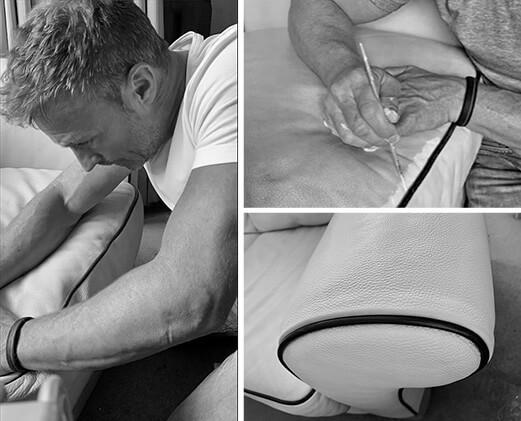
The honest answer is that new foam for sofa cushions usually costs a good deal less than people expect, and a great deal less than a new sofa. The price depends on how many cushions you need doing, their size, the grade of foam that suits how you sit, and whether the leather covers need any work while they are open. In this post we explain what actually goes into the price so you can judge a quote sensibly rather than guessing.
We fit new foam cushions for customers across Essex and London every week, from three-piece suites in Basildon to corner sofas in Canary Wharf flats, so what follows comes from doing the job rather than reading about it.
Why sofa cushions go flat in the first place
Foam is a sponge of tiny air cells. Every time you sit down those cells compress, and every time you stand up they spring back. Over thousands of evenings the cell walls weaken, the foam loses its bounce and the cushion starts to “bottom out”, which is that feeling of sinking until you can feel the frame or the springs underneath.
It happens faster on the seat everyone favours. Jon, our founder, sees the same pattern in almost every home: the cushion nearest the television or the radiator is flat as a pancake, the one at the far end is still like new. Heat speeds up the process too, so a sofa pushed against a radiator, or sat in a south-facing conservatory in Leigh-on-Sea, tends to go sooner.
Cheaper sofas often come with low-density foam from the factory. It feels lovely in the showroom and gives up within two or three years. Good quality leather, on the other hand, can easily last twenty years or more. That mismatch is the reason so many people end up with a sofa whose leather looks fine but which is miserable to sit on.
What new foam for sofa cushions costs and what drives the price
We do not publish a fixed price list, because no two sofas are the same. What we can do is explain the factors that move the price up or down, which is more useful than a number plucked from the air.

How many cushions and how big they are
A single seat cushion on an armchair is a small job. Three seat cushions and three back cushions on a large chesterfield is a much bigger one, simply because there is more foam to cut and more covers to open and close. Deep, boxy cushions on modern Italian designs use more material than slim ones on a traditional suite.
The grade of foam
Foam comes in different densities and firmness ratings. Higher density foam costs more per block but holds its shape for far longer, so it is usually the better buy over the life of the sofa. Some customers want a firmer seat to help them get up, especially older customers or anyone with a bad back or knees. Others want the softer, sink-in feel of the sofa they bought. We talk this through before anything is cut.
Wrapping and layering
Many good quality sofas have a layer of polyester wadding or a feather wrap around a foam core. That is what gives the plump, rounded look. Replacing the wrap as well as the core costs a little more but makes a big difference to how the cushion looks in the leather cover. Skip it and you can end up with a firm seat that looks oddly square.
What we find when the cover comes off
This is the part people do not think about. When a cushion has been sat on flat for years, the leather cover has often taken a beating too. Seams can be strained, zips broken, piping worn. If the cover needs re-stitching while it is open, it makes sense to do it at the same time rather than pay for a second visit later.
Where the work is done
Most cushion refills can be done in your home, which keeps things simple. Occasionally a job is easier in our workshop in South Benfleet, for example when the covers need a lot of stitching or the cushions are an unusual shape that needs templating. We will tell you which applies when we quote.
A rough idea of the numbers
As a broad guide only, refilling a single seat cushion with good quality foam typically comes in well under the cost of a new cushion from the manufacturer, and a full set of seat cushions on a three-seater is usually a fraction of the price of replacing a decent leather sofa. If your sofa is a well-made piece from somewhere like John Lewis or Natuzzi, new foam almost always makes financial sense. Every job is quoted individually, and quotes are free.
Where the sums stop working is when the leather itself is at the end of its life, or the frame is broken. We will tell you straight if that is the case. There is no point putting new foam into a cover that is about to split.
Why the cheap options tend to disappoint
Search online and you will find foam sold by the sheet, and “sofa saver” boards that slide under the cushions. We understand the appeal, but we see the results of both in homes across Essex and they rarely end well.
Foam bought blind is the biggest problem. Without the right density and a proper template the new block is either too soft (so you are back where you started within months) or too hard and slightly the wrong size, which strains the seams and makes the cover pucker. Cutting foam cleanly to the exact profile of a cushion, with the correct allowance so the cover fits snug, is a skilled job with the right tools. A bread knife on the kitchen floor does not get you there.
Boards under the cushions simply move the problem. They stop the sag from the top but do nothing for the tired foam, so the seat feels hard and thin at the same time. They also stop the sofa breathing, which can leave the underside of the cushion damp in a cold room.
There is a safety angle too. Foam sold for furniture in the UK has to meet the fire safety regulations that apply to upholstered furniture, and not everything sold as “cushion foam” online does. You can read about those rules on GOV.UK. We only use foam that complies, and we can show you the certification if you want to see it.
What happens when we refill your cushions
Jon starts by having a proper look at the whole sofa, not just the flat cushion. He checks the frame, the springs or webbing, and the condition of the leather. Then he measures each cushion and talks to you about how you want it to feel. Somebody who reads on the sofa every evening wants something different from a family whose kids launch themselves onto it.
The old foam comes out and the covers are checked inside and out. New foam is cut to a template taken from the cover, not from the collapsed old block, so the finished cushion matches the sofa’s original shape. Where there was a wrap, a new one goes on. The cover is fitted, zipped and dressed so the leather sits properly with no loose corners.
If the sofa has fixed seats rather than loose cushions, the job is slightly different because the foam sits inside the upholstered base. That is still very doable, and it often forms part of a wider leather sofa reupholstery job where the seat platform and the leather are refreshed together.
When new foam is not the right call
We are not in the business of selling work you do not need. There are a few situations where we will advise against refilling.
If the leather is a cheap bonded or “faux” leather that is already peeling, spending money on new foam is throwing good money after bad. If the frame has cracked or the springs have collapsed, the foam is not the problem and new foam will not fix it. And if the sofa was a budget buy that has done its time, it may simply be sensible to replace it.
On the other hand, if you love the sofa, it is real leather and it still looks good, new foam is one of the best value things you can do for it. We have refilled cushions on sofas in Chelmsford and Romford that customers had been told to throw away, and they are still in daily use years later.
Get a Quote for New Foam Cushions
Send us a couple of photos of the sofa, ideally one from the front and one showing the flattest cushion from the side, along with a rough idea of where you are in Essex or London. If you know the make of the sofa that helps too. Jon will come back to you with an honest view and a price for new foam for sofa cushions.
Call Jon on 07967 216250, or fill in the enquiry form below this post and we will get back to you.