Mould on a leather sofa is unpleasant to find, but in most cases it can be cleaned safely and the sofa brought back to full use. The key word is safely. Mould spores need removing rather than spreading, the leather needs treating without stripping its finish, and the cause, which is nearly always damp air or a damp room, needs sorting out so it does not come back. Bleach, vinegar and scrubbing with a wet cloth are the three things most likely to make a mouldy sofa worse.
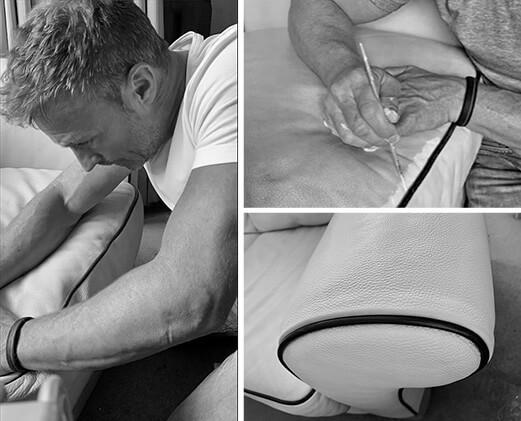
We deal with mouldy and musty leather furniture across Essex and London from our base in South Benfleet, often in conservatories, garden rooms, rented flats and houses that have been shut up for a few months. Jon, our founder, has been cleaning and restoring leather for 26 years, and this post explains what causes mould on leather, why home remedies backfire, and what a professional clean involves.
Why Mould Grows on Leather
Mould needs moisture, warmth and something to feed on. Leather provides the food: it is a natural material, it holds oils and it collects skin cells, dust and food residue. All it needs is damp air and a little time.
The classic case is a conservatory or garden room. The sofa sits in a space that is warm and humid during the day, cold at night, and often shut up with the doors closed. Condensation forms, the air stays moist, and within a few weeks a fine grey or white bloom appears on the seats and backs. We see this a lot in Leigh-on-Sea, Rayleigh and along the Thames estuary where the air is already damp.
Other common causes include a sofa pushed against an external wall with no air gap behind it, a spare room that is rarely heated, a basement flat in east London, a holiday let or second home left empty over winter, a leak from a radiator or washing machine that has soaked the base, and furniture that has been stored in a garage or a storage unit without ventilation. Spilled drinks that were never properly dried out can grow mould inside the cushion where no one sees it until the smell arrives.
Aniline and other absorbent leathers are more vulnerable than sealed pigmented leather, because moisture and oils sink into the surface rather than sitting on top of it.
How to Tell Mould from Other Marks
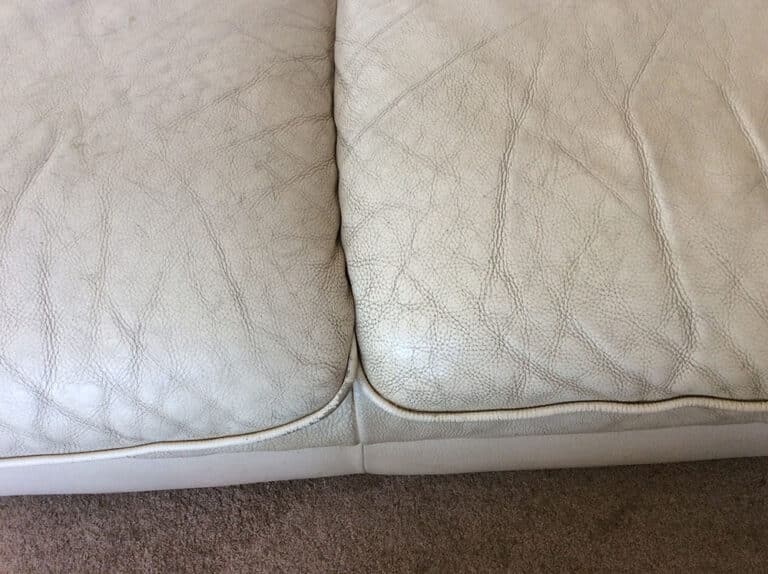
Not every white bloom is mould on a leather sofa. Fatty spew, where waxes and oils in the leather migrate to the surface in cold conditions, looks very similar and is harmless. Dried salt from sweat or sea air, and residue from conditioners, can also leave a pale film. Mould usually has a musty smell, often appears in spots or patches that grow over time, and is worst in the creases, seams and the underside of cushions where air does not circulate.
If you are not sure, a photograph in daylight is usually enough for Jon to tell you which it is. The treatment is different, so it matters.
Why Household Remedies Make Mould on a Leather Sofa Worse
Most of the advice online for mould on a leather sofa is borrowed from bathroom tiles and is wrong for leather.
Bleach and mould sprays are the worst offenders. They will kill surface mould, but they also strip colour and the protective topcoat, leaving pale patches and a surface that is now more absorbent and easier for mould to grow on next time. On a dark brown or black sofa the damage is immediate and obvious.
Vinegar and water is the most common suggestion. Vinegar is acidic, dulls the finish, and leaves the leather smelling for days. It also does not remove the spores; it wets them and spreads them into the grain and seams with the cloth. Scrubbing with a wet sponge does much the same, and adds more moisture to leather that was too damp to begin with.
Alcohol and surgical spirit can lift mould but will also lift colour and dry the leather out badly. Baking soda pastes leave a residue in the grain that is hard to remove. Airing the sofa in the sun is not a bad instinct, but a few hours of direct summer sunshine on a sofa that is already stressed can cause fading and cracking that costs more to fix than the mould.
The other risk is to you. Disturbing dry mould releases spores into the room, and if anyone in the house has asthma or allergies that is worth avoiding. A professional will remove it in a way that contains it rather than spreading it.
What a Professional Clean Involves
Our leather sofa cleaning service for mould follows a broad sequence, adapted to the leather type and how far the problem has spread.
Jon assesses the sofa first: the type of leather, how extensive the mould is, whether it has got into the seams, foam or fabric underneath, and whether the finish has already been damaged by an earlier attempt. Surface mould is removed in a way that captures the spores rather than brushing them into the air. The leather is then cleaned with products suited to its finish and treated to deal with the spores that remain in the grain. It is dried properly, which is not the same as leaving it in front of a radiator, and finished with the correct protection for the leather type.
Where the mould has left staining behind, which is common on lighter leathers, we treat that separately; our leather stain removal page covers how. Where a previous bleach or vinegar attempt has stripped colour, the affected area is recoloured and resealed. If the mould has got into cushion fillings, new foam may be the cleanest solution.
In more serious cases, where the finish has broken down across large areas and the leather has dried and cracked, the job becomes a wider leather restoration rather than a clean. We will tell you which applies before we start.

Stopping the Mould Coming Back
Cleaning the sofa is only half the job. If the room stays damp, mould on a leather sofa will return, and no amount of leather treatment will prevent it. The fix is almost always about air: ventilation, heating that keeps the room above the temperature where condensation forms, and an air gap between the sofa and any external wall.
Conservatories and garden rooms are the hardest to manage because of the temperature swings. Leaving a vent open, running a dehumidifier over winter, or simply not leaving the sofa in there through the coldest months all help. The Energy Saving Trust has practical guidance on managing damp and condensation in the home, which applies just as much to protecting furniture as it does to walls and windows.
If the sofa has been stored, bring it back into a heated, ventilated room and give it a few days before deciding anything. And if the mould was caused by a leak, deal with the leak first; we have cleaned sofas in Basildon and Chelmsford that went mouldy again within weeks because a slow drip under the floor was never found.
When a Mouldy Sofa Is Not Worth Saving
We would rather be honest than take on a job that will disappoint. If the mould has penetrated deep into the leather on an absorbent aniline sofa and the surface has rotted, or if the frame and webbing have been wet for a long time and have started to go soft or smell, cleaning alone will not restore it. Bonded leather that has been damp tends to delaminate and peel, and that cannot be reversed.
For a genuine leather sofa with surface mould, even quite extensive surface mould, the outlook is usually good. Most of the mouldy sofas we see in Essex and London go back into daily use looking and smelling as they should.
Get a Free Quote to Clean the Mould from Your Leather Sofa
If you have found mould on a leather sofa and want it dealt with properly, send us two or three photographs in daylight: one of the whole piece and a couple of close-ups of the mould, including any seams or cushion undersides that are affected. Tell us where the sofa lives, whether that is a conservatory, a spare room or a flat, and whether anything has already been tried on it. Let us know roughly where you are; we cover Essex, including Southend-on-Sea, Billericay, Colchester and Thurrock, and east and central London.
Call Jon on 07967 216250 or fill in the enquiry form below this post. There is more about our approach on the leather sofa cleaning page. Quotes are free, and Jon will tell you straight whether your sofa needs a clean, a restoration or a frank conversation about replacement.