Yes, in most cases a leather steering wheel can be restored, and the result is usually far better than people expect. Shiny patches, worn-through colour at ten and two, cracked leather along the stitching and that sticky, greasy feel on a hot day can all be put right without replacing the wheel or sending the car away for weeks. The exceptions are wheels where the leather has actually split through or where the foam underneath has crumbled, and we will tell you honestly if yours is one of them.
We restore steering wheels as part of our leather car seat repair service, working on everything from daily commuter cars parked on drives in Rayleigh to classic Jaguars and Mercedes tucked away in garages around Brentwood and Chelmsford. The wheel is the part of the car you touch most, so it is often the first thing to look tired and the first thing customers want sorted.
Why a leather steering wheel wears so quickly
Think about what a steering wheel goes through. Your hands are on it every single journey, gripping, sliding and turning. Skin carries natural oils, plus hand cream, sun cream, sanitiser and whatever was on the sandwich you ate at the lights. All of that ends up on the leather.
Over time the oils soak into the top coat and break it down. The pigment layer that gives the leather its colour starts to polish smooth, which is why a worn wheel goes shiny before it goes pale. Once the top coat is gone the leather itself is exposed and it begins to darken, dry out and eventually crack along the grain.
Heat makes everything worse. A black wheel in a car parked outside a Southend office through a July afternoon gets hot enough to soften the finish, and then the next grip drags it about. Rings and watch straps add scuffs. Jon, our founder, can often tell which hand a driver favours from the wear pattern alone.
What people try first, and why it tends to backfire
The most common thing we see is a wheel that has been “conditioned” with an off-the-shelf leather cream or, worse, something from the kitchen. On a pigmented automotive leather these products sit on top of the finish rather than feeding it, and they attract more dirt. The wheel ends up stickier and darker than before.
Next come the aerosol leather dyes and touch-up pens sold online. The colour rarely matches properly, it does not bond to the worn surface, and it rubs off onto your hands within a few weeks. We have had customers in Basildon arrive with black palms and a wheel that now has three different shades on it.
Stretch-on wheel covers are the other regular. They hide the problem, but they trap moisture and heat against the leather, and on a wheel that is already deteriorating that speeds things up. They also change the feel of the wheel, which some drivers find unsafe. If you are considering one, please talk to us first.
Superglue on a small split is the one that makes us wince. It goes hard, it goes white, and it makes the area impossible to repair properly later without cutting the glue out.

What a professional leather steering wheel restoration involves
The first stage is always assessment. Jon looks at whether the damage is in the finish only, which is the good news scenario, or whether it has gone into the hide. He also checks the stitching, the condition of the leather at the spokes and whether the wheel has any foam padding that has softened.
Deep cleaning comes next, and it is more involved than it sounds. Years of hand oil and old conditioner have to come out of the leather before anything else will bond. This is the step most home attempts skip, and it is the reason they fail.
Any cracking or worn-through areas are then prepared and treated. Fine cracks are filled and smoothed so the surface is level again. Where the leather is thin, it is stabilised so it will not open up. If a small section of stitching has failed, it is re-stitched by hand to match the original.
Colour is matched to the untouched leather elsewhere on the wheel, not to a chart. Black is not simply black: there are dozens of blacks in automotive leather, and a wheel that does not match the gear knob or the seats looks wrong immediately. Pigment is built up in thin layers so the grain still shows through, then sealed with a lacquer designed for high-contact automotive use. That top coat is what gives a restored wheel its matt, slightly grippy feel rather than a plastic shine.
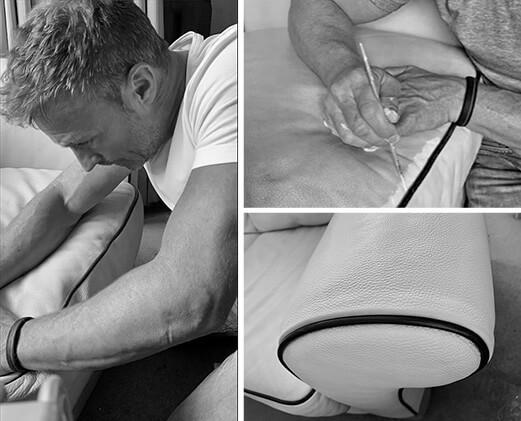
The process is much the same as the leather restoration work we do on furniture, adapted for a small, curved surface that has to cope with far more handling.
Colour changes and classic cars
Some customers do not just want the wheel restored, they want it changed. A tan wheel in a car with a black interior, or a faded burgundy wheel on a classic that has been retrimmed, can be recoloured in the same way we recolour furniture. We use the same colour matching approach as our leather sofa recolouring service, just on a smaller scale, so the finish is even and durable rather than a painted-on look.
Classic cars need extra care. Older wheels sometimes use different leathers and tanning methods, and the aim is usually to keep as much of the original as possible rather than make it look brand new. Jon has worked on wheels for owners’ club members across Essex where the brief was “make it feel right, not make it look wrong”, and that is a brief we understand. Anyone interested in how leather is made and finished in the UK can read more at Leather UK, the industry’s trade association.
How long it takes and what affects the price
A wheel with worn finish and light cracking can usually be restored in the car, at your home or workplace, in a few hours. If the wheel has to be removed, for example on a classic where the leather needs work right around the hub, the job takes longer and we may ask to do it in our workshop in South Benfleet.
The main things that affect price are how far the damage has gone (finish only, or into the hide), whether there is any splitting or stitching to repair, whether the colour is being matched or changed, and whether other parts of the interior are being done at the same time. Doing the wheel alongside worn seat bolsters or a gear gaiter is usually more cost-effective than three separate visits.
When restoration is not the right answer
If the leather has split right through and the foam beneath is exposed and crumbling, restoration will not hold. The wheel needs retrimming, which is a different job and one we will point you towards rather than pretend we can patch it.
Airbag wheels are perfectly safe to restore because we are only working on the leather rim, never the centre module, but we will not do anything that involves disturbing the airbag unit. If a wheel needs to come off for a full retrim on a modern car, that is a job for a garage with the right equipment.
For everything else, which is the great majority of wheels we see, restoration is quicker, cheaper and keeps the original part in the car, which matters a great deal on anything with resale or heritage value.
Get a Quote to Restore Your Leather Steering Wheel
Take two or three photos of the wheel in daylight: one of the whole wheel and a couple of close-ups of the worst areas at the top and at the spokes. Let us know the make, model and year, roughly where you are in Essex or London, and whether you would like anything else in the interior looked at. Jon will come back to you with an honest assessment and a price through our leather car seat repair service.
Call Jon on 07967 216250, or fill in the enquiry form below this post and we will be in touch.