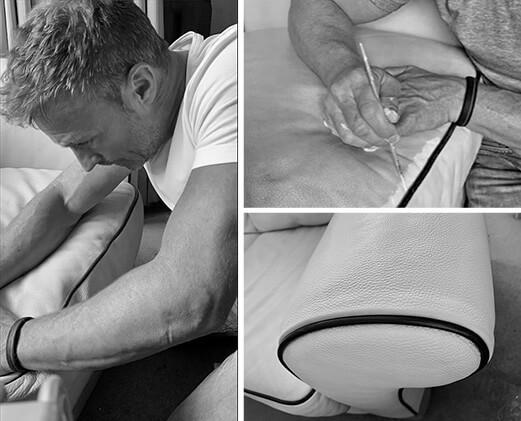
A leather sofa seam coming apart is one of the most common faults we are asked about, and one of the most worthwhile to fix early. Sometimes the thread has broken and the leather either side is perfectly sound. Sometimes the stitches are fine but the leather has torn along the stitch holes. The two look similar from the sofa but need different repairs, and getting that diagnosis right is the first job. We are The Leather Expert, based in South Benfleet, and Jon, our founder, has been carrying out leather sofa stitching repairs across Essex and London for 26 years.
Why seams open up in the first place
Every seam on a sofa is under load. The seat cushion seams take your weight each time you sit. The front border seam takes the drag of legs sliding off the edge. The arm seams get leant on, sat on and used as a step by children and cats. Over years, one of three things gives way.
The first is the thread. Furniture thread is strong but it is not indestructible. It wears where it rubs against the leather, it can be weakened by sunlight and by the chemicals in household cleaners, and on some imported sofas it was never heavy enough for the job to begin with. When thread fails, the stitches simply unravel and the seam gapes, but the leather itself is undamaged.
The second is the leather at the seam. The stitch holes act like a row of perforations, and if the leather has dried out or is thin, it tears along that line. You will see the stitches still holding on one side and a ragged edge of leather on the other. This is a split rather than a stitching failure, and our split and tear repair page covers how we treat it.
The third is the construction. Seams that were sewn too close to the edge, cushions that were overstuffed or foam that has collapsed and let the cover slop about all put unusual strain on the stitching. On a newer sofa this can be a manufacturing fault rather than wear, which matters if it is still within its guarantee.
Why a leather sofa seam coming apart gets worse fast
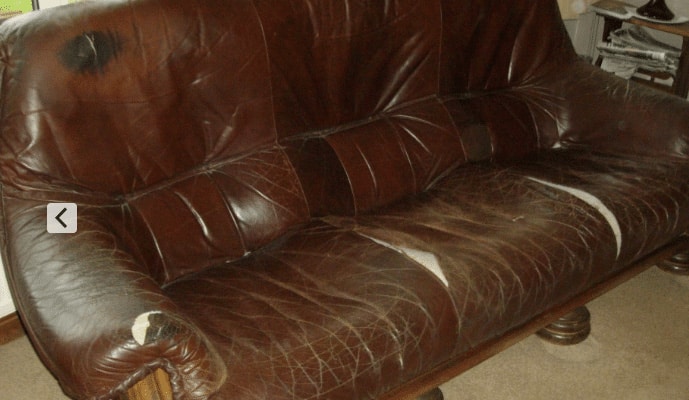
Unlike a scratch, an open seam is under tension. Each time someone sits down, the load that was spread along the whole seam is now carried by the last few intact stitches at each end of the gap. Those stitches pull through, the gap lengthens, and the leather at the ends of the tear starts to distort. A seam that opened by five centimetres in January can be halfway along the cushion by summer.
The foam or fibre inside is also exposed. It catches on clothing, picks up dirt and, on seat cushions, gets crushed at the edge where the cover no longer holds it. Jon has seen many sofas in Chelmsford and Romford where a small seam repair was left for a year and became a full cushion re-cover with new foam.
What not to do while you wait
The usual instinct is to close the gap with something from the drawer. Superglue is the worst option, because it sets the leather rigid and the seam simply tears again along the edge of the glue, with the leather now ruined for stitching. Fabric glue and contact adhesive peel away within days and leave a residue that stops a proper repair bonding. Duct tape pulls the finish off when it is removed. Hand-sewing with a domestic needle and cotton thread rarely holds, and the extra holes weaken the leather further.
With a leather sofa seam coming apart, the most helpful thing you can do is stop using that seat until it is looked at, or at least put a folded blanket over the cushion so the edge is not being caught. Then send a photograph.
Your repair options, from simplest to biggest
Re-stitching the original seam
If the leather is sound and only the thread has failed, the seam can be re-stitched. On loose cushions the cover comes off and the seam goes through an industrial machine with a heavy thread matched to the original. On fixed parts of the sofa, such as the arms and the back, Jon can often re-stitch by hand in place using the original stitch holes, so there is no sign the seam ever failed. Either way, the result is a seam at least as strong as the one that came out of the factory.
Sub-patching and re-stitching a torn seam
Where the leather has torn along the stitch line, re-stitching into the same holes will not hold. The usual approach is to reinforce the leather from behind with a bonded backing that gives the new stitches something solid to hold on to, then re-sew slightly inside the original line. Any filling and colour work needed to hide the old perforations is done afterwards.
Replacing the panel
If the leather at the seam is thin, dry and cracked, or the tear has run out into the panel, the honest answer is a new piece of leather. The old panel is unpicked and used as a pattern, new matching leather is cut and sewn in, and the panel is colour matched to its neighbours. On a good quality sofa this is far cheaper than replacement and is the right call when the rest of the piece is sound.
Re-covering the whole cushion or sofa
Occasionally the seams are failing everywhere at once, usually on an older sofa where the thread has perished throughout or the leather has gone brittle. Chasing each seam as it goes is poor value. At that point we talk about leather sofa reupholstery, either of the affected cushions or the whole piece, with new foam where it is needed. It is a bigger job but it gives the sofa a fresh start.

If the sofa is fairly new
A leather sofa seam coming apart on a piece that is only a year or two old is not normal wear. Furniture sold in the UK has to be of satisfactory quality and last a reasonable time, and a seam failure early in a sofa’s life is often the retailer’s responsibility rather than yours. Citizens Advice explains your rights on faulty goods in plain language. It is worth contacting the retailer before paying for a repair. If they decline, or if the guarantee has expired, we are happy to quote, and in some cases an independent assessment from a specialist helps your case.
What the repair involves in practice
Most seam work on loose cushions is done at our workshop in South Benfleet, because that is where the industrial machines are. Cushions are collected or dropped off, repaired and returned. Fixed seams on arms and backs are usually done in your home, whether that is a terrace in Leigh-on-Sea or a flat in east London. Jon will tell you which applies when he quotes, along with a realistic timescale.
The cost depends on the length of the seam, whether the leather needs reinforcing or replacing, how many seams are involved and whether any colour work is needed afterwards. A straightforward re-stitch on one cushion is a modest job; a panel replacement is more. Every job is quoted individually after we have seen photographs.
Get a quote to repair your sofa seam
Send us two or three clear photographs of the open seam, one close enough to see whether the thread or the leather has failed, and one showing where it sits on the sofa. Add the make if you know it and a rough idea of where you are. Jon will tell you which repair is right and what it is likely to cost. There are more examples of our leather sofa stitching repairs on that page.
Call Jon on 07967 216250 or fill in the enquiry form below this post. We work across Essex, London and the surrounding area, and quotes are free.