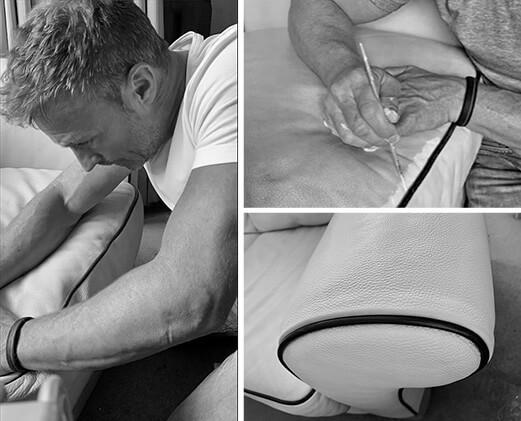
Leather sofa repair cost is the question behind nearly every enquiry we receive, and it deserves a straight answer rather than a sales pitch. The short version is that most leather sofa problems (a cat scratch, a split seam, a cracked seat cushion, a faded arm, a biro mark, a burn) can be repaired for far less than the sofa is worth, and usually for a small fraction of what a comparable new sofa would cost. What you actually pay depends on the type and size of the damage, the leather, and how much colour matching is involved. This post explains those factors so you can judge a quote with confidence.
We are The Leather Expert, a family business based in South Benfleet in Essex, working across Essex and London. Jon, our founder, has 26 years in the trade and more than 220 five-star Google reviews. You can see the full range of what we do on our leather repair and restoration page, and every job we take on is quoted individually.
The Main Factors Behind Leather Sofa Repair Cost
There is no fixed menu of prices because no two sofas arrive in the same state. These are the things Jon looks at when he puts a quote together.
The type of damage
Surface wear and colour loss, where the leather is intact but looks tired, is the simplest category. Cracks need filling and levelling. Cuts, splits and tears need a backing patch bonded behind the leather before filling and colouring. Burns need the melted material cut back. Stains might clean out or might need recolouring over the top. Peeling on real leather can be restored; peeling on bonded leather cannot, and we will tell you that up front rather than charging for a repair that will fail.
The size and number of areas
One scratch on one cushion is a small job. Scratches across the whole seat, both arms and the back is a full recolour. The good news is that the cost does not scale in a straight line, because the set-up, cleaning and colour mixing are shared once we are working on the whole piece.
The leather and the colour
Pigmented leather, which is what most sofas from DFS, Natuzzi, John Lewis and similar are made from, is the most straightforward to repair and recolour. Aniline and semi-aniline leathers, with their natural finish, take more care. Black and dark brown are easy to match; creams, greys, two-tone and antiqued finishes take longer to get right. If the sofa has faded, the repair often has to be blended over a wider area so the fresh colour does not stand out.
Where the work happens
Most repairs are done in your home, which keeps the cost down and means the sofa is back in use the same day. Larger jobs, and anything that needs panels replaced or cushions rebuilt, may be better done at our workshop, which changes the timescale and sometimes the price.
Previous repair attempts
This is the factor people do not expect. If a sofa has been treated with a home repair kit, shoe polish, superglue or a spray dye, that product has to be stripped off before a proper repair will bond. That adds time, and time is the main thing you are paying for.

A Rough Guide by Type of Job
We do not publish prices, because a figure that is right for one sofa is wrong for the next, and we would rather give you an accurate quote for yours. As a rough guide only, this is how the jobs compare with each other.
Small localised repairs, such as a single scratch, a small tear, a cigarette burn or a pen mark on one cushion, are the least expensive thing we do and usually come in well under the cost of a new seat cushion. Repairing and recolouring a whole seat or arm, where the wear is concentrated in one area, sits in the middle. Full recolouring of a three-seater or a suite is a larger job, but it is normally a fraction of the cost of replacing a good quality sofa, and the result is a sofa that looks close to new. Panel replacement and full reupholstery are the biggest jobs and are priced accordingly, but for a well-made frame they are still usually well below the price of an equivalent new piece.
The way to think about it is against the value of the sofa. Spending a modest amount to repair a sofa that would cost thousands to replace is nearly always sensible. Spending the same on a sofa that was cheap to begin with and has a weak frame may not be, and we will say so.

The Jobs We Quote for Most Often
It might help to see the common enquiries and how they tend to go, because leather sofa repair cost is easiest to understand through examples. A tear on the seat cushion from a dog’s claws or a belt buckle, common in homes across Basildon and Southend-on-Sea, is a sub-patch, fill and colour job handled by our leather split and tear repair service, usually done in a single visit. Cracked and worn seat fronts on a family sofa that has done ten years of service are a clean, fill and recolour of the affected panels. A sofa that has faded on one side because it sits in a conservatory in Rayleigh is a full recolour, matched to the original shade on the side that never saw the sun. A cream sofa that has picked up a general grubbiness plus a few marks is a deep clean and, if the marks have gone into the finish, a recolour of the affected area.
Where the whole sofa has aged evenly, leather sofa recolouring is often the better value option compared with patching, because it deals with everything in one go and the finish is uniform.
Why the Cheap Route Usually Costs More
The temptation is to try a repair kit first. Jon has seen the results hundreds of times, and they rarely save money. Kit fillers are either too soft or too rigid for a seat that flexes, and they crack within weeks. The colours are generic and never match. Shoe polish and balms transfer onto clothing. Superglue on a tear goes hard, cracks the leather around it, and turns a small repair into a rebuilt panel. Spray dyes go on unevenly and have to be stripped off entirely.
In every one of those cases, the professional repair afterwards costs more than it would have on the untouched sofa. If you are trying to keep the leather sofa repair cost down, the single most effective thing you can do is leave the damage alone until someone has looked at it.
Insurance, Retailers and Who Else Might Pay
Before you pay for a repair yourself, it is worth checking whether someone else should. Accidental damage cover on home contents insurance sometimes covers things like burns, spills and tears, and some pet insurance policies include damage to furniture. The Association of British Insurers has general guidance on what home policies typically include, and your own policy document will spell out the detail. We can provide a written quote for an insurance claim if you need one.
If the sofa is fairly new and the damage looks like a fault rather than wear (peeling, cracking or colour loss within the first couple of years), the retailer may be responsible, and it is worth raising it with them before spending anything.
When Repair Is Not Worth It
We turn away work that will not last. Bonded leather that is peeling, leather that crumbles when flexed, and frames that have broken are all beyond a surface repair. If cushions have collapsed, the leather will keep creasing however well it is finished, and the honest fix is new foam cushions first. For an inexpensive sofa with widespread damage, replacement is sometimes the better use of the money, and we would rather tell you that than take the job.
Every job is quoted individually, and quotes are free.
Get a Free Leather Sofa Repair Quote
The fastest way to a real figure is a couple of photos: one close up of the damage and one showing the whole sofa, taken in daylight if you can. Tell us the rough size of the damage, whether the sofa is real leather if you know, and where you are, whether that is Chelmsford, Brentwood, Colchester, Romford, Canvey Island or anywhere across east and central London.
Call Jon on 07967 216250 or fill in the enquiry form below this post, and you will get an honest answer and a price with no obligation. There is more about every service we offer on our leather repair and restoration page.