A leather sofa peeling is one of the most upsetting things to find, because it seems to come from nowhere and it gets worse quickly. One week there is a small flake on the seat, a month later there are bare patches on the arms and a dusting of brown crumbs on the carpet. Whether it can be put right depends entirely on what is peeling: the finish on real leather, or the plastic film on a bonded or bicast product. Those are very different problems with very different answers. Our leather restoration service deals with both across Essex and London, and this post will help you work out which you have and what your options are.
Two Very Different Reasons a Leather Sofa Peels
Jon, our founder, gets sent photos of peeling sofas most weeks, and the first thing he looks at is not the peeling itself but what is underneath it.
Real leather with a failing finish
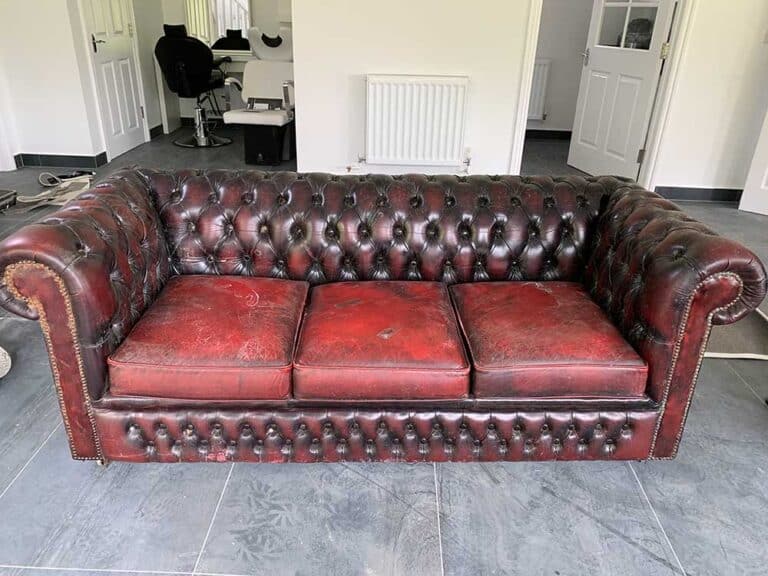
Most sofas are made from pigmented leather: a real hide with a thin coloured coating and a clear lacquer on top. Over the years that coating can break down. Sun through a conservatory roof dries it out, body oils and hair products soften it, harsh cleaners strip it, and constant flexing on the seats cracks it. Once cracked, the coating lifts at the edges and flakes off in small pieces. Underneath you see leather: fibrous, suede-like, usually a lighter shade than the surface. This is repairable, and often very well.
Bonded, bicast or “faux” leather
The other kind of peeling comes from sofas made of bonded leather, bicast leather or PU leather. Bonded leather is leather fibre waste mixed with polyurethane and pressed into a sheet; bicast is a thin split hide with a thick plastic film glued on top. Both are sold as leather, often at attractive prices, and both have a habit of failing within a few years. The plastic layer separates from its backing and peels off in large flakes or sheets, and underneath is a grey or cream fabric-like material rather than leather. This cannot be restored in any meaningful sense, because the surface you would be repairing is gone.
A quick way to tell the difference: real leather peels in small flakes and shows a fibrous, natural-looking surface beneath. Bonded and bicast peel in bigger pieces and reveal something that looks like cloth or card. If you are not sure, a photo of the worst area will usually tell us.
What Makes the Peeling Worse
Whatever is behind a leather sofa peeling, a few things speed it up, and we see them again and again in homes from Basildon to Romford.
Heat is the big one. A sofa pushed up against a radiator or sat under a conservatory roof gets baked, and both leather finishes and plastic films go brittle when they dry out. South-facing bay windows in Leigh-on-Sea and Southend-on-Sea do the same job more slowly. Body heat on the seat cushions and headrest adds to it, which is why the peeling nearly always starts where people sit.
Cleaning products come next. Baby wipes, antibacterial sprays, washing-up liquid and household polish all attack a pigmented finish. Each wipe takes off a little lacquer, and once the lacquer is gone the colour coat has no protection and starts to lift. We have seen sofas that were perfectly good for a decade begin peeling within a year of a new cleaning routine.
Pets and rough use contribute too. Claws, buckles and Velcro catch the edge of a crack and pull, and once a flake lifts, every trouser leg drags a little more off.
Why Leather Paint, Patches and Glue Do Not Solve a Leather Sofa Peeling
Search for a fix and you will be offered leather paint in a pot, self-adhesive repair patches, spray-on “leather restorer” and, inevitably, superglue. We have been called to sofas after all of these.
Painting over peeling leather is like painting over flaking plaster. The new coat sticks to the flakes, not to the sofa, and lifts off with them. The paint is also thick and inflexible, so it cracks at the seat crease the first time anyone sits down. Self-adhesive patches curl at the edges within weeks on a surface that flexes constantly, and they leave a sticky residue that collects grime. Glue soaks into the hide and sets hard, which makes the leather crack further along the glued edge and has to be cut back before any proper work can start.
On bonded and bicast leather these products are simply wasted money, because there is nothing sound beneath them to bond to. On real leather they turn a manageable finish repair into a strip-and-recolour job. Either way, leaving the sofa alone and getting it looked at is the cheaper option.
How We Restore Real Leather That Is Peeling
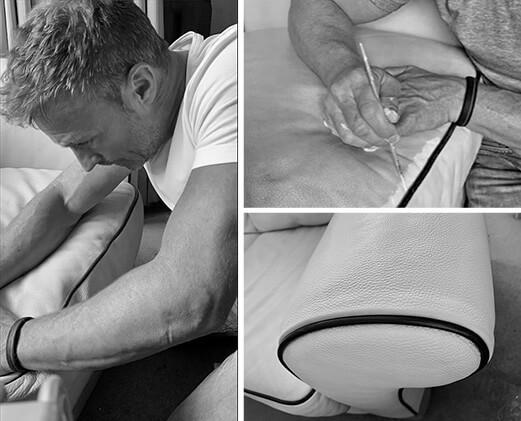
Where the hide underneath is sound, the repair is a restoration of the finish, done in stages, mostly at your home.
We begin by cleaning the whole panel to remove the oils, silicone and residue that caused the breakdown in the first place. Loose finish is carefully removed rather than glued down, so we are working on a stable surface. The exposed leather is then conditioned and smoothed, and any cracks or deeper wear are filled with flexible fillers built up in thin layers, so the surface is level again.
Next comes colour. We mix pigment to match your sofa exactly, checking in daylight, and apply it in fine, flexible coats over the repaired area and out across the panel so there is no visible join. Finally a lacquer topcoat in the correct sheen seals everything and gives the leather back the protection it lost. On a sofa where several panels are peeling, we usually recommend recolouring the whole piece at once so it all ages together; our leather sofa recolouring page shows what that looks like.
Where the leather has cracked right through in one area, a seat cushion top for instance, we may recommend a single new panel in matching hide rather than a repair that will keep opening up. Details are on our replacement leather panels page.
What Can Be Done With a Peeling Bonded Leather Sofa
We would rather be honest than take a job that will not last. If your sofa is bonded or bicast and peeling, there is no product or process that will make the plastic layer stay put. The realistic options are:
- Re-cover the sofa in real leather. If the frame and cushions are good, which they often are on a sofa that is only a few years old, we can strip the failed covering and reupholster in proper hide. It is a bigger job, but you end up with a genuinely leather sofa on a frame you already own. See our leather sofa reupholstery service.
- Replace only the worst panels in real leather. Sometimes the seats have failed and the outsides are fine. New leather seats on a bonded sofa is a compromise, and we will say so, but it can buy several years.
- Go back to the retailer. A sofa sold as leather that has peeled within a few years of normal use may not be of satisfactory quality, and you may be entitled to a repair, replacement or partial refund. Citizens Advice explains your rights on faulty goods clearly, and we can give an independent opinion on the material if that helps your case.
- Replace the sofa. On a cheap sofa with a weak frame, this is sometimes the honest answer, and Jon will tell you if it is.
Is It Worth Restoring a Peeling Real Leather Sofa?
Nearly always. A quality sofa with a failed finish is still a quality sofa. The hide is intact, the frame is sound and the cushions can be re-foamed if they have gone soft. Restoring the finish costs a great deal less than replacing a good suite, it is usually done in your living room over a day or two, and the result is a sofa that looks and feels close to new rather than one that goes to the tip in Thurrock.
The only time we hesitate is when the leather beneath the finish has itself become dry, thin and papery across large areas, which happens on very old or very sun-damaged pieces. Then a new panel or full re-cover may be the better use of money, and we will explain why.

Get a Quote for a Leather Sofa That Is Peeling
If you have a leather sofa peeling and want a straight answer, send us two or three photos: one close up of the worst peeling, showing what is underneath, and one of the whole sofa. Tell us how old it is and where you bought it if you know, and roughly where you are in Essex or London. Jon will tell you whether you have a restoration job, a re-covering job or a conversation with the retailer, and give you a free quote for anything we can do.
Call Jon on 07967 216250 or fill in the enquiry form below this post, and see examples of finished work on our leather restoration service page.