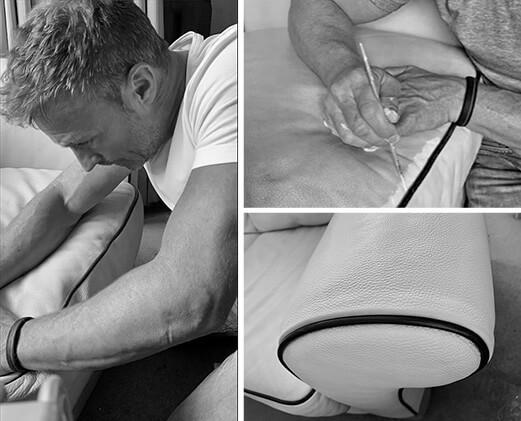
Leather sofa care in winter comes down to one thing above all others: moisture, or rather the lack of it. From October to March the heating goes on, the windows stay shut, and the air inside an Essex living room becomes far drier than at any other time of year. Leather is a natural material that holds a certain amount of moisture and oil, and when the surrounding air pulls that out, the hide stiffens, the finish loses its flexibility and cracks begin to appear. This post explains what winter actually does to leather, what tends to go wrong, and what we can do when the damage has already been done.
What dry winter air does to leather
Leather is skin. It was tanned to stop it decaying, and it was finished to give it colour and protection, but underneath it is still a network of protein fibres held supple by natural oils and a small amount of water. In a comfortable room the leather sits in balance with the air around it. When the air is dry, the leather gives up moisture to it, slowly and continuously, for months.
The first sign is usually a change in feel. Seat cushions that used to give softly become firmer and slightly papery. Then the finish, which is a thin flexible coating over the hide, starts to lose its stretch. Every time someone sits down, the leather creases in the same places, and a finish that has become brittle cracks along those creases rather than flexing with them. By February the front edge of the seat, the tops of the arms and the fold where the back cushion meets the seat are showing fine white lines.
Jon, our founder, sees a clear pattern every year. Enquiries about cracking, peeling and colour loss peak in late winter and early spring, when people notice what the heating season has done. The damage does not appear overnight; it is the result of a few months of dry air on leather that was probably already a little tired.
Radiators, wood burners and where the sofa sits

Position matters more than most people realise, and it is the part of leather sofa care in winter that costs nothing to get right. A sofa with its back against a radiator, or an armchair pulled up beside a wood-burning stove, is being gently baked for six or seven hours every evening. The side facing the heat dries faster than the rest, so the damage is uneven: one arm cracked and faded, the other fine.
We visit a lot of homes in Rayleigh, Billericay and Brentwood where the only sensible place for the sofa is along the wall with the radiator, and we understand that furniture has to go where it fits. Even so, a gap of a foot or so between the leather and the radiator makes a real difference, and keeping a throw over the back panel nearest the heat protects the area that suffers most.
Underfloor heating creates a different problem. The whole sofa sits in a rising column of warm dry air, so the underside of the seat cushions and the lower front panel dry out first. Conservatories are worse still in winter than in summer for some sofas, because a cold night followed by a heater running full blast in the morning takes the leather through a big swing in temperature and humidity every day.
Common winter problems we are asked to fix
Cracking on the seats and arms
This is the classic one. Fine cracks in the finish along the creases, sometimes deepening into the hide itself where the leather has been flexed while dry. On dark sofas the cracks show as pale lines; on light sofas they collect dirt and show as dark lines. Once the finish has cracked, dirt and moisture get into the hide underneath and the damage accelerates.
Peeling and flaking
When a finish has lost its flexibility completely, it stops cracking and starts lifting. Small flakes come away on the seat, particularly on lower quality pigmented leather and on bonded leather. Customers often mistake this for the leather itself peeling, but on genuine leather it is usually the coating, which can be stripped and replaced.
Colour loss and dullness
Dry leather looks dull. The surface loses its soft sheen and the colour looks flatter, and where the finish has worn thin, the paler hide starts to show through. This is very common on the head area and arm tops of sofas near heat sources, and it often gets mistaken for sun fading.
Stiff, noisy cushions
A less obvious sign is sound. A leather sofa that has dried out creaks and crackles when you sit on it, because the finish is no longer moving smoothly with the hide. If your sofa has started to sound different this winter, it is telling you something.
What people do at home, and where it goes wrong
When people think about leather sofa care in winter, the instinct is to put moisture back, and they reach for whatever is in the cupboard. Olive oil, coconut oil, baby oil and even butter turn up regularly. These do soften the leather briefly, but they do not penetrate evenly, they soak into the hide and turn rancid, they attract dirt, and they leave a surface that nothing else will bond to. A sofa that has been oiled at home takes far longer to restore properly, because all of that has to come out first.
Supermarket leather creams and wipes are less harmful but often do very little. Many of them are mostly water and silicone, which gives a temporary shine and then evaporates. On a sofa that has already cracked, no cream will close the cracks; at best it stops them getting worse for a while, and at worst it fills them with residue.
Placing bowls of water on radiators, or running a humidifier, is a reasonable idea for the room as a whole. The Energy Saving Trust has sensible guidance on balancing heating, ventilation and humidity in the home, and a more comfortable indoor humidity is better for people and for wooden furniture as well as leather. It will not repair damage that has already happened, though, and it is easy to overdo it and create condensation problems instead.
Professional leather sofa care in winter and beyond
When a sofa has come through a winter or two with cracks, dull colour or flaking, the answer is a proper leather restoration rather than another tub of cream. Jon starts by assessing the leather type, the finish and how deep the damage goes. Surface cracking in the finish is a very different job from cracks that have opened up in the hide.
The leather is deep cleaned to remove oils, residue and whatever has been applied at home. The hide is then fed with professional conditioning products that penetrate properly and restore flexibility, which is essential before any colour work; putting a new finish on stiff leather just means new cracks. Cracks are filled and smoothed, worn areas are rebuilt, and the colour is matched and reapplied in thin coats so the grain still shows. Finally a flexible protective top coat is applied to seal everything and give the sofa back its correct sheen.
Where the whole sofa has faded and dulled rather than cracked, a full leather sofa recolouring is often the better option, because it brings every panel back to the same shade in one go. Where the damage is limited to grime and dullness with no cracking, a professional leather sofa cleaning and conditioning treatment may be all that is needed, and as leather sofa care in winter goes, having it done before the heating comes on in autumn is the single best thing you can do.

When it is too late for a restoration
Leather that has been dried out for many winters can eventually go beyond saving. If the hide itself has become brittle enough to tear under light pressure, or if cracks have opened right through the leather across a wide area, then feeding and refinishing will not hold. On those pieces we look at replacing the worst panels with new matching leather while restoring the rest, which keeps a good frame in service for a fraction of the price of a new suite.
Bonded leather, which is made from leather fibres glued to a backing, is the other exception. When bonded leather starts flaking in winter it is the whole surface failing, and it cannot be fed back to life. If you are not sure what your sofa is made from, a photo will usually tell us.
Get a quote for your winter-damaged leather sofa
If your sofa has come out of the heating season looking worse than it went in, or you would like advice on leather sofa care in winter before it does, send us two or three photos taken in daylight, including a close-up of the cracking or dull area and one of the whole sofa, and let us know roughly where you are. We cover Essex and London from our base in South Benfleet, and most restorations are carried out in your home.
Call Jon on 07967 216250 or fill in the enquiry form below this post. There is more about the process on our leather restoration page, and every quote is free and without obligation.