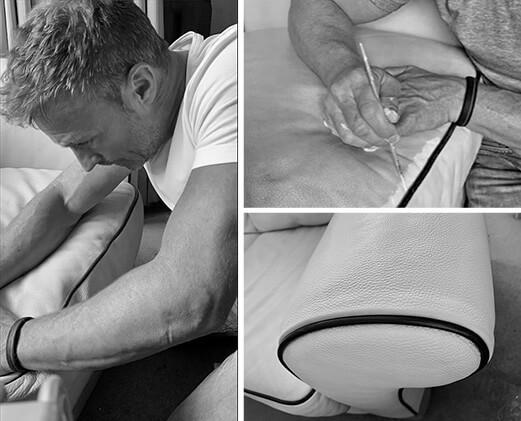
The leather dye vs leather paint question comes up in almost every recolouring enquiry we get, and the confusion is understandable because the words are used loosely, even by people selling the products. Put simply, a dye soaks into the leather and stains the fibres, while a paint (properly called a pigment or a pigmented finish) sits on top of the leather as a coloured film. Which one your sofa needs depends on what type of leather it is and what you want the result to look like. Get it wrong and the colour cracks, rubs off or looks like plastic. Get it right and the sofa can look new for years. We use both in our leather sofa dyeing and recolouring work across Essex and London, and this post explains how we decide.
What leather dye actually does
A leather dye is a translucent colour that penetrates into the fibres of the hide. It does not form a layer. Because it is see-through, the natural grain, the scars, the growth marks and any variation in the original colour all stay visible underneath. That is exactly what you want on an aniline or semi-aniline leather, the soft, natural-looking leathers used by makers like Timothy Oulton, Halo and many of the Italian brands.
The limits of dye follow from that. Because it is translucent, it can only ever make leather darker or shift it in tone. You cannot dye a chocolate brown sofa cream. It also does not hide damage: a scuff, a bleached patch or a filled repair will still show through a dye. And on a leather that has a pigmented, sealed surface, dye simply cannot get in. It sits on the lacquer and wipes off.
Dye finishes are usually protected with a wax or a light top coat rather than a hard lacquer, which keeps that lovely soft hand. We wrote about a Timothy Oulton piece we recoloured this way in our post on wax leather recolouring, if you want to see what the finished look is like.
What leather paint (pigment) actually does
Most sofas sold in the UK, from the big retailers through to Natuzzi and John Lewis own-brand ranges, are pigmented leather. The hide has been coated with a layer of coloured pigment and a clear protective lacquer at the tannery. That is why they wipe clean, resist spills and have such an even colour. When we recolour that kind of leather, we are essentially doing what the tannery did, on site or in the workshop: preparing the surface, applying new flexible pigment and sealing it with a matching lacquer.
Pigment is opaque, so it can take a sofa from one colour to a completely different one, and it hides repairs. That is why a filled cigarette burn or a sub-patched tear disappears on a pigmented sofa. Done properly, with the right products and the right preparation, it is very durable and it flexes with the leather. Done badly, it is the “painted sofa” you have probably seen, with colour flaking off the seat and a stiff, plasticky feel.
The difference between those two results is almost entirely down to preparation and the quality of the pigment and lacquer. In the leather dye vs leather paint debate, the pigment itself is not the problem. The problem is what it is put on and how.

Leather dye vs leather paint: how we decide which to use
The starting point is always the leather itself, not the colour you want. Jon, our founder, tests every piece before recommending anything. A drop of water on a hidden area tells us a lot: if it darkens and soaks in, the leather is absorbent and a dye is on the table. If it beads and sits there, the surface is sealed and we are talking about pigment. A close look at the grain, the edges of cushions and any worn areas tells us the rest.
When dye is the right choice
Aniline and semi-aniline leathers that have faded, gone patchy from sunlight in a conservatory window, or simply lost their depth respond beautifully to a dye. The colour goes back into the fibres and the character of the hide stays. It suits customers who chose that leather because they liked its natural look and do not want it turned into something uniform. Dye is also what we use to restore colour on nubuck and other open-fibre leathers, where a coating would be completely wrong.
When pigment is the right choice
Any pigmented leather that is worn, scuffed, cracked in the finish or the wrong colour needs pigment. So does any leather where you want a genuine colour change, such as a tired cream sofa in Chelmsford going to a deep grey, or a red Chesterfield in Brentwood becoming a traditional oxblood. If there are repairs to hide, it has to be pigment. Where the original was a protected aniline (a natural leather with a thin coat of colour over the top, common on mid-range sofas), we often use a hybrid approach that keeps some translucency while adding enough coverage to even things out.
When neither will work
If the leather has become dry and brittle to the point that it cracks when you fold it, no colour product will fix that. The fibres have gone. That is a replacement panel or a reupholstery conversation, and we would rather say so than sell you a recolour that will split in six months.
Why home dye and paint kits go wrong so often
We get a steady stream of enquiries from people who have already tried a kit without understanding leather dye vs leather paint, and the pattern is always the same. The kit was sold as “leather dye” but was really a thin pigment. It was applied to a sofa that had not been properly cleaned and prepared, so it stuck to the silicone in the old furniture polish, or to the body oils on the arms, rather than to the leather. Within weeks it started rubbing off onto jeans and peeling at the seams.
The other common failure is the reverse: a genuine dye applied to a sealed pigmented leather. It sits on the surface, looks streaky, transfers onto clothing and never dries properly. On a pale sofa this leaves stripes and tide marks that then have to be stripped before any real recolouring can be done, which makes the professional job bigger and more expensive than it would have been.
Colour matching is the third issue. Kits come in a dozen shades. Sofas come in thousands. A near-miss brown on a cushion looks fine in the shop and completely wrong in your living room in daylight. We mix colour to the actual leather, on site, adjusting until it matches under the light the sofa lives in.
Shoe dyes, fabric dyes, acrylic paints and spray cans all fall into the same trap. They were designed for something else. Furniture leather flexes thousands of times a week and is sat on by warm bodies; the colour has to be made for that.
What professional recolouring involves
Whichever side of leather dye vs leather paint your sofa falls on, the process begins with a thorough deep clean to remove years of body oils, polish and dirt. Then the existing finish is prepared: on a pigmented leather that means removing the old lacquer so the new colour can bond, and on an aniline it means opening the fibres so the dye penetrates evenly. Repairs to scuffs, cracks, cat scratches and worn piping are done at this stage.
Colour is then mixed to match a sample from the sofa, or to the new shade you have chosen, and applied in thin, even coats. Pigment is built up gradually and sealed with a flexible lacquer in the right sheen (matt, satin or gloss to suit the original). Dye is worked into the leather and finished with a protective wax or top coat that keeps it soft. Either way the aim is a finish that looks like the sofa came that colour, not one that looks coated.
The result is durable. A properly recoloured pigmented sofa can be wiped down and lived on like a new one. If you want to understand how leather is finished at the tannery in the first place, the Leather Working Group is a good place to read about how hides are made and finished responsibly. Our page on leather sofa recolouring covers the service in more detail.
Does it matter for cost and timing?
A little. A dye job on a soft aniline armchair is often quicker because there is less surface preparation and no lacquer stage, but the colour work is more delicate and there is less room for error. A pigment recolour of a full three-seater with repairs is a longer job and may come into the workshop in South Benfleet so the coats can dry properly between stages. A colour change (light to dark, or dark to light) takes more coats than a like-for-like refresh.
What matters more than dye versus pigment is the size of the piece, the condition of the leather, how many repairs are needed first, and whether you are changing colour or restoring the original. Every job is quoted individually and quotes are free.
Get a Quote to Dye or Recolour Your Leather Sofa
If you are still unsure where your sofa sits on leather dye vs leather paint, do not buy anything yet. Send us two or three photos: the whole sofa in daylight, a close up of the most worn area, and if you can, the label under a cushion. Tell us roughly where you are, whether that is Southend-on-Sea, Basildon, Colchester, Romford or central London, and what colour you are hoping for.
Call Jon on 07967 216250 or fill in the enquiry form below this post. You can read more about our leather sofa dyeing service and our wider leather restoration work on those pages, and Jon will tell you honestly which approach your leather needs.