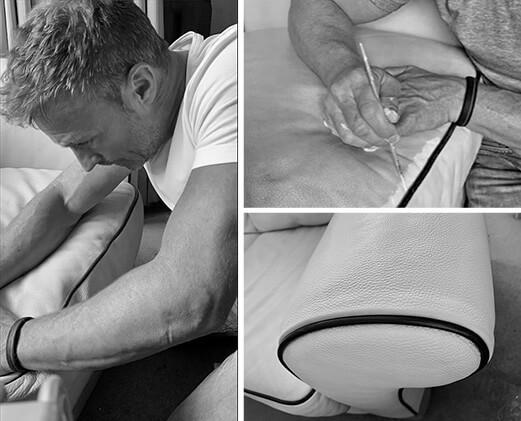
Having leather dining chairs reupholstered is one of the more sensible things you can do with a good set, because the frames on decent dining chairs outlast the seats many times over. Cracked, split or worn leather on the seat pad does not mean the chairs are finished. It means the covering has done its job and needs replacing, or in some cases just restoring. This post explains what reupholstering a dining chair actually involves, when it is the right choice and when a repair or recolour will do, and what affects the cost. It is based on the sets we handle through our leather reupholstery service for customers across Essex and London.
Why dining chair seats wear out faster than sofas
A dining chair seat is a small piece of leather taking a lot of punishment. Every meal means someone sliding on and off it, often in jeans with rivets, belts and keys. Kids kneel on them. Chairs get dragged in and out from under the table, so the back edges scuff on the table rail and the front edges catch on knees. Food and drink land on them. In a kitchen-diner the seats near the cooker get heat and grease as well.
On top of that, many dining chairs are covered in thinner leather than a sofa, stretched tightly over a firm foam pad with no give. Where a sofa cushion flexes and spreads the load, a dining seat takes it on the same few square inches every time. The result is that the leather dries, creases along the front edge, cracks, and eventually splits, usually on the two or three chairs that get used every day while the others at the end of the table still look new.
That uneven wear is a clue in itself. If four chairs are perfect and two are ruined, the frames are fine and the question is simply whether to have the leather dining chairs reupholstered or dealt with another way.
Reupholster, replace the panel or restore?
There are three routes and the right one depends on how far the leather has gone.
Restoration and recolouring
If the leather is intact but faded, scuffed, stained or cracked only in the finish (the colour layer rather than the hide itself), the seat can be cleaned, repaired and recoloured in place. This is far quicker and cheaper than reupholstery and it works well on pigmented leather, which most dining chairs are. It is also the way to bring a mismatched set back together, for example where the two chairs by the window have gone pale in the sun and the rest have not. Our leather recolouring page describes the process.
Replacement leather panel
Where the leather has split through on the seat but the back and frame are fine, the seat pad can often be recovered on its own in matching leather, leaving the rest of the chair untouched. On a drop-in seat this is straightforward. We match the hide as closely as possible and colour blend it so the new seat sits with the old back. Our replacement leather panels service covers this.
Full reupholstery
When the seat and back are both worn, when the foam has gone flat and hard, or when you simply want a different colour and finish across the whole set, full reupholstery is the answer. The old leather comes off entirely, the padding is renewed, and the chair is recovered from scratch. It is the most involved option and it gives you a set that is effectively new on the original frames.

What getting leather dining chairs reupholstered actually involves
People are often surprised by how much goes into a small chair. Here is the shape of the job, without turning it into an instruction sheet.
The chairs are assessed first. We check the frames for loose joints and wobbles, because there is no point putting new leather on a chair that is about to fail at the leg. Drop-in seats are removed; fixed seats and upholstered backs are stripped in situ. The old leather, staples and tacks come off, and the foam underneath is inspected. On most sets over ten years old the foam has compressed and hardened and it is replaced with a new seating-grade pad cut to the seat shape, with a fibre or wadding layer over it so the leather sits smoothly rather than showing every edge of the foam.
Then the new leather. We use a full hide of the right weight for seating, chosen to match your existing chairs if only some are being done, or to a new colour and grain if the whole set is being recovered. The leather is cut to pattern, stretched and fixed so that the corners are pleated neatly and the tension is even, which is the part that separates a good reupholstery job from a lumpy one. Backs with piping, studs or stitched detail are reproduced to match the original. Finally the underside is closed off with a dust cloth and the chairs are reassembled.
New upholstery in the UK has to meet furniture fire safety regulations, which cover the foam and the interliner as well as the cover. We use compliant materials as a matter of course. GOV.UK carries the current rules if you want to read them.
Why home reupholstery kits and quick fixes rarely work on dining chairs
Getting leather dining chairs reupholstered looks like an easy first project, and there are plenty of videos suggesting a staple gun and some off-cut leather will do it. Jon, our founder, has recovered a lot of chairs that started that way.
The usual problems are the leather and the tension. Craft leather and thin upholstery vinyl sold by the metre are not the same as furniture hide, and they split at the corners or go shiny within a few months. Leather that is not stretched evenly puckers, and once it is stapled there is no adjusting it. Foam bought online is often the wrong density, so the seat is either rock hard or collapses. And the corners, which on a proper job are folded so the pleats disappear under the seat, end up as bunched lumps that show from the front.
The other route people take is to patch a split with a repair kit or tape. On a dining seat that is sat on twenty times a day, a filler and pigment patch over a through-split has a very short life. It cracks along the same line, usually within weeks, and the filler then has to be removed before the seat can be properly recovered.
None of this is to say people cannot do it. It is to say that a good set of dining chairs, the kind that came with a solid oak or walnut table in Chelmsford or Brentwood, deserves better than a first attempt, and that fixing a bad reupholstery job costs more than doing it once.
Choosing the leather
If the whole set is being recovered, you get a free choice. Most customers stay with a pigmented leather in a similar tone because it is the most practical for a dining room: it wipes clean, it resists spills and it takes recolouring later if it ever needs it. Some choose a contrast, such as a dark grey or a deep green to lift a pale table. A few go for a softer aniline or a distressed finish for a more relaxed look, and that is fine as long as you know it will mark more easily.
If only some chairs are being done, matching is the priority. We match to a cutting from one of the existing chairs, taking the colour, the grain and the sheen into account, and colour blend the new leather so that it sits with the old rather than looking like the newest chair in the room. It is also worth thinking about carvers and bar stools at the same time, because doing everything together keeps the set consistent.
What affects the cost and how long it takes
The number of leather dining chairs reupholstered is the obvious one, but a set of six is not simply six times the price of one, because the pattern, the hide and the set-up are shared. Beyond that, the price depends on whether it is seats only or seats and backs, whether the seats are drop-in or fixed, how much detailing there is (piping, studs, buttoning, shaped backs), the leather you choose, and whether the foam needs replacing. A pair of simple drop-in seats from Leigh-on-Sea is a small job. Eight fully upholstered chairs with deep-buttoned backs for a house in Romford is a proper project.
Recolouring or a single replacement seat panel can often be done at your home. Full reupholstery is workshop work in South Benfleet, and we can usually take the chairs in batches so you are never without somewhere to sit. Every job is quoted individually, and quotes are free.
Get a Quote to Reupholster Your Leather Dining Chairs
If you would like your leather dining chairs reupholstered, or simply want to know whether they need it, send us a photo of the full set around the table, a close up of the worst seat, and a photo of the underside of one chair so we can see how the seat is fixed. Tell us how many chairs you want done, whether you are thinking of a colour change, and roughly where you are, whether that is Southend-on-Sea, Basildon, Colchester, Billericay or across London.
Call Jon on 07967 216250 or fill in the enquiry form below this post. You can read more on our leather reupholstery page, and Jon will come back to you with an honest recommendation on whether your chairs need reupholstering, a new seat panel or simply restoring.