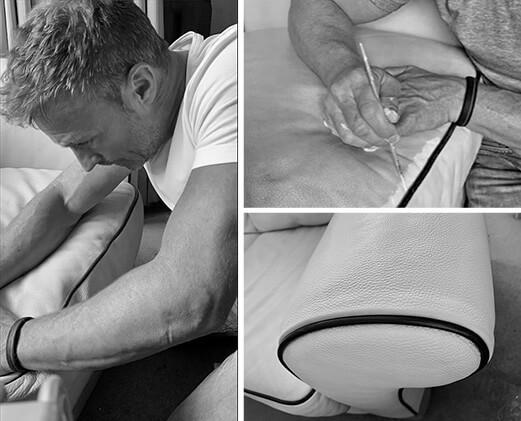
Leather car seat repair cost is one of the first things people ask us about, usually after a garage or a main dealer has quoted them for a complete new seat cover and they have nearly dropped the phone. The honest answer is that most leather seat damage we see (worn driver’s bolsters, cracking on the seat base, a small tear from a bag buckle, a cigarette burn) can be repaired for a great deal less than replacement. The price depends on the type of damage, the leather, and how much colour work is involved. This post walks through what drives the cost so you know what you are looking at before you ask for a quote.
We are The Leather Expert, based in South Benfleet in Essex. Jon, our founder, has been repairing leather for 26 years and has worked on everything from commuter hatchbacks in Basildon to chauffeur cars in central London. Our leather car seat repair service covers wear, cracks, tears, burns, fading and colour loss on all makes and models.
What Damages Leather Car Seats in the First Place
Car seats have a harder life than any sofa. The driver’s seat in particular takes the same movement thousands of times a year: you slide in over the outer bolster, twist, sit, and then slide back out over the same bolster. On a car doing the A127 or the A13 twice a day, that adds up quickly. The pigment on the bolster wears through, the leather underneath goes pale and rough, and eventually it cracks and splits.
Sun is the other big one. A car parked on a driveway in Rayleigh or a station car park in Leigh-on-Sea sits in full sun through the summer with the windows shut, and the cabin gets extremely hot. That dries the leather out, fades the colour, and makes the surface brittle. Add in jeans rivets, keys in back pockets, child seats with rough bases, dogs in the back, and the occasional coffee spill, and it is not surprising that most cars over five or six years old show some wear.
Not every car has real leather, either. A lot of modern cars use a mix, with real hide on the seat faces and a vinyl or coated fabric on the sides and backs. Some use fully synthetic material that is marketed under a brand name. The material matters for the leather car seat repair cost, because synthetic surfaces behave differently and sometimes cannot be repaired invisibly.

The Factors That Decide Leather Car Seat Repair Cost
We do not have a price list, because two cars with what looks like the same problem can need very different amounts of work. These are the things Jon weighs up when he quotes.
The type and size of the damage
Surface wear on a bolster, where the colour has rubbed off but the leather is still sound, is the simplest job. A crack or split needs the edges stabilised, filled and levelled before any colour goes on. A tear that goes right through needs a backing patch bonded behind it. A burn hole needs the melted material cut back and rebuilt. Each of those steps adds time, and time is most of what you are paying for.
The colour
Black is the most forgiving colour to match. Greys, creams, tans and the two-tone interiors on some premium models take more skill. Jon mixes colour by eye against the seat itself, and if the whole seat has faded, he may need to blend the repair across a larger area so the fresh colour does not stand out against the old. A repair to the driver’s bolster on a black BMW is a very different job from matching a faded oyster leather on a ten-year-old Jaguar.
How many seats and panels are affected
Most enquiries are for the driver’s seat only. If the passenger seat, the rear bench and the door cards all need attention, the job grows, but the cost per panel usually comes down because the set-up, colour mixing and sealing are shared across the work.
Where the work is done
A lot of car seat work can be done in situ at your home or workplace, provided there is somewhere dry to work with the doors open. Larger jobs, or seats that need the cover partly removed, are better done with the seat out. That involves more time and sometimes a trip to us, which affects the quote.
Whether the leather is real
Real hide takes colour and filler well and can usually be repaired so that you would struggle to find the spot afterwards. Some synthetic and bonded materials peel rather than wear, and once they start peeling there is no repair that lasts. In those cases we will tell you honestly that a replacement cover or a trimmer is the better route.
A Rough Guide to What People Pay
We would rather give you a real figure for your car than a vague one for somebody else’s, so treat this as a rough guide only. Small, localised repairs (a worn bolster, a single crack, a small tear or burn on one seat) usually come in well under what a dealer or trimmer would charge for a new seat cover, and often at a fraction of it. Restoring colour across a full front seat is a bigger job than a single bolster but is still normally far cheaper than re-trimming. A full interior refresh across all seats is the largest job we do on a car, and it is still typically a fraction of what a complete re-trim in new hide costs.
If your car is a lease or a PCP that is going back, the maths usually favours repair even more strongly. End-of-contract inspections tend to charge for damage at replacement rates, and a professional repair beforehand often costs less than the penalty. Every job is quoted individually, and quotes are free.
Why Cheap Kits and Home Fixes Usually Cost More in the End
We see a lot of cars where the owner has had a go first. The common ones are a leather repair kit from the internet, shoe polish, a colour balm from a supermarket, or a tube of superglue on a tear. Almost all of them make the job harder.
Kit fillers are usually too soft or too hard for a seat that flexes every time you get in. They crack within weeks, and the colour in the kit is a generic shade that rarely matches. Shoe polish and balms sit on top of the surface, transfer onto clothing, and have to be completely stripped off before a proper repair will bond. Superglue goes rigid, cracks the leather around it and leaves a hard lump that has to be cut out, so a tear that would have been a small repair becomes a panel that needs rebuilding.
Jon has seen this hundreds of times. It is not that people are careless; the kits are simply sold with promises that do not survive contact with a real car seat. The frustrating part is that stripping a failed home repair adds time to the professional job, so the leather car seat repair cost ends up higher than it would have been on the untouched seat.
What a Professional Car Seat Repair Involves
Every job starts with an assessment. Jon checks what the material actually is, how deep the damage goes, and whether the foam underneath has collapsed (a common problem on worn driver’s seats, and one that no amount of surface work will fix). He then cleans the area thoroughly to remove silicone dressings, body oils and any previous products.
For cracks and worn areas, the surface is prepared and a flexible filler is built up in thin layers until it is level. For tears, a backing is bonded behind the leather first so the repair has something to hold onto. For burns, the damaged material is cut back to sound leather before rebuilding. Then the colour is mixed to match, applied in layers, and sealed with a lacquer chosen to match the original sheen and to stand up to the abrasion a car seat gets. On faded interiors we treat the whole panel so the finish is even, which is the same approach we take on sun bleached and faded leather in the home.
The result should be a seat that looks and feels right, flexes without cracking, and does not mark your clothes. The same skills apply to full leather restoration on furniture, and Jon uses the same professional products across both.
When Repair Is Not the Right Answer
We will always tell you if a repair is not worth doing. Seats where the leather has become so dry and brittle that it crumbles when flexed are past the point of a durable repair. Peeling synthetic material is the same. If the foam has collapsed badly, the cover will keep creasing and cracking however well it is finished, and the honest fix is new foam or a new cover. On older cars where the value is low and the damage is widespread, we may suggest a partial job on the driver’s seat only rather than a full interior.
You do have some options if the leather has failed early on a car that is still fairly new. If the wear seems unreasonable for the age and mileage, it is worth reading the general consumer advice on faulty goods at Citizens Advice before you spend anything, because there may be a case for the dealer to put it right.
Get a Free Quote for Your Leather Car Seat Repair
To give you an accurate leather car seat repair cost, we need to see the damage. Take two or three clear photos in daylight with the door open (one close up, one showing the whole seat), tell us the make, model and year, and let us know roughly where you are, whether that is Southend-on-Sea, Chelmsford, Romford or east London. If you know whether the seats are real leather, mention it, but do not worry if you are not sure.
Call Jon directly on 07967 216250 or fill in the enquiry form below this post, and we will come back to you with a straight answer and a price. You can read more about what we do on our leather car seat repair page.