Is it worth repairing a leather sofa, or should you cut your losses and buy new? In our experience, for any sofa that was well made to begin with, repair wins comfortably: it costs a fraction of replacement, it keeps a piece you chose and are used to, and a properly restored leather sofa will go on for many more years. The cases where it is not worth it are real but fairly specific, and we will walk you through them honestly. Our leather repair and restoration service across Essex and London starts every job with exactly this conversation.
Here are the seven things Jon, our founder, weighs up when a customer sends photos and asks whether their sofa is worth saving.
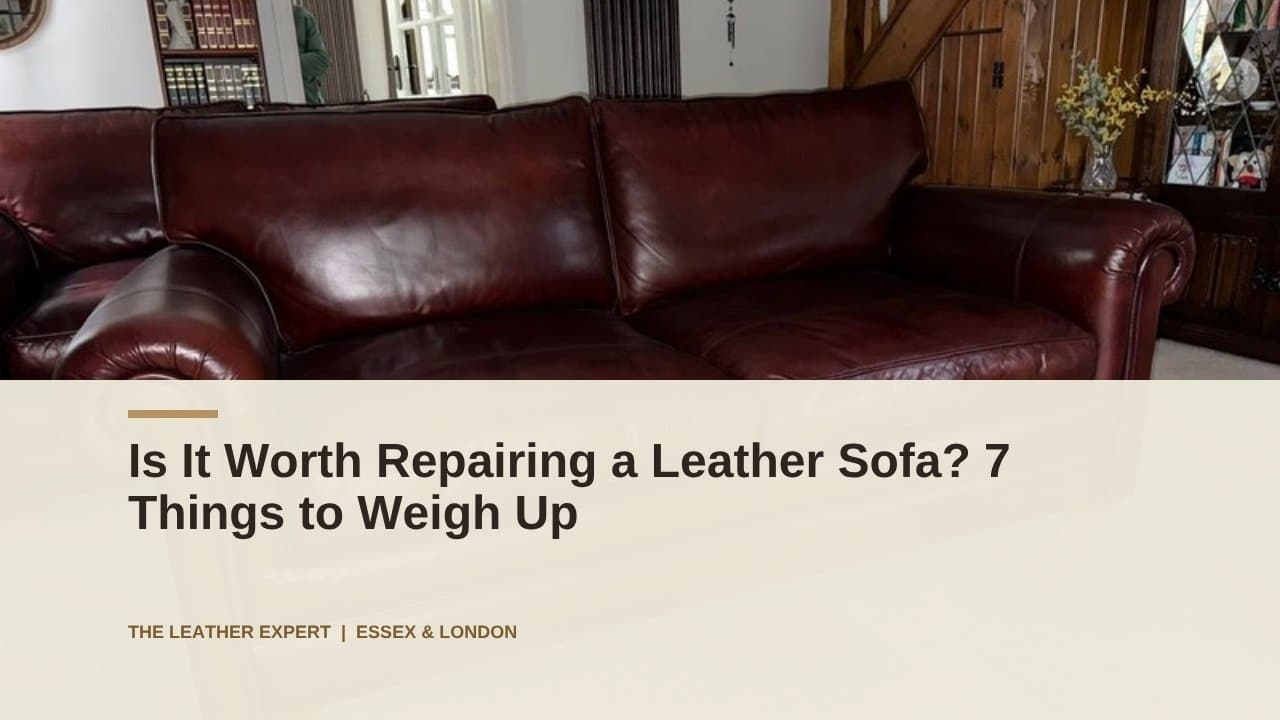
Is It Worth Repairing a Leather Sofa? 7 Things to Weigh Up
1. What the sofa is made of
This is the first and most important question. A frame of hardwood or good-quality engineered board, sprung or webbed properly, covered in real leather, is a sofa that can be repaired again and again. Many of the pieces we work on from John Lewis, Natuzzi, Duresta, Ekornes and the better Chesterfield makers are twenty or thirty years old and still fundamentally sound.
The opposite end of the market is different. Bonded leather (leather fibres bonded to a backing with a plastic surface) peels rather than wears, and there is no sound material underneath to repair. Faux leather and PU coverings on cheap frames go the same way. If the surface is coming off in sheets and the sofa is a few years old, honesty says replacement is usually the better answer.
2. What kind of damage it is
Most leather damage is in the finish, not the hide. Scuffs, scratches, colour loss on arms and cushion fronts, cat scratches, fading, darkening from body oils, small tears and burns, split seams: all of these are routine repairs. Even deep cracking across seats can usually be filled, recoloured and sealed. Where a panel is torn beyond saving it can be replaced with matching leather.
Damage that goes to the structure is a bigger job. A broken frame, collapsed springs or rotten webbing can all be fixed, but they add cost, and on a lower-quality sofa they can tip the balance towards replacement.

3. How much of the sofa is affected
A single scuffed arm on an otherwise good sofa is a small localised repair, done in a couple of hours at your home. A sofa where every seat is cracked, every arm is faded and the seams are going is a full restoration, which is a day or two of work. Both are usually worth doing, but the second needs the sofa to be worth investing in, because the bill is naturally higher.
4. What it would cost to replace
Be realistic about like-for-like. A three-seater leather sofa of the quality you already own may well be considerably more today than you paid for it. Replacing a large corner suite or a matching three-piece with something equivalent runs into serious money, plus delivery lead times of weeks and the cost or hassle of getting rid of the old one. It is worth pricing up a genuine equivalent before deciding a repair is expensive.
5. Whether you actually like it
This sounds obvious, but it matters. If you chose the sofa, it fits the room and the family is comfortable on it, that is worth a great deal. A restored sofa comes back looking like it did when it was delivered. A new one is a gamble on comfort, size and colour, and many customers in Chelmsford and Brentwood have told us they only called because the replacement they were looking at was not as good as the one they had.
6. Whether anyone has had a go at it already
A sofa that has been rubbed with olive oil, patched with a repair kit or coloured with shoe polish is still nearly always repairable, but it costs more, because the previous attempt has to be removed before the real work starts. If you are weighing up repair, the best thing you can do is leave the damage alone until we have seen it.
7. What the sofa means to you
Some pieces are simply not replaceable. A Chesterfield that has been in the family for generations, a designer piece that is no longer made, a sofa bought as a couple’s first big purchase. For these the question is rarely about money at all, and restoration is nearly always worth it.
Roughly What Leather Sofa Repair Costs
We do not quote fixed prices because no two sofas are the same, but a rough guide helps. The main things that affect the cost are the size of the damaged area, the type of leather, how much colour matching is involved, the number of panels or seats affected, whether the work can be done in your home or needs to come to our workshop in South Benfleet, and how easy the sofa is to get at.
As a broad picture: small localised repairs (a scuff, a scratch, a split seam, a single cat-damaged corner) often come in well under the cost of a single new seat cushion. Restoring the head, arm and seat areas of a whole sofa is a larger job but still a fraction of buying an equivalent sofa new. Full recolouring or reupholstery is the biggest spend, and even then it is normally a fraction of replacing a good-quality piece like for like.
Every job is quoted individually, and quotes are free. If the honest answer is that a repair would cost more than the sofa is worth, we will say so.
Why the Cheap Fixes Do Not Change the Maths
The reason people ask whether repair is worth it is often that they have already tried a cheap fix and it has failed. A repair kit at a few pounds looks like a bargain against a professional bill, but the colour rarely matches, the filler goes hard and shiny, and within weeks the patch is more visible than the damage was. Oils darken the leather and stop dyes bonding. Baby wipes and household cleaners strip the finish a little more each time.
None of these save money. They delay the real repair, make it bigger, and in the worst cases turn a repairable sofa into one that needs a new panel. Jon has seen this hundreds of times across Essex and it is why we always say: photos first, products never.
What a Professional Repair Gives You
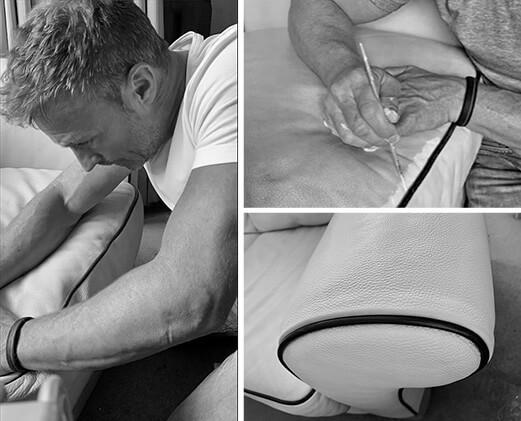
A proper repair starts with an assessment of the leather and the frame. The sofa is deep cleaned, damage is stabilised and filled, colour is mixed and matched in your room under your own lighting, and the finish is sealed with a flexible top coat so it moves with the leather. Full leather restoration brings a tired sofa back completely, and where the covers are beyond saving but the frame is good, leather sofa reupholstery in new hides gives you what is effectively a new sofa on a frame you already know is solid.
Most work is done at your home in a single visit, so you are not without a sofa. The result, if it is done well, is a piece that looks and feels like it did when it arrived.

When We Will Tell You Not to Bother
We would rather lose a job than do one that will not last. We will usually advise against repair when the sofa is bonded or faux leather that is peeling, when the frame is broken or flimsy and not worth the cost of fixing, or when the damage is so extensive on a low-value sofa that the repair bill would be close to a decent replacement. If the sofa is fairly new and the damage looks like a manufacturing fault rather than wear, it may be a matter for the retailer instead, and the Furniture and Home Improvement Ombudsman is a good place to look if the retailer is not helpful.
Get a Free Quote Before You Decide
The quickest way to find out is it worth repairing a leather sofa in your case is to send us two or three photos of the damage in daylight, one close up and one showing the whole sofa, with a rough idea of where you are. We cover Essex and east and central London, from Southend-on-Sea, Rayleigh and Basildon up to Colchester and across to Romford and the City. Jon will give you a straight answer, and if that answer is “buy new”, you will hear it from us.
Call Jon on 07967 216250 or fill in the enquiry form below this post. There is more about what we can do on our leather repair and restoration page, and every quote is free and without obligation.