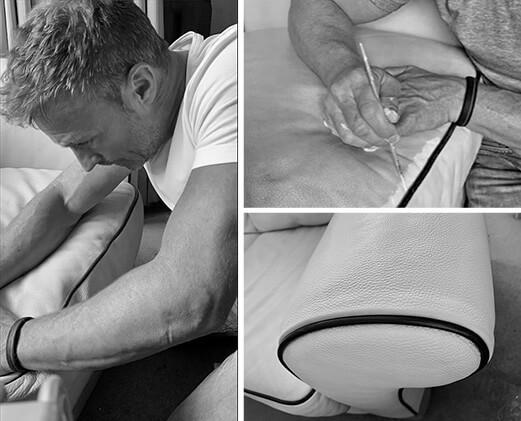
If you are wondering how to restore a leather sofa that has gone shabby, the honest answer is that it is a craft job rather than a weekend project, but it is a craft job that transforms furniture. A sofa that looks finished, with pale scuffed arms, cracked seats and a colour that has drifted three shades from where it started, can come back to something close to showroom condition in a day or two. Jon, our founder, has been doing exactly this for 26 years across Essex and London through our leather restoration service. This post walks through what restoration actually means for each part of the sofa, so you know what to expect and what to ask for.
What Restoration Means and What It Does Not
Restoration is not cleaning, and it is not just painting. It is the process of taking a worn sofa back to sound, supple, evenly coloured leather with a properly sealed finish. Depending on the sofa it can include deep cleaning, degreasing, repairing cracks and tears, replacing worn foam, recolouring panels or the whole piece, and re-lacquering so the colour stays put and the leather is protected again.
What it does not do is turn one type of leather into another or undo years of neglect in an afternoon with a product from a bottle. That distinction matters, because most of the disappointment we hear about comes from people who bought a “restoration kit” expecting the first thing and getting the second.

How to Restore a Leather Sofa: Part by Part
A sofa does not wear evenly. The arms, the seats, the headrest and the outsides each have their own problems and need their own treatment, which is why a one-product approach never works. Here is how we look at each area.
The arms
Arms take forearms, hands, mugs, laptops and, in a lot of homes around Rayleigh and Leigh-on-Sea, a cat. The tops go pale and shiny where the finish has been rubbed through, the fronts get scuffed by the vacuum cleaner, and the leather at the front edge often cracks. Restoring an arm means cleaning right into the grain, removing the failed finish, repairing scuffs and cracks with flexible filler, then recolouring and sealing so it matches the rest of the sofa. Where an arm has been scratched to ribbons by claws, we may fill and recolour or, in bad cases, fit a new leather panel.
The seats
Seat cushions carry the whole weight of the household. The leather flexes constantly and dries out from body heat, so the top surface cracks and the colour wears away in the sitting area. Underneath, the foam collapses so the cushion loses its shape and the leather creases more deeply, which makes the cracking worse. Proper seat restoration deals with both: the leather is cleaned, cracks are filled and the surface is recoloured and sealed, and where the foam has gone we replace it with new foam cut to the original cover. Any new filling we fit is compliant with the UK furniture fire safety regulations set out on GOV.UK, which matters both for safety and for anyone letting a property.
The head area and back
The top of the back, where heads rest, is the most abused part of many sofas and the one people notice least until it is dark and sticky. Hair products and skin oils soak through the finish into the hide, turning it a shiny black-brown and softening the colour coat until it lifts. This needs proper degreasing before any colour can be applied, otherwise the oils come straight back through. We treat this as a specific job through our head area restoration service, and it is often the single biggest improvement on an older sofa.
The colour
After ten years by a window in Southend-on-Sea, no sofa is the colour it left the factory. The sun-facing side fades, the sitting areas wear through, and the outsides, which never see sun or bottoms, stay dark. Restoring colour means recolouring the whole sofa to one consistent shade, matched by eye to the original where you want it, or to a new colour if you fancy a change. Each panel is prepared, recoloured in thin flexible coats and sealed. Our leather sofa recolouring page shows the difference this makes, and our earlier post on reviving sun-faded leather sofas follows one job from start to finish.
Why Restoration Kits and Home Remedies Disappoint
We are not against people looking after their furniture. We are against products that promise restoration and deliver a mess, and we see the results every week.
Kits bundle a cleaner, a colour and sometimes a sealant, and the colour is chosen from a chart rather than matched to your sofa. Even a close chart colour looks wrong next to leather that has aged, so the arms end up a different shade from the seats. The kits also skip the hard part: proper degreasing of head areas and arms, removal of failed finish and repair of cracks before any colour goes on. Colour applied over grease or over loose finish lifts within weeks, usually onto someone’s trousers.
Home remedies are worse. Olive oil and Vaseline go rancid and attract dirt. Shoe polish never dries on upholstery and transfers to clothing. Baby wipes and washing-up liquid strip the lacquer, and hairspray and nail varnish remover take the colour off with it. Each of these turns a sofa that needed a clean and a light recolour into one that needs stripping and rebuilding.
If your sofa has already had a kit or a remedy applied, do not panic; nearly everything can be rescued. But please mention it when you send photos, because it changes how Jon plans the job.
What a Professional Restoration Visit Looks Like
Most full restorations happen in your living room in Essex or London and take one to two days depending on the size of the suite and how much repair is needed. Jon starts by assessing the leather type and testing the finish in an unseen spot, then works through the sofa in order: deep clean and degrease, repairs to cracks, tears and scratches, foam replacement if needed, colour matching in daylight, recolouring, and finally the lacquer topcoat in a matt, satin or gloss sheen to suit the original.
You get to see the colour on a test area before the whole sofa is done, and you get to see the finished result in daylight before Jon leaves. The sofa is usually back in use the next day. Larger structural jobs, reupholstery or panel replacement come into the workshop instead.
Is Every Sofa Worth Restoring?
Most are. If you are asking how to restore a leather sofa that was good quality to begin with, the answer is that it is worth doing more than once over its life. A quality frame with real, decent leather and good cushions is worth restoring several times over its life, and each restoration gives it years more. We restore sofas from the big retailers, from Italian makers, hand-built Chesterfields and inherited pieces from the 1970s, and the results speak for themselves; have a look at our gallery for a sense of what is possible.
The exceptions are bonded and bicast leather that is peeling, which cannot be restored because the surface is a failed plastic film rather than a finish on hide, and sofas where the frame has broken. In both cases Jon will tell you plainly, and if there is a sensible alternative such as re-covering in real leather, he will explain it.

Get a Free Quote to Restore Your Leather Sofa
If you have been searching for how to restore a leather sofa and would rather have it done properly, send us a few photos in daylight: the arms, the seats, the back and a shot of the whole sofa. Tell us roughly where you are, whether that is Chelmsford, Colchester, Romford or central London, and Jon will tell you what the restoration would involve, how long it would take and what it would cost. Quotes are free and there is no obligation.
Call Jon on 07967 216250 or fill in the enquiry form below this post, and read more about our leather restoration service to see how we bring tired sofas back.