If you are searching for how to repair leather peeling, the first thing to establish is whether your sofa is real leather or bonded leather, because the answer is completely different for each. Real leather does not peel in the true sense; its surface finish can crack and flake, and that is very repairable. Bonded leather peels because the thin plastic top layer is separating from the fibre backing underneath, and once that starts, no repair holds for long. This post explains how to tell which one you have, what a professional can do about it, and why the products sold online for peeling leather almost always disappoint.
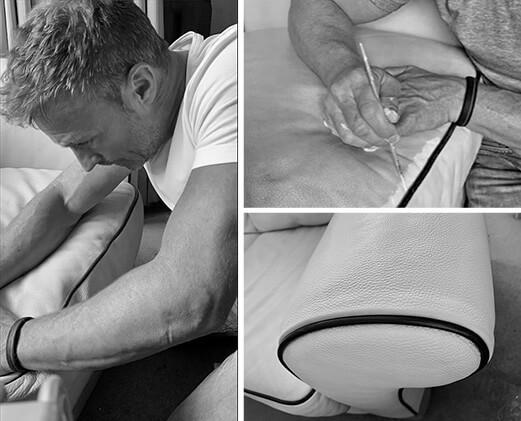
We are The Leather Expert, based in South Benfleet and working across Essex and London. Jon, our founder, has been restoring leather furniture for 26 years, and peeling sofas are one of the most common enquiries we get. Our leather restoration service covers flaking, cracking and colour loss on real leather, and we are honest about the cases where the material simply cannot be saved.
Real Leather or Bonded Leather? How to Tell
Bonded leather arrived in a big way in the 2000s as a cheap way to sell sofas that looked like leather at a fraction of the price. It is made by grinding leather offcuts into fibres, gluing them to a fabric backing, and covering the whole thing with a thin polyurethane skin that is embossed to look like grain. It feels smooth and slightly plasticky, it is very uniform, and it is often marked “bonded leather”, “leather match” or “bycast” on the label under the cushion.
Real leather, by contrast, is a whole hide with a pigmented finish on top. It has natural variation, it warms to the touch, and even the smoothest corrected-grain leather has some irregularity when you look closely. When it fails, the top finish cracks into a network of fine lines and eventually flakes, but the hide underneath is still a solid piece of material.
The tell-tale sign of bonded leather is the way it peels. The top layer lifts in sheets or curls, and underneath is a fuzzy, fabric-like surface, often a different colour. On real leather, the flakes are tiny and the surface underneath is still leather, usually a paler shade of the same colour. If you send us a photo we can normally tell you within a minute which one you have.

How to Repair Leather Peeling on Real Leather
When the finish on real leather cracks and flakes, it is usually because the leather underneath has dried out. Radiators, conservatories, big south-facing windows in Leigh-on-Sea and Southend-on-Sea, and years of the wrong cleaning products all strip the moisture and oils from the hide. The finish is designed to flex with the leather, and once the leather stiffens, the finish cannot keep up. Arms, seat fronts and the head area of recliners go first because that is where the most flexing and the most skin contact happens.
A professional repair starts with a proper clean to remove the loose finish, old conditioners, silicone sprays and body oils. Jon then assesses whether the hide itself is sound. If it is, the flaking areas are stabilised and any cracks are filled and levelled with a flexible compound. The colour is mixed to match the rest of the sofa, applied in layers to the repaired areas and blended out, and the whole panel is sealed with a matching top coat so that the finish, sheen and feel are consistent. On a sofa where the wear is widespread, we often recolour the whole piece rather than patching, which gives a uniform result that lasts.
Done properly, that turns a flaking, tired sofa into one that looks close to new, and because the leather underneath is still good, the repair has something solid to bond to. This is precisely the sort of job our restoration service is designed for, and you can see plenty of examples in our gallery.

Why Bonded Leather Cannot Really Be Repaired
This is the part nobody selling a peeling leather kit wants to tell you. On bonded leather, the problem is not a damaged surface on a sound material; it is a plastic skin that has lost its grip on a fibre board. Any filler or paint applied to it is being applied to a layer that is already letting go. It may look fine for a few weeks, and then the next section lifts, taking the repair with it.
Jon has seen this hundreds of times: a sofa that has been through two or three repair attempts, each covering a larger area, with the peeling still spreading. We could take your money to paint over it, but we would rather tell you the truth. If you are asking how to repair leather peeling on a bonded sofa, the honest answer is that you replace the affected leather rather than repair it. Where the frame and cushions are good, the realistic options are to have the affected panels replaced with real leather, or to have the whole piece reupholstered. Our replacement leather panels service handles the first, and leather sofa reupholstery the second. If the frame is cheap and the sofa was inexpensive to begin with, replacement is usually the sensible answer, and we will say so.
It is also worth knowing your rights. Bonded leather sofas that peel within a couple of years are a recurring complaint, and if yours is fairly new you may have a claim against the retailer. The guidance on faulty goods from Which? is a good place to start before you spend money on repairs.
What People Try at Home and Why It Goes Wrong
The internet is full of products promising to fix peeling leather in an afternoon: spray-on leather paint, “leather and vinyl” filler kits, colour balms, and various oils and conditioners. We see the results, and they are rarely good.
Paint and spray products sit on top of a surface that is still flaking, so they flake too, only now the flakes are two colours. Filler kits come with a rigid compound that cracks the first time someone sits down, and a generic colour that never matches. Olive oil, coconut oil and baby oil darken the leather in patches and go rancid over time, and they have to be fully drawn out before any proper colour will bond. Nail varnish remover and other solvents dissolve the finish further and spread the damage. On bonded leather all of these are a waste of money; on real leather they turn a straightforward restoration into a strip-and-start-again job, which costs more.
The kindest thing we can say is that if the sofa is peeling, stop putting things on it and get it looked at. A flaking real leather sofa that has been left alone is a much easier job than one that has been through three different kits.
How Long Does a Peeling Leather Repair Take?
For a real leather sofa with flaking on the arms and seat fronts, the work can normally be done at your home in a day, with the sofa usable that evening. A full recolour of a three-piece suite is a longer job and sometimes better done over two visits, or at our workshop. Panel replacement on a bonded sofa takes longer because the new leather has to be cut, matched and fitted, and the timescale depends on how many panels are involved. We will give you a realistic timeframe with the quote rather than a promise we cannot keep.
Sofas That Are Worth Saving
The question is always whether the sofa underneath is good enough to justify the work. A solid hardwood frame, sprung seats, decent cushions and real leather that has simply been neglected is nearly always worth restoring, and the restored sofa will outlast most of what you can buy today for the same money. That covers a lot of the DFS, Natuzzi, Marks and Spencer and John Lewis leather sofas we see in homes across Essex, along with older Chesterfields and family heirlooms.
A bonded leather sofa from a budget range with a lightweight frame is a different story. Replacing panels costs real money, and putting that money into a sofa that was never built to last rarely makes sense. We are straightforward about this because we would rather you trusted us with the next sofa than resented us for the last one.
Ask Us How to Repair Leather Peeling on Your Sofa
The quickest way to find out what is possible is to send us a few photos. Include one close up of the peeling area, one of the whole sofa, and if you can, a photo of the label under a cushion, which often tells us the material straight away. Let us know roughly where you are, whether that is Basildon, Brentwood, Rayleigh, Romford or anywhere across Essex and London.
Call Jon on 07967 216250 or fill in the enquiry form below this post. He will tell you honestly whether your sofa is a candidate for leather restoration, panel replacement, or replacement, and what it will cost. Quotes are free and there is no obligation.