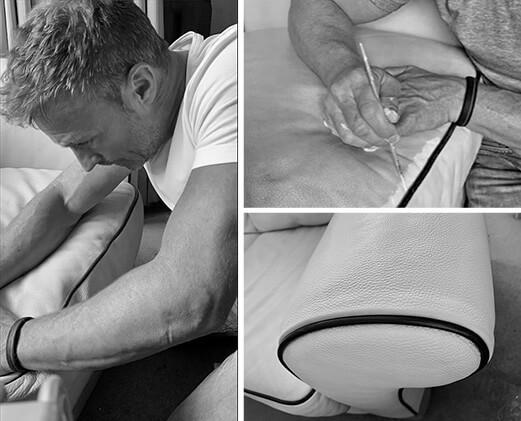
People ask us how to repair cracked leather almost every week, usually after they have already tried a conditioner and found the cracks are still there. The short answer is that cracking cannot be reversed by feeding the leather, but it can be restored: the surface is cleaned, the cracks are filled and smoothed, and the panel is recoloured and sealed so it looks and feels right again. Whether that is worth doing depends on how deep the cracks go, which is where a proper look from a specialist earns its keep. Jon, our founder at The Leather Expert, has been doing this kind of leather restoration across Essex and London for 26 years.
What cracked leather actually is
Most furniture leather has a coloured, protective finish on top of the hide. Underneath, the leather itself is made up of fibres held together with natural oils. Over time those oils dry out, the fibres stiffen and the leather loses its ability to flex. Every time someone sits down the surface creases, and a crease in stiff leather becomes a crack.
Cracking starts in the places that flex most: the front edge of seat cushions, the crease where the back meets the seat, the tops of arms and the headrest area. It also starts where the leather is driest, so the end of a sofa nearest a radiator, a conservatory chair, or the seat that catches the afternoon sun through a bay window in Leigh-on-Sea are the usual suspects.
There are two levels of damage, and the difference matters. Surface cracking is where the finish has crazed but the hide underneath is still sound. Deep cracking is where the leather itself has split and gone brittle, often with the fibres showing through as a lighter, fuzzy line. The first is very repairable. The second is sometimes repairable and sometimes a case for a new panel.

Why the usual home remedies do not work
The internet is full of suggestions: olive oil, coconut oil, Vaseline, baby oil, saddle soap, hair conditioner. All of them rest on the same idea, that cracked leather is thirsty and if you feed it, the cracks will close. Unfortunately that is not how it works. Once the fibres have split, no amount of oil will knit them back together, and on a coated leather the oil cannot even get past the finish. It sits on the surface, attracts dirt and goes rancid.
Jon has seen many sofas in Basildon and Brentwood that were oiled for months in good faith. The cracks are still there, but now the leather is sticky, dark and smells faintly of the kitchen. Everything has to be stripped back before repair work can begin, which adds to the cost.
Leather creams and conditioners sold in supermarkets are gentler but do little for real cracking. At best they add a temporary sheen. Filler kits and colour balms bought online are a different problem again: the filler is rarely flexible, the colour is a generic brown or black, and there is no sealant, so the repair goes shiny and rubs off within weeks. Trying to sand the surface smooth with fine sandpaper, another popular tip, removes what is left of the protective finish and makes the cracking spread faster.
The videos that claim to show you how to repair cracked leather in twenty minutes nearly all use a sound, lightly scuffed piece of leather for the demonstration, not a sofa arm that has spent a decade beside a radiator in Rayleigh. On real cracking the kit filler shrinks as it dries, the colour settles into the cracks as a darker line, and the whole area looks worse in daylight than it did before. We are not against people saving money; we simply see the results too often to recommend it.
How to repair cracked leather the professional way
A proper repair follows the same broad sequence whether the leather is on a sofa, an armchair or a car seat. It begins with an honest assessment. Jon will press and flex the leather to judge how deep the cracking goes, check whether the finish is pigmented or aniline, and look at how the rest of the piece has aged. If one cushion is cracked and the other five are heading the same way, it is usually better value to treat the whole sofa than to chase one cushion at a time.
Cleaning and preparation
The surface is deep cleaned to remove body oils, old products and dirt trapped in the cracks. If the leather is dry, it is rehydrated with products designed to get into the hide rather than sit on top of it. This is the step home remedies try to shortcut, and it is the one that decides whether the repair lasts.
Filling and smoothing
The cracks are filled with a flexible filler in thin layers and smoothed so the surface texture matches the surrounding grain. On deeper cracks this may take several applications. Where the leather has actually split, a sub-patch may be bonded behind it for strength before filling begins.
Colour and sealing
The colour is mixed by eye to match the existing leather, because an eight-year-old tan sofa is not the colour it was on the showroom floor. It is applied in fine coats, then sealed with a protective finish that gives the right sheen and stands up to daily use. We go into the colour side in more detail on our leather sofa recolouring page. On a heavily cracked piece, recolouring the whole panel rather than just the repair area is what makes the finished job invisible.
The result should be a panel that looks uniform, feels supple again and does not crack along the same lines the following winter. The photograph below shows what that looks like on a sofa that most people would have written off.

When a new panel is the better answer
There is a point where cracked leather is beyond restoring. If the hide crumbles when you press it, if the cracks go right through to the back, or if the leather has been stretched thin over collapsed foam, filling it is putting a plaster on the problem. In those cases we recommend replacement leather panels: the damaged section is unpicked, a new piece of matching leather is cut and stitched in, and the rest of the piece is colour matched to blend it. On a good frame this gives a piece another decade of life.
It is also worth checking what the leather actually is. A great deal of cheaper furniture sold in the last fifteen years is bonded or bicast leather, which is a thin layer of leather fibre with a plastic coating. When that coating cracks and peels, it is not repairable in the usual way and the honest advice is reupholstery in real leather or replacement. Leather UK, the trade body for the British leather industry, has useful guidance on what counts as genuine leather. Jon can normally tell from a photograph.
Stopping it coming back
Once a piece has been restored, keeping it that way is mostly common sense. Move it away from radiators and out of direct sun where you can, keep pets’ claws and belt buckles off it, and clean it with a product made for coated leather rather than anything from under the kitchen sink. A professional clean and protection treatment every year or two costs little and puts off the day the cracking returns. If you are unsure what your leather needs, ask; we would rather answer a quick question than restore the same sofa twice.
Cracking on car seats follows the same rules, with heat through a windscreen doing the work a radiator does at home. Jon repairs cracked leather on driver’s bolsters and seat bases as well as on furniture, and the sequence is the same: assess, clean, fill, colour, seal. What changes is how hard the finish has to work afterwards, because a car seat is slid across every day.
Get a quote to restore your cracked leather
If you want to know whether your sofa or chair is worth saving, send us two or three clear photographs: one of the whole piece and a couple of close-ups of the cracking, taken in daylight. Let us know roughly where you are in Essex or London, and Jon will tell you honestly whether it is a restoration job, a panel replacement or not worth spending money on. There is no charge for the advice, and it is the quickest way to find out how to repair cracked leather properly rather than guessing. See more examples of our leather restoration work on that page.
Call Jon on 07967 216250 or fill in the enquiry form below this post. Quotes are free and there is no obligation.