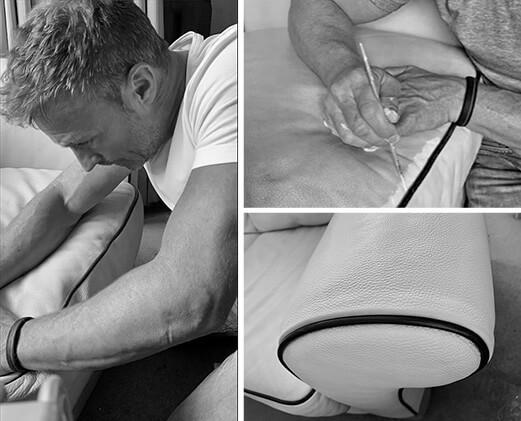
If you are searching for how to repair cat scratches on a leather sofa, the short answer is that the scratches can almost always be repaired properly, but not with a kit from the internet or anything from under the kitchen sink. Fine surface scratches are recoloured and sealed so they disappear. Deeper scratches where the claws have lifted the grain are filled, textured and recoloured. Scratches that have gone right through are sub-patched from behind first. The key is matching the repair to the depth of the damage, which is where most home attempts go wrong.
We carry out leather pet scratch repair in homes across Essex and London most weeks, and cats are responsible for the majority of it. Jon, our founder, has repaired sofas belonging to Bengals in Brentwood, rescue moggies in Romford and a very determined Maine Coon in Canvey Island. He has seen every version of this problem.
Why cats go for the leather sofa
Scratching is normal cat behaviour. It keeps the claws in condition, stretches the shoulders and back, and leaves both a visible mark and a scent from glands in the paws. A cat is not being naughty when it scratches your sofa. It is doing what cats do, and it has simply chosen your sofa because leather feels good under the claws and the sofa is in the room where the family spends its time.
Leather sofa arms are especially attractive because they are the right height for a full stretch and they are usually near a doorway, which is where cats like to leave their marks. The front corners of seat cushions get the same treatment. The RSPCA has good advice on scratching posts and where to place them if you want to give your cat a better option, which is well worth doing before the sofa is repaired rather than after.
The three kinds of cat scratch damage
Before anyone talks about repair, it helps to understand what you are actually looking at. Cat scratches on leather fall into three groups, and each needs a different approach.
Surface scratches
These are the fine, pale lines that show up most on darker leather. The claw has scored the top coat and the pigment layer but not gone into the hide. Run a finger across and you can barely feel them. On their own they are the easiest to sort out.
Scratches that lift the grain
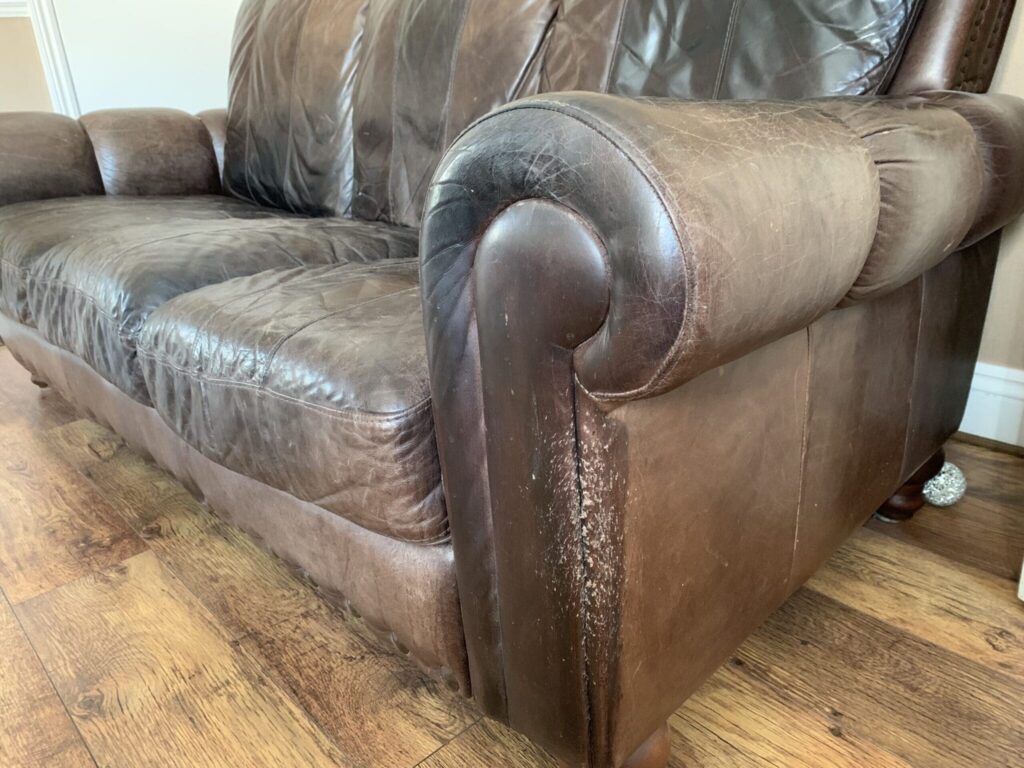
This is the classic cat damage: little raised fibres or “pulls” where the claw has hooked the surface of the leather and dragged it up. Rub your hand over the area and it feels fuzzy. On a tan or cream sofa these look like small pale tufts. The leather is not torn through, but the surface has been disturbed and simply recolouring over it will not hide it.
Deep scratches and punctures
Where a cat has really dug in, often on an arm it uses as a launch pad, the claws can go right through the leather. You may see small holes or short slits, sometimes with the foam visible underneath. These need structural repair before any cosmetic work.
What people try at home, and why we end up fixing it
Search for how to repair cat scratches on a leather sofa and you will find a great many confident answers. Olive oil is the most famous. It darkens the leather temporarily, which hides pale scratches for a day or two, then it soaks in, goes rancid and leaves a dark, greasy patch that is far harder to fix than the original scratches. We have recoloured whole seat cushions because of a teaspoon of olive oil.
Shoe polish and boot cream are next. They sit on top of the finish, never quite dry, and transfer onto light clothing. They also seal dirt into the scratches. Nail varnish or clear glue on the lifted fibres makes them go hard and shiny, and it has to be cut out before a real repair can be done.
Then there are the repair kits: a little pot of filler, a handful of colour tubes and a piece of grain paper. In theory they are a miniature version of what we do. In practice the colours never match a real sofa, the filler shrinks and cracks, and the result is a stiff, slightly wrong-coloured patch that draws the eye more than the scratches did. Jon spends a fair amount of time removing kit repairs before he can start.
The worst outcome is a sofa that has been sanded. Somebody reads that the fuzzy fibres can be sanded off, takes a sheet of sandpaper to the arm, and removes the entire finish along with the fibres. That turns a small cosmetic job into a full panel recolour.
How to repair cat scratches on a leather sofa the professional way
The first thing Jon does is establish which of the three types you have, and usually it is a mixture. A sofa arm will have deep damage at the corner, lifted grain along the top and fine scratches everywhere else. He also checks whether the leather is pigmented, aniline or semi-aniline, because that changes the whole approach.
The area is deep cleaned to remove any oils, polish or products that have been applied. Any lifted fibres are carefully dealt with so the surface is smooth again without thinning the leather. Deeper scratches are filled in thin layers, each one levelled, and the grain pattern is put back so the repair does not look flat under the light.
Punctures and slits are sub-patched from behind with a backing that holds the edges together, then filled and grained in the same way. Colour is mixed to match your sofa, not chosen from a chart, and applied in layers until it blends with the surrounding leather. Finally a sealant and lacquer go on to protect the repair, and this is the bit that gives it a matching sheen and makes it durable against the next round of claws.
Where the arms have been scratched over and over for years, the most invisible result often comes from recolouring the whole arm panel rather than treating fifty individual marks. That work is closer to our leather sofa recolouring service, and it is still done in your home in most cases.
Will the cat just do it again?
Honestly, probably, unless something changes. That is not a reason to leave the sofa looking shredded, but it is a reason to think about the cat at the same time. A tall, sturdy scratching post placed right next to the arm the cat prefers, and a bit of patience, redirects most cats within a few weeks. Blue Cross and the RSPCA both cover this well.
A repaired and sealed sofa also stands up to claws better than a worn one, because the fresh top coat is harder and smoother than an old finish that has already been roughened. Several of our customers in Rayleigh and Southend have had arms repaired, moved a post into position, and not needed us back.
When repair is not the best route
On a very cheap bonded leather sofa where the surface is already peeling, cat scratches are usually the least of the problems and repair rarely makes sense. On an aniline leather that has been scratched deeply all over, the honest advice may be a full leather restoration rather than spot repairs, or in extreme cases a replacement panel on the worst arm. We will tell you which applies to your sofa before you spend anything.
Get a Quote to Repair Your Cat Scratched Sofa
Send us a couple of photos in daylight, one of the whole sofa and one or two close-ups of the scratched areas, and let us know roughly where you are in Essex or London. If you know the brand of the sofa, that helps too. Jon will come back with an honest assessment and a price for leather pet scratch repair.
Call Jon on 07967 216250, or fill in the enquiry form below this post and we will get back to you.