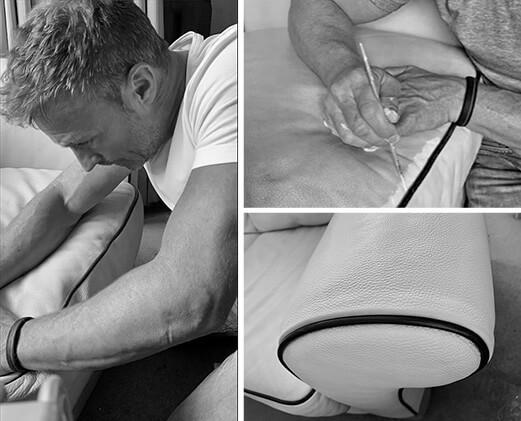
If you are searching for how to repair a rip in a leather sofa, the short answer is that a proper repair is done from behind, not on top. The tear is backed with a sub-patch, the edges are bonded flat, the surface is rebuilt with flexible filler, and the colour is matched and sealed so the leather flexes as one piece again. That is very different from what a tube of glue or a patch kit does, and the difference shows within weeks.
We repair rips and tears in leather sofas all over Essex and London, from our workshop in South Benfleet. Jon, our founder, has been doing this for 26 years and has fixed everything from a tiny puncture on a Natuzzi corner unit in Brentwood to a foot-long split on a Chesterfield in a Hackney flat. This post explains what causes rips, why the home fixes usually backfire, and what you can expect from a professional repair.
Why Leather Sofas Rip in the First Place
Leather is tough, but it is not indestructible, and most rips have a fairly predictable story behind them. The most common one we see is a seat cushion that has thinned over years of use until the leather simply gives way one evening. The fibres have been flexed, dried and stretched so many times that they have lost their strength, and a knee or a belt buckle finishes the job.
Then there are the sudden ones. A dog’s claws catching on the arm as it jumps down. A child’s toy with a sharp corner. The zip on a pair of jeans dragged across a seat. Keys in a back pocket. Removal men catching a sofa on a door frame when moving into a new house in Rayleigh. A cat that has decided the back of the sofa is a scratching post.
Rips also open up along seams. If the stitching thread has rotted or the leather along the seam has weakened, the panel can tear away from the seam line, which is a slightly different problem that often needs re-stitching as well as patching. Sun and radiator heat make all of this more likely, because dried-out leather tears far more easily than supple leather.

What Most People Try at Home
Almost every rip we are asked to look at has already had something done to it. We understand why. A rip is ugly, it gets bigger every time someone sits down, and a quick search for how to repair a rip in a leather sofa turns up plenty of quick fixes. Unfortunately most of them make our job harder and the final result worse.
Superglue and household adhesives
Superglue sets hard and brittle. Leather needs to bend. The glued area cracks the first time someone sits on it, usually taking a bit more of the surrounding leather with it. The glue also soaks into the fibres and stops proper filler and colour bonding later, so the repaired area often has to be enlarged to get past it.
Iron-on and stick-on patches
Patch kits sold for car seats and sofas are a flat piece of vinyl or leather-look material with adhesive on the back. They sit on top of the rip like a plaster. The edges lift, the colour never matches, and the texture is wrong. On a seat cushion they peel within weeks. The adhesive they leave behind is a nuisance to remove.
Filler kits and colour pens
Some kits come with a filler and a set of colour tubes to mix your own shade. The filler is often fine, but without a sub-patch underneath it has nothing to hold on to and simply falls through or cracks. The colour mixing is where things really go wrong. Getting a brown to match a brown by eye, on a leather that has faded unevenly, takes years of practice. The result is usually a patch that is a shade too red or too dark, which draws the eye more than the original rip did.
Stitching it yourself
Hand-stitching a rip closed with a needle and thread pulls the edges together under tension and puts a row of holes along both sides of the tear. Leather does not heal around those holes. If the stitches are removed later, the tear is now longer and has a perforated edge, which is much harder to repair invisibly.
How to Repair a Rip in a Leather Sofa: The Professional Method
We are not going to give you a step-by-step recipe for how to repair a rip in a leather sofa here, partly because it takes years to do well and partly because the products a professional uses are not the ones sold in a kit. But it helps to understand roughly what happens, so you know what you are paying for and can judge the finished result.
The first stage is assessment. Jon looks at the type of leather, how the rip has happened, whether the leather around it is still sound, and whether the seam or the foam underneath has been affected. A rip in strong leather that has been caught on something is a straightforward repair. A rip in leather that is thin and dry across the whole cushion is a warning sign, because the next tear is only a matter of time.
The area is then cleaned to remove skin oils, silicone from furniture sprays and any glue from earlier attempts. A sub-patch of flexible material is worked in behind the tear so the edges have something solid to bond to. The edges are laid down flat and secured. The surface is built back up with a flexible leather filler in thin layers, shaped and smoothed so the texture blends in with the grain around it.
Colour comes next, matched by eye to the sofa as it is today rather than the colour it was on the showroom floor, and applied in fine coats to feather out into the surrounding leather. A sealant and topcoat are then applied to match the sheen of the rest of the sofa and to protect the repair from wear. On seat cushions we pay particular attention to flexibility, because that part of the sofa is bent thousands of times a year.
Where the rip has run along a seam, we re-stitch it. You can read more about that on our leather sofa stitching page. And if the surrounding area is badly faded, we may recommend blending the colour across the whole panel so the repair does not sit in a slightly different shade. Our leather split and tear repair service covers all of this.

Can Every Rip Be Repaired?
Most can, and once you know how to repair a rip in a leather sofa properly, the result on a single tear in otherwise good leather is usually very hard to spot. There are a few situations where we will be honest with you and suggest something else.
If the leather across the whole cushion has gone thin and papery, repairing one rip is like patching one hole in a worn-out pair of jeans. The next one will appear a few inches away within months. In that case a replacement leather panel for the affected cushion is a better long-term answer. If the sofa is bonded leather or faux leather rather than the real thing, the surface is a thin coating on fabric, and tears in it behave differently. We will tell you what is realistic.
Very large tears with missing leather, where a dog has actually chewed a piece away, can be repaired but the missing area has to be rebuilt, which takes longer. If the sofa is under a couple of years old and the leather has torn without any obvious cause, it may be worth raising a fault claim with the retailer first. Citizens Advice has clear guidance on your rights when furniture fails early.
What Affects the Time a Rip Repair Takes
A single clean tear on a pigmented leather sofa can usually be repaired in one visit to your home, with the leather fully usable once the topcoat has cured. Multiple rips, rips on aniline or two-tone leather, or rips that need re-stitching along a seam take longer because each stage needs time to set before the next. Colour matching is the stage that varies most: a mid-brown is quick, an unusual grey-green or a distressed vintage finish needs test patches.
We work in homes across Essex, including Southend-on-Sea, Basildon, Chelmsford, Colchester and Thurrock, and across east and central London. Where a sofa needs more than surface repair, it can come to the workshop.
Get a Quote to Repair the Rip in Your Leather Sofa
If you would rather leave how to repair a rip in a leather sofa to us, send us two or three photographs of the tear: one close enough to see the edges clearly, one showing the whole cushion or panel so we can judge the leather around it, and one of the sofa as a whole in normal daylight. If you have tried a glue or a patch, tell us; it is not a problem, but it changes how we approach the job. Let us know roughly where you are.
Call Jon on 07967 216250 or fill in the enquiry form below this post. You can see what a finished repair looks like on our leather split and tear repair page. Quotes are free, and we will tell you honestly whether a repair is the right call for your sofa.