How long should a leather sofa last? A well-made sofa in real leather, looked after sensibly, should give you fifteen to twenty-five years, and we regularly work on Chesterfields and older pieces that are far past that. A cheaper sofa in bonded or bicast leather may only manage five to eight before the surface starts to peel. The difference comes down to what the sofa is made of, where it lives and what has been done to it, and the good news is that most of the wear that makes people give up on a sofa is repairable. We are The Leather Expert, based in South Benfleet, and Jon, our founder, has spent 26 years on leather restoration for homes across Essex and London.
What decides a leather sofa’s lifespan
The leather itself
Full grain and top grain leather with a pigmented finish is the workhorse of the furniture trade, and it lasts. Aniline leather is softer and more beautiful but marks more easily. Corrected grain leather sits somewhere between. The one to be wary of is bonded leather, which is shredded leather fibre glued to a backing and coated with a plastic finish. It looks convincing in a showroom but the coating cracks and peels within a few years, and there is no repairing it in the usual way.
If you are unsure what your sofa is, look at the back and underside. Cheaper sofas often use real leather only on the seats and arms and a matching vinyl everywhere else, which is fine, but the leather itself will be thin. A heavy, supple hide with a visible natural grain is a good sign.
The frame, springs and foam
The leather is only part of the story. A hardwood frame with proper springing and high-density foam will outlast the cover several times over, which is why restoring a good sofa makes sense. A softwood frame with cheap foam that has collapsed within three years is a different matter, because the leather creases over the sagging cushion and wears out early.
How it is used
A sofa in a formal front room that is sat on at Christmas will look new for decades. One in a family living room in Basildon, with two teenagers, a Labrador and the television on all evening, will show its age in five. Neither is wrong; they simply age at different speeds. Pets, children, jeans rivets and people who sit on the arms all add up.
How long should a leather sofa last in a typical home?
From what we see in Essex and London homes, here is a realistic picture. A budget sofa in bonded leather: five to eight years before peeling makes it embarrassing. A mid-range sofa in pigmented leather from a high street retailer: ten to fifteen years of honest use, longer with care. A good quality sofa from a maker such as Natuzzi, a Chesterfield from a proper manufacturer or something bought from John Lewis or Harrods: twenty years is normal, and with a restoration at some point in its life, considerably more.
Jon has restored sofas in Colchester and Brentwood that were bought in the 1980s and are still in daily use. The leather on a well-made piece does not wear out so much as get tired, and tired leather can be brought back.
The things that shorten a sofa’s life
Almost every sofa we are asked to write off has been shortened by one of a small number of things, and none of them is age.
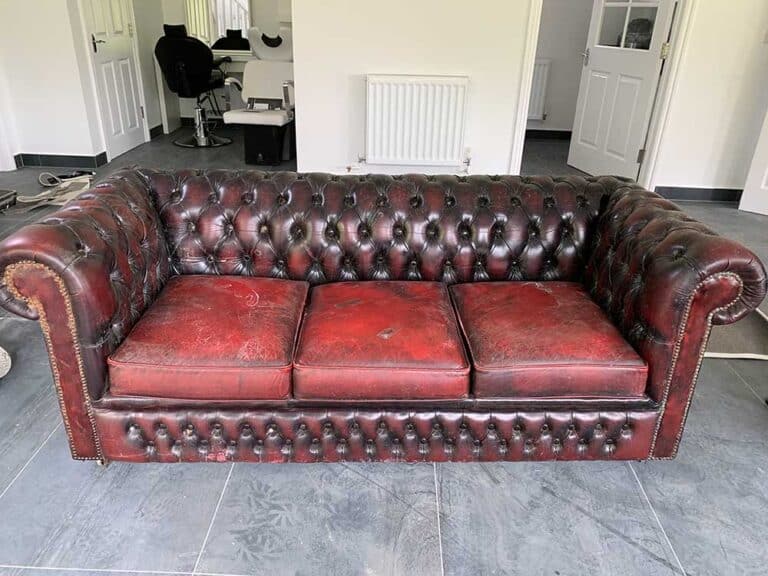
Sunlight. A sofa under a south-facing window or in a conservatory fades on the side that catches the sun and dries out along the top of the back. We see this constantly along the coast in Southend-on-Sea and Leigh-on-Sea. Fading is repairable; the drying that comes with it leads to cracking, which is harder.
Radiators and heat. Leather pushed against a radiator, or a recliner parked in front of a log burner, dries out from the back. Modern homes are heated hard and ventilated little, and the Energy Saving Trust has good general advice on keeping heating and humidity sensible, which happens to suit leather as well as people.
Body oils and hair products. The head area and the arms darken and go shiny where skin and hair rest on them. Left alone, the oils soften the finish and it wears through. This is one of the most common jobs we do and one of the most avoidable.
Wrong cleaning products. Baby wipes, washing-up liquid, multi-surface sprays and vinegar all strip the protective finish a little each time. Sofas that are wiped down with wipes every week are among the quickest to crack. A proper professional leather sofa clean every year or so, with a suitable cleaner in between, is a fraction of the trouble.
Well-meaning repairs. Filler kits, colour balms, spray dyes and superglue on a small scratch or split. They rarely last, and they often turn a small repair into a large one.
Neglect of small faults. A seam that has started to open, a scratch from the cat or a small tear on a cushion piping all get worse with every sitting. Fixed early, they are minor jobs. Left for a year, the leather around them weakens and the repair becomes more involved.
How restoration adds years to a good sofa
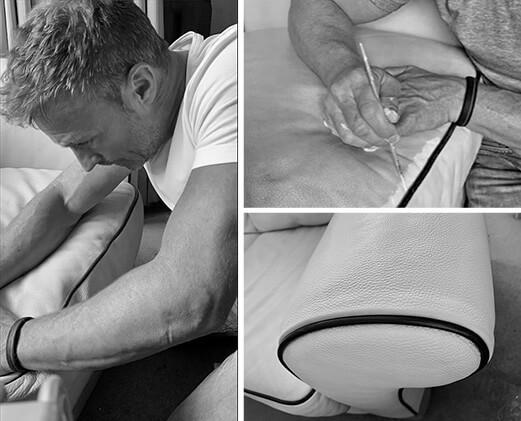
Because the frame and springs usually outlive the cover, restoring the leather resets the clock. A typical restoration involves a deep clean to remove years of oils and dirt, repair of any cracks, scuffs and splits, recolouring of faded or worn panels so the whole sofa matches, and a new protective finish over the top. Where cushions have collapsed, new foam brings the seats back to the right height and stops the leather creasing. Where a panel is beyond saving, it can be replaced with new leather.
A sofa that comes out of that process should look and feel close to new, and can reasonably be expected to give you another good stretch of years. It is usually a fraction of the cost of replacing a quality sofa like for like, and it keeps a piece you already know is comfortable. Our leather sofa recolouring page shows what the colour side of this looks like on real sofas.
People sometimes ask how long should a leather sofa last once it has been restored, and the honest answer is that it depends on the same things as before: the quality of the original piece, where it sits and how it is treated. Keep it out of the sun, away from the radiator and cleaned with the right products, and a restored sofa should behave much like a good new one. Treat it as it was treated before and it will age the same way it did the first time, just from a fresh start.
Jon has gone back to sofas he first worked on well over a decade earlier, in homes around Billericay and Rayleigh, and found the frames still sound and the leather ready for another round. That is what a good sofa is capable of when the leather is looked after and put right when it needs it.

When it is time to let a sofa go
Not every sofa is worth saving, and we would rather say so. If the frame creaks or has cracked, if the leather is bonded and peeling across every panel, or if the sofa was inexpensive to begin with and the restoration would cost more than you paid, replacement is the sensible choice. If the frame is sound, the leather is real and you like the sofa, restoration almost always wins. So how long should a leather sofa last in your home? With a good piece, as long as you want it to.
The simplest way to find out which side of that line your sofa sits on is to ask. Jon can usually tell from a few photographs, and he will give you a straight answer either way.
Get a quote to extend the life of your leather sofa
If your sofa is looking tired and you want to know whether it can be brought back, send us a few photographs in daylight: the whole piece, plus close-ups of any fading, cracking, worn arms or dark head areas. Tell us roughly where you are in Essex or London and Jon will tell you what is possible and what it is likely to cost. You can see examples of full leather restoration work on that page.
Call Jon on 07967 216250 or fill in the enquiry form below this post. Quotes are free, and there is no obligation.