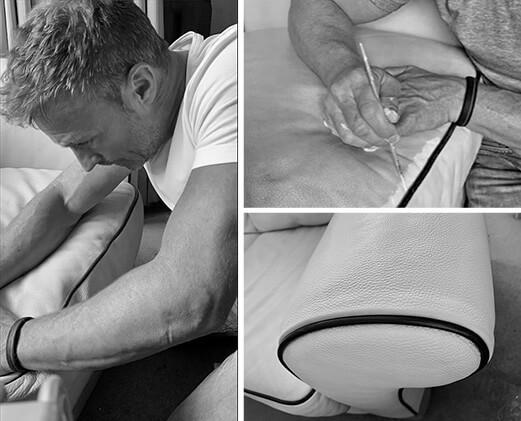
People ask how long does leather sofa repair take before they ask almost anything else, usually because they are picturing weeks without somewhere to sit. The realistic answer is that most repairs are finished in a single visit of a few hours, larger restoration work takes a day or two, and only jobs that need the sofa in our workshop, such as panel replacement or reupholstery, run into a week or more. Our leather repair and restoration service across Essex and London is built around doing as much as possible in your home so you are not left without a sofa.
This post walks through the timescales for the jobs we do most often, what makes one repair quicker than another, why drying and curing time matters, and how to get the fastest honest answer for your own sofa.
How Long Does Leather Sofa Repair Take for Common Jobs?
Every sofa is different, so treat the following as a guide rather than a promise. These are the timescales Jon, our founder, works to on a typical day after 26 years of doing this.
Small scuffs, scratches and localised colour loss
A cat scratch on an arm, a scuff from a belt buckle, a patch of colour rubbed away on a cushion edge. Jobs like this are usually done in a couple of hours at your home. Cleaning, a light prep of the area, filler if the surface is broken, colour and sealant, then a short time for the finish to set before we leave.
Split seams and stitching
A single seam that can be reached with the cushion in place is often re-sewn in an hour or two. Where a cover has to come off to get the seam under a machine, the cover may come back to the workshop for a day or so while the rest of the sofa stays with you.
Tears, splits and burns
A tear needs sub-patching from behind, filling, colour and sealing. Small tears are a half-day job on site. A large split across a seat, or a burn that has gone through the leather, can take most of a day because each layer of filler needs to cure before the next goes on.
Head, arm and grease darkening
Restoring the darkened areas where heads and hands rest involves deep cleaning to draw out the oils before any colour can be applied. This is typically a half to a full day depending on how many seats are affected and how far in the grease has gone.
Full recolouring or restoration
Bringing a whole faded or worn sofa back to its original colour, or changing it to a new one, is normally one to two days for a three-seater, sometimes a little more for a large corner suite. This is where most of the time goes on cleaning, prep and patient colour work, and it is worth every hour. You can read more about that on our leather sofa recolouring page.
Replacement panels and reupholstery
When a section of leather is beyond saving it has to be cut out and replaced with matching hide, sewn in and colour blended. Cushion covers can often be handled while the sofa stays at home. Whole arms or backs usually mean a trip to the workshop in South Benfleet, and you should expect the piece to be away for a week or two depending on the work involved and whether matching leather has to be sourced.

What Makes One Repair Quicker Than Another
Two sofas with what looks like the same damage in the photos can take very different amounts of time once Jon is in the room. These are the things that matter most.
The type of leather. Pigmented leather, which is most of what is sold for sofas, takes colour predictably and dries fast. Aniline and semi-aniline hides, the soft, natural-looking leathers on higher-end pieces, need a gentler approach and more time between stages. Wax-pull and oiled leathers, like those on a Timothy Oulton or a distressed Chesterfield, are a specialist job in their own right.
How the damage has been treated before. A sofa that has been rubbed with olive oil, dabbed with a repair kit or scrubbed with baby wipes has to be cleaned back to sound leather before any real work can start. That can add hours, occasionally a whole extra visit.
Colour matching. A plain black or dark brown sofa is quick to match. A two-tone antiqued finish, a pale cream that has yellowed unevenly, or a colour that has faded differently on every cushion takes longer to get right. Jon mixes colour on site under your lighting rather than working from a chart, and that patience is what makes the repair invisible.
The number of areas. One scuff on one arm is quick. The same scuff repeated across every cushion front, both arms and the headrests is a full day, because each area needs the same care.
Access and space. A sofa in a bright, well-ventilated lounge in Rayleigh is faster to work on than a heavy corner unit wedged into a small flat in east London where it cannot be moved away from the wall. We work around it, but it takes longer.
Why Drying and Curing Time Cannot Be Rushed
This is the part people do not expect. The hands-on work on a repair might be an hour, but the filler needs to cure, each coat of colour needs to dry before the next, and the sealant and lacquer have to set before anyone sits down. Skipping any of those stages is how a repair ends up cracking or peeling a month later.
We use professional heat and airflow tools to speed this up safely, which is one reason a job that would take a hobbyist a weekend takes us an afternoon. Even so, we will usually ask you to keep off the repaired area for the rest of the day and to avoid heavy use for a day or two while everything fully hardens. You can still sit on the rest of the sofa.
Why the DIY Route Usually Takes Longer, Not Shorter
A repair kit promises a fix in an evening. What tends to happen is that the colour is wrong, the filler shrinks as it dries, the patch goes stiff, and after a few weeks the whole thing needs redoing. Jon has spent a great many mornings removing failed kit repairs before he can even begin. The sofa ends up out of action for longer and the eventual bill is higher than if we had seen it first.
The same goes for home remedies. Oils and polishes have to be drawn back out of the leather before dyes will bond. Household cleaners leave residues that stop sealants curing properly. None of these things are impossible to deal with, but every one of them adds time. If the sofa is under guarantee and the damage is a fault rather than wear, Which? has plain-English guidance on your rights, and it is worth checking before anyone touches it.
Planning Around the Work
For most home visits we ask for the sofa to be cleared of cushions, throws and anything on the floor around it, and for pets to be kept in another room while the finish dries. A window that opens is helpful. If the piece is going to the workshop we will agree collection and return dates with you before we start, and we will tell you if sourcing matching leather is likely to add to the wait.
We work across Essex and into east and central London, covering places like Southend-on-Sea, Basildon, Chelmsford, Brentwood, Romford and Canvey Island as well as the City and the Docklands. Because there is no call centre and the phone goes straight to Jon, you get a realistic date rather than a slot in a system, and we would rather tell you next week than promise tomorrow and let you down.
When a Longer Job Is the Better Answer
Occasionally a customer wants the quickest possible fix on a sofa that really needs more. A quick colour touch-up on a cushion that is cracking underneath will look fine for a fortnight and then fail. In those cases we will say so, and suggest proper leather restoration that takes a day or two but lasts for years. Time spent doing it once, properly, is nearly always time saved.
Get a Quote and an Honest Timescale for Your Sofa
If you want to know how long does leather sofa repair take for your particular piece, the quickest route is to send us two or three photos of the damage in daylight, one close up and one of the whole sofa, and tell us roughly where you are. Jon will come back to you with what he thinks is involved, how long it is likely to take, and whether it can be done at home or needs to come to the workshop.
Call Jon on 07967 216250 or fill in the enquiry form below this post. There is more detail on every type of job on our leather repair and restoration page, and every quote is free and quoted individually.