You can get paint off a leather sofa without ruining it, but the honest answer is that the best results come from leaving the paint alone and calling someone who removes it for a living. Every scrubbing session, every solvent and every “miracle” wipe tried in the first panicked hour makes the eventual repair harder. If a roller has flicked emulsion across the seat, or a toddler has decorated the arm with poster paint, take a photo, stop, and read this before you touch it. Our leather stain removal service exists for exactly this situation.
Why Paint on Leather Is Harder Than It Looks
Leather is not a hard, sealed surface like a laminate worktop. Even a pigmented sofa has a grain full of tiny pores and creases, and the topcoat that protects it is thin and softens under many of the products people reach for. Paint sits in that grain and bonds as it dries. Water-based emulsion is the mildest case. Gloss, satinwood, fence paint, spray paint and artist’s acrylics all cure into a film that is chemically tougher than the finish on the sofa underneath.
The trap is that most things strong enough to get paint off a leather sofa are also strong enough to shift the sofa’s colour. So the amateur approach usually ends one of two ways: the paint stays and the leather around it is scuffed and faded, or the paint comes off along with a patch of pigment, leaving a pale bald spot that is far more visible than the original splash.
The other variable is time. Fresh, still-wet emulsion on protected leather is usually recoverable with the right cleaner. Paint that dried a fortnight ago and has been rubbed at with a kitchen sponge has often worked its way into the grain and needs a different approach altogether.
What Not to Do When You Try to Get Paint Off a Leather Sofa

We are not going to give you a recipe to get paint off a leather sofa here, because we have seen the aftermath of every recipe on the internet. What we can tell you is which ones cause the most damage, so you know what to avoid while you wait for a proper assessment.
White spirit, turps and paint thinners. These are made to dissolve paint film, and they do. They also dissolve the lacquer on the sofa and soften the pigment beneath it. Jon, our founder, has lost count of the sofas from Chelmsford to Romford where a small gloss splash became a hand-sized patch of dull, sticky, discoloured leather because someone went at it with white spirit and a cloth.
Nail varnish remover. Acetone strips colour from pigmented leather almost instantly. It is one of the worst things you can put on a sofa, and it is one of the most common things people try because it is under the bathroom sink.
Scraping with a knife or a razor. Dried paint sits proud of the surface, so it is tempting to lift it off with a blade. On a soft, grained hide this shaves the top layer of the leather along with the paint. You cannot put that back.
Baby wipes, washing-up liquid and “magic” sponges. These feel gentle, and that is the problem. They do little to the paint and quite a lot to the finish around it, especially the abrasive melamine sponges, which act like very fine sandpaper.
Hairspray, olive oil and vinegar. Each one has a fan club online. None of them removes cured paint, and oil in particular soaks into the leather and darkens it permanently.
The one thing you can safely do
If the paint is still wet, blot it gently with a dry, clean, white cloth to lift the excess. Blot, do not rub. Then stop. If it has already dried, do nothing at all beyond taking clear photographs in daylight. That is genuinely the most useful thing you can do for the outcome.
How a Professional Removes Paint From Leather
When we come out to a sofa in Southend-on-Sea, Brentwood or east London, the first job is identifying two things: what kind of paint it is and what kind of leather it is on. A splash of matt emulsion on a pigmented Natuzzi is a different proposition from oil-based gloss on a semi-aniline chair, and the products and techniques change accordingly.
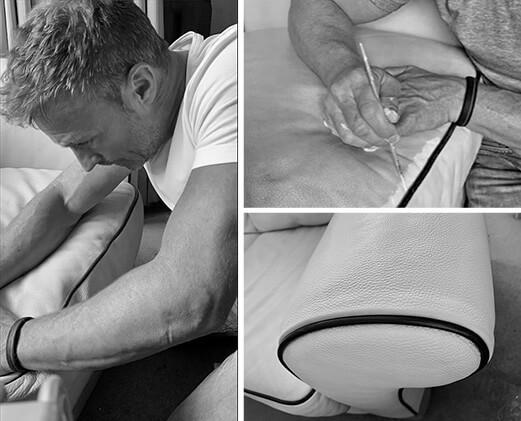
Jon then tests in a hidden spot, usually under a cushion or on the back skirt, to see how the finish reacts before anything touches the visible area. Only then does the actual removal start, using cleaners and softening agents chosen for that combination of paint and finish, worked in small stages rather than one aggressive pass. Some paints lift cleanly. Others come away in layers over a couple of passes.
Once the paint is gone, there is very often some disturbance to the finish underneath, even when the removal has gone perfectly. The last stage is to refinish that area: rebalancing the colour to match the surrounding leather and resealing it so the repair is invisible and protected. That refinishing step is the part no home method can offer, and it is the reason a professional result looks like nothing ever happened rather than “better than it was”.
When the paint has already been attacked
Roughly half the people who call us to get paint off a leather sofa have already had a go with something from the cupboard. In those cases the paint itself is often the smaller problem. What we are actually repairing is a solvent-damaged patch of finish, sometimes with a scrape or two from a blade. That moves the job from a clean-and-refinish into a small leather restoration: preparing the damaged area, rebuilding the colour in thin coats and sealing it. Still very doable, and still far cheaper than a new sofa, but more work than it needed to be.
Larger Spills and Full Panels
Sometimes the damage is not a splash but a tipped tin. A litre of emulsion across a two-seater is a different scale of job. It may still be recoverable, but the realistic route is usually a full clean of the affected panels followed by a leather sofa recolouring of those panels, or the whole sofa if the colour cannot be blended convincingly. We will always tell you which it is before any work starts.
Where paint has soaked deep into an unprotected aniline hide, or where the leather itself has been shaved by scraping, a panel replacement may be the sensible option. This is rare with paint alone. It becomes more likely when a spill has been left for months under a throw or has been repeatedly scrubbed.

Decorators, Insurance and Who Pays
If a tradesperson caused the damage, take photographs straight away and let them know in writing. Most reputable decorators carry public liability insurance for exactly this, and a paint removal and refinish is a small claim compared with a replacement sofa, which is why they will often prefer to pay for a repair. We are happy to provide a written quote you can pass on.
Home contents policies sometimes cover accidental damage to furniture. Whether yours does depends on the policy wording, and the Association of British Insurers has plain-English guidance on what accidental damage cover usually means. Our quotes are itemised, so if you do claim, the insurer can see exactly what the work involves.
Preventing It Next Time
We are not decorators, but after 26 years of cleaning paint off furniture we have some opinions. A cotton dust sheet on its own is not enough because emulsion soaks straight through it. Put a plastic sheet or a decorator’s polythene drop cloth under the cotton one, and move the sofa out of the room or at least away from the wall being rollered. Ceilings are the usual culprit: fine spatter from a roller travels further than most people expect and dries before anyone notices.
If a sofa is going to be in a room during decorating for a long stretch, it is worth having it cleaned and protected afterwards anyway, because dust and fine spray settle into the grain. A professional leather sofa clean once the decorating is finished puts it back to how it should be.
Get a Quote to Remove Paint From Your Leather Sofa
If you need to get paint off a leather sofa, send us two or three clear photos of it in daylight, tell us what kind of paint it is if you know, and let us know roughly where you are. Jon will give you a straight answer on whether it is a simple clean, a clean and refinish, or something bigger, and what it is likely to cost. Our leather stain removal work covers South Benfleet, Basildon, Rayleigh, Colchester and across east and central London.
Call Jon on 07967 216250 or fill in the enquiry form below this post. Quotes are free, and the sooner we see the paint, the simpler the fix.