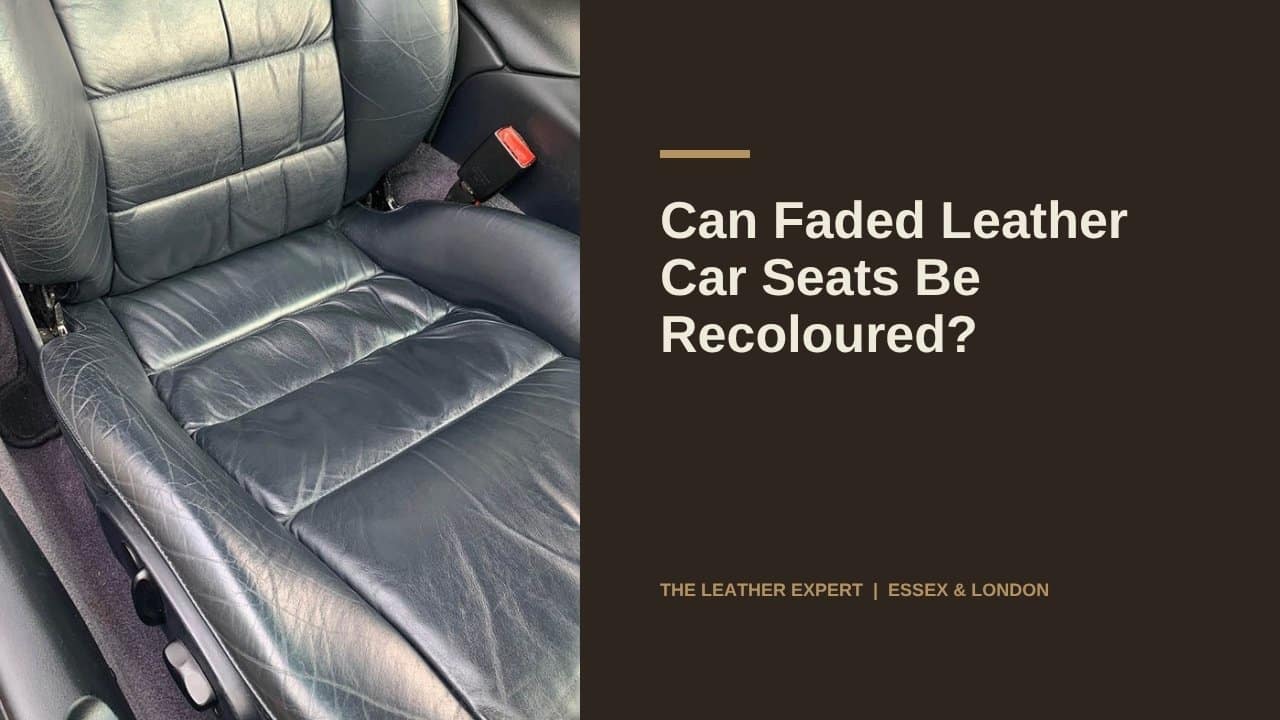
Faded leather car seats can be recoloured, and in most cars the result is close to indistinguishable from the seats as they left the factory. The colour loss you see on a driver’s seat bolster, the top of a rear bench under the back window or the arm of a door card is almost always in the finish rather than the hide itself, and a finish can be cleaned, prepared and rebuilt. Our leather car seat repair service covers exactly this kind of work for drivers across Essex and London.
In this post we look at why car leather fades faster than furniture leather, which seats and colours suffer most, why the products sold to touch it up at home rarely end well, what a professional recolour involves, and when it is worth combining fading with the wear and cracking that usually comes with it.
Why Faded Leather Car Seats Are So Common
A car is a small glass box that sits outside. On a summer afternoon in a supermarket car park in Southend-on-Sea the cabin can reach temperatures no living room ever will, and the sunlight coming through the glass is concentrated on a few square feet of seat. Ultraviolet light breaks down the pigment and the clear top coat on the leather, and heat dries out the hide underneath. Between them they do in five years what a sofa by a window might take fifteen to suffer.
The seats that fade first are the ones the sun reaches. The rear bench and parcel shelf side of the back seats in a saloon, the tops of the front seat backs, the outer bolsters nearest the doors, and the top of the driver’s door armrest. Cars parked nose-out on a south-facing drive in Rayleigh or Leigh-on-Sea, or left all day in an open commuter car park at Basildon or Chelmsford station, tend to show it worst.
Colour matters too. Red, tan, cognac and cream leathers show fading far sooner than black, partly because the pigments themselves are less UV-stable and partly because the contrast between faded and unfaded areas is more obvious. A black seat can be badly faded and just look slightly grey; a red seat looks tired within a couple of summers.

Fading Rarely Comes Alone
By the time a seat has faded noticeably, the top coat has usually also worn thin in the places it gets rubbed. The outer bolster of the driver’s seat, where you slide in and out every day, is the classic spot. What starts as a lighter patch turns into a shiny, smooth area, then fine cracks, then bare hide showing through as a pale, fibrous surface. Jean rivets and belt buckles add scuffs on top.
This matters because it changes the job. Fading on its own is a recolour. Fading plus worn bolsters is a recolour with repair work first, so the cracks are filled and the surface is level before any colour goes on. Jon, our founder, always asks for a photo of the driver’s bolster for exactly this reason, because that is where the answer to “how much work is this” usually lives.
Why the Touch-Up Products Usually Make It Worse
The motor factors and the internet sell a great many bottles and kits for faded leather car seats: colour balms, dye pens, spray-on leather paint, “restoration” kits with a sponge and a small pot of colour. The appeal is obvious. The results, in our experience, are not.
The first problem is colour. Car leather comes in thousands of shades, and the nearest “tan” or “beige” in a kit is rarely the right one. The touched-up area stands out more than the fading did. The second problem is adhesion. Car seats are covered in years of silicone from dashboard sprays, body oils and conditioner residue, and a colour applied over that will rub off on the next pair of light trousers or crack within weeks. The third is finish. Sprayed colour without a proper flexible top coat goes tacky in the heat and stiff in the cold.
We have also seen conditioners and oils rubbed into faded seats in the hope of bringing the colour back. On pigmented car leather they do not reach the colour at all; they simply sit on the surface, attract dirt and have to be stripped off before real work can start. If your car is still under a manufacturer’s warranty and the fading looks like a defect in the finish rather than sun damage, it is worth raising with the dealer first, and Which? has clear guidance on your rights when goods are not up to standard.
What a Professional Recolour of Car Leather Involves
We start by identifying the leather. Most modern car seats are pigmented, corrected-grain leather, sometimes with vinyl side panels and backs that look identical, and the two need different products. Older luxury cars and some high-end trims use softer semi-aniline hides that need a gentler approach. We check with a small test in an unseen spot before committing.
The seats are then deep cleaned and degreased to remove silicone, oils and old products. This is the step that determines whether the new colour lasts, and it is the step the home kits skip. Any cracking, scuffing or worn areas on bolsters and seat bases are filled and levelled, and the surface is prepared so the new pigment keys properly to it.
Colour is matched by eye against an unfaded area, usually the underside of a seat or the inside of a bolster, and adjusted in the car under daylight rather than under workshop lights. The pigment is applied in thin coats, blended into surrounding areas so there is no hard edge, and sealed with a flexible top coat matched to the original sheen. Modern car leather is usually quite matt, and getting that right is as important as the colour itself.
Most car work is done at your home or workplace, wherever the car can sit for a few hours with the doors open. The work on a full set of seats in a family car is usually a day. A single faded bolster or headrest is a shorter visit.

Recolour, Refresh or Replace?
There are three broad answers depending on the state of the leather. Where the fading is even and the surface is sound, a full refresh of the affected seats in the original colour is the answer, and it is the same process we use for sun bleached and faded leather on furniture, adapted for the harder life a car seat leads.
Where the fading is patchy and the bolsters are cracked or holed, repair comes first and the recolour follows. If a panel has actually split or worn through to the foam, that section may need replacing with new leather before colour work, which we do regularly on driver’s seats.
Replacement of a whole seat cover is rarely necessary and rarely worth it. Genuine covers from a main dealer are expensive and often no longer available for older cars, while aftermarket covers seldom match the rest of the interior. A well-executed recolour keeps the original leather, the original stitching and the original fit.
Keeping Recoloured Seats Looking Right
Once the seats are done, the enemies are the same ones that caused the fading: sun and heat. A windscreen sunshade on a hot day does more than any product. Parking in shade where you can, and keeping the seats clean with a proper leather cleaner rather than a general interior wipe, keeps the new finish in good condition for years. Avoid silicone-based dashboard sprays drifting onto the leather, as they are the main reason finishes fail early.
Some customers also ask whether the same treatment works on the sofa at home that has faded in the conservatory. It does, and our leather sofa recolouring page explains how that side of the work differs.
Get a Quote for Faded Leather Car Seats
If your car has faded leather car seats and you want an honest opinion on what can be done, send us a few photos taken in daylight with the doors open: one of each affected seat, and a close-up of the driver’s outer bolster. Let us know the make, model and colour and roughly where you are. We cover Essex and east and central London from our base in South Benfleet, and Jon can usually tell from the photos whether it is a straightforward recolour or a repair-and-recolour.
Call Jon on 07967 216250 or fill in the enquiry form below this post. You can read more on our leather car seat repair page, and every job is quoted individually and without obligation.