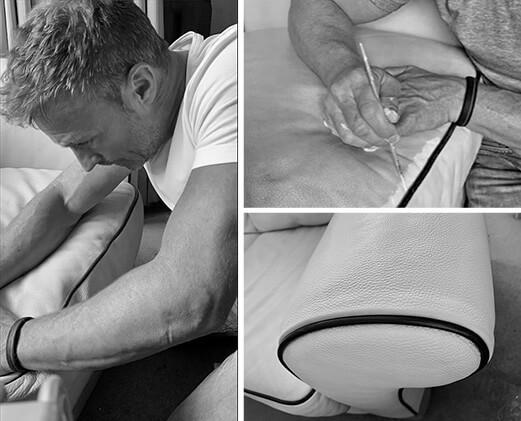
Dog scratches on leather are one of the most common problems we are asked about, and the good news is that most of them can be repaired properly rather than lived with or hidden under a throw. Claw marks on a sofa arm, a shredded seat cushion where the dog leaps up every evening, or a scuffed, pale patch on the corner of a footstool can all be brought back with the right professional approach. Here is what Jon, our founder, looks for when he assesses dog damage, what can be fixed, and where the limits are.
Why dog scratches on leather look worse than they are
Most modern leather sofas are finished with a pigmented top coat. That coat carries the colour and a protective seal, and it sits on top of the actual hide. When a dog’s claws drag across it, the first thing to go is that coloured finish. Underneath, the hide is usually a paler grey or tan, which is why fresh scratches often look so bright against a dark brown or black sofa.
It looks alarming, but in many cases the hide itself is only lightly marked. The scratch is really a finish problem, not a structural one. That distinction matters, because a finish problem is very repairable. A deep gouge that has torn through the hide, or a cluster of scratches that has been worn into a fuzzy, suede-like patch over months, is a different job, and we will come to those below.
We see the same spots again and again. The front edge of the seat cushion where a Labrador scrambles up. The arm nearest the window where a terrier stands to bark at the postman. The back cushion of a Natuzzi corner suite in a Rayleigh living room where a spaniel turns three circles before settling. Dogs are creatures of habit, so the damage tends to be concentrated rather than spread across the whole sofa.
Types of dog damage we repair

Not every mark a dog leaves is the same, and the repair method changes with the type of damage. Our leather pet scratch repair service covers all of the following, but it helps to know which one you are looking at when you send us photos.
Surface scratches and scuffs
These are the light, pale lines where the claws have taken off the colour but left the leather beneath more or less intact. Run a finger across them and they feel smooth or only slightly rough. This is the easiest category to put right, and the result is usually invisible once the colour has been rebuilt and sealed.
Deeper claw marks with lifted fibres
When a dog pushes off hard, particularly a heavy breed, the claws can dig into the hide and lift tiny fibres, leaving a rough, hairy texture. Sometimes there is a small flap of leather standing proud. These need more preparation before any colour goes on, otherwise the rough texture shows straight through and catches the light.
Worn patches from repeated scratching
This is the one that creeps up on people. A dog that scratches the same spot every day for a year does not leave individual lines; it wears the finish away entirely and starts thinning the hide. The area looks matt, feels soft like suede and often has a slightly different colour tone to the surrounding leather. These are still repairable, but the work is closer to a small restoration than a scratch repair.
Tears and punctures
Occasionally a claw goes right through, especially on thinner leather or on cushions that are already tired. A puncture or tear needs backing from behind and filling before the colour work can begin, which is a job for our split and tear repair process rather than a simple scratch treatment.
What people try at home, and why it tends to backfire
We understand the temptation. The scratches appear, the sofa looks ruined, and there is a cupboard full of things that might help. Unfortunately, most of the popular fixes make the eventual repair harder and more expensive.
Olive oil and other household oils are the most common. They darken the scratch temporarily, so it looks better for an evening, but oil soaks into the exposed hide, attracts dirt and eventually goes rancid. Worse, it stops any proper repair product from bonding, so the oily area has to be thoroughly stripped before we can start. Shoe polish and furniture wax do something similar, sitting on top of the damage rather than repairing it, and rubbing off onto clothes.
Online scratch kits and colour pens are another regular problem. The colours are generic, so a “brown” pen on a warm chestnut Chesterfield produces a muddy stripe that is often more visible than the original scratch. The filler in cheap kits tends to be applied too thickly, dries hard, and cracks along the edge the next time someone sits down. Jon has spent many hours removing dried kit filler from sofas in Brentwood and Chelmsford before he could even begin the actual repair.
Sanding is the one we would most like people to avoid. Rubbing at a scratch with sandpaper or a nail file removes far more finish than the dog ever did, and turns a two-inch scratch into a six-inch bald patch.
How a professional repair of dog scratches on leather works
Every job starts with an assessment. Jon checks the type of leather, the depth of the damage, how the finish has been applied and whether the hide has been weakened. He also looks at the overall condition of the sofa, because there is no point restoring one arm to showroom condition if the seat cushions next to it are faded and dry.
The damaged area is then cleaned properly to remove body oils, dog hair, dust and anything that has been applied at home. Loose or lifted fibres are dealt with so the surface is smooth again. Where the scratches have gone deep, a flexible leather filler is used in fine layers to bring the surface level without leaving a hard patch.
Colour matching is where experience really shows. Leather colours are rarely a single flat shade, and a sofa that has been in a Southend-on-Sea conservatory for five years is not the colour it was when it left the shop. Jon mixes pigment to match the leather as it is today, blends it into the surrounding area so there is no hard edge, and then seals the repair with a protective top coat and lacquer that gives it the same sheen and feel as the rest of the sofa.
If the scratches are widespread, or the whole seat has been worn pale, it can be better to recolour the full panel or cushion rather than chase dozens of individual marks. Our leather sofa recolouring service is designed for exactly that, and it often gives a more uniform, longer-lasting result on heavily used family sofas.

Will the dog just scratch it again?
Honestly, probably, unless something changes. A repair is only as good as what happens to it afterwards, so it is worth thinking about why the dog is scratching in the first place. Some dogs scratch to nest before lying down. Some are trying to bury a treat. Some simply use the sofa as a launch pad to the window. The RSPCA has sensible guidance on dog behaviour and enrichment that can help reduce the habit, and keeping claws trimmed makes a real difference to how much damage a happy leap causes.
From our side, the repaired area is sealed with a durable finish that stands up to normal wear, and we can apply a protective treatment to the rest of the sofa at the same time. A washable throw on the dog’s favourite spot is not glamorous, but it is the single cheapest way to protect a fresh repair. Many of our customers in Basildon and Billericay keep the throw on during the week and take it off when visitors come.
When repair is not the right answer
We would rather tell you the truth than take your money. If a dog has chewed through the hide in several places, if a cushion cover is shredded to the point where the foam is showing across a wide area, or if the leather has been scratched so thin that it tears when pressed, then a localised repair will not hold. In those cases we can look at replacing the affected panel or cushion cover with new matching leather, which is often still far cheaper than a new sofa.
Very cheap bonded leather and some faux leather sofas are also a poor candidate for scratch repair, because the surface layer peels rather than scratches, and there is little underneath to work with. If you are unsure what your sofa is made from, a couple of photos will usually tell us.
Get a quote to repair dog scratches on your leather sofa
The quickest way to find out what can be done is to send us two or three photos of the damage in normal daylight, ideally one close up and one showing the whole piece of furniture, along with a note of where you are. We cover Essex, London and the surrounding areas from our base in South Benfleet, and most scratch repairs are carried out in your home.
Call Jon directly on 07967 216250 or fill in the enquiry form below this post. You can read more about our leather pet scratch repair service, and every job is quoted individually, with no obligation.