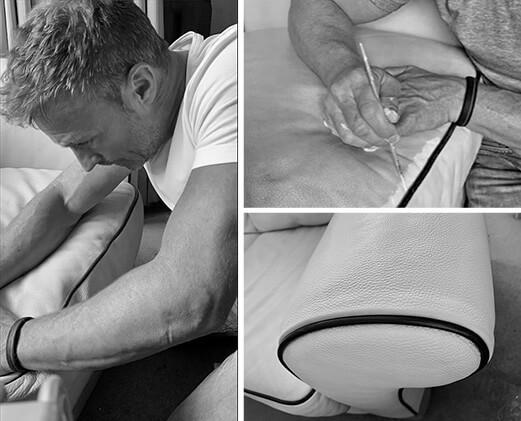
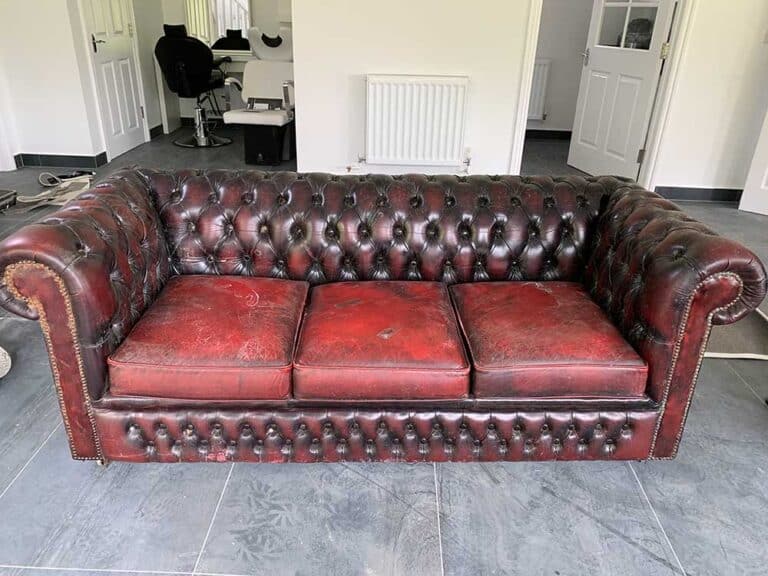
A cracked leather sofa rarely cracks overnight. It starts as a faint web of lines on the seat where you always sit, then the lines deepen, catch the light and fill with grime, and eventually the surface feels rough and the colour starts to go. It looks like the leather has died, but in most cases it has just dried out and the finish has given up, and both of those can be put right. Our leather restoration service repairs cracked seats, arms and backs across Essex and London most weeks, and this post explains what causes the cracking, what to avoid, and what a proper repair involves.
Why Leather Sofas Crack
Leather is skin, and like skin it needs a certain amount of moisture and oil to stay supple. In the tannery it is loaded with fat liquors that keep the fibres moving over each other. Over years in a warm living room those oils slowly migrate out, the fibres stiffen, and the leather stops flexing and starts breaking instead. The finish on top, the coloured coating and lacquer on most sofas, goes the same way: it dries, hardens and cracks along the lines where the leather bends most.
Jon, our founder, sees the same handful of causes over and over in homes from Canvey Island to central London.
Heat. Radiators behind the sofa, underfloor heating, wood burners and a spot under the conservatory roof all cook the oils out of a hide. A cracked leather sofa is very often one that has spent a decade next to a heat source.
Sunlight. UV light breaks down both the finish and the fibres, and a south-facing window does it fastest. The Met Office publishes UV levels for the UK, and sunny stretches in Essex are more than enough to dry and fade a sofa over a few summers. Cracking and sun fading usually arrive together, which is why we often treat them in one visit; see our sun bleached and faded leather repair page.
Body oils and sweat. Oddly, human oils do not feed leather. They soften and break down the finish, and once the finish is compromised the hide beneath dries faster. That is why headrests and the front edge of the seat crack early.
Cleaning products. Wipes, sprays and washing-up liquid strip the protective lacquer. Silicone-based polishes leave a film that stops any conditioning getting in, and then the surface cracks over a slippery, sealed skin.
Flexing. Seat cushions bend thousands of times a year. If the leather is dry, every bend is a small tear waiting to happen, which is why cracking concentrates on the seats and the tops of the arms.
Surface Cracks or Cracks Through the Hide?
Not all cracking is equal, and working out which kind you have is the first thing we do from your photos.
Finish cracking
Fine, shallow lines in the coloured coating, often in a crazed or web pattern, with sound leather underneath. If you press the area it still feels soft and flexes without splitting. This is by far the most common kind on sofas that are five to fifteen years old, and it responds very well to restoration.
Cracks into the hide
Deeper splits where the leather itself has broken. The edges are rough and fibrous, the cracks are wider and you can feel them with a fingertip. The leather around them is often stiff and papery. These are still repairable, but the work is more involved and, where a whole seat cushion has gone this way, a new panel may be the better answer.
Cracking on bonded leather
If the cracked areas are also peeling in flakes and reveal a grey, cloth-like backing, the sofa is probably bonded or bicast leather rather than real hide. That cannot be restored in any lasting way, and we will tell you so rather than take the job.
Why Olive Oil, Conditioners and Filler Kits Make a Cracked Leather Sofa Worse
Because cracking looks like dryness, the instinct is to feed the leather. Unfortunately most of what people reach for does harm.
Olive oil, coconut oil, Vaseline and baby oil are the usual suspects. On a pigmented sofa they cannot get through the finish, so they sit on top, go rancid and attract dust, leaving the seats dark and sticky. Where the finish is already cracked they soak in unevenly through the cracks, so you get dark lines where the cracks were and pale leather in between, which is far more noticeable than the original problem. None of these oils are the type leather was tanned with, and they do not restore flexibility; they just make the surface greasy.
Supermarket leather conditioners are less harmful but rarely helpful on a sofa that has already cracked. The damage is in the finish, and conditioner cannot repair a coating. Applied heavily and often, some also soften the finish further.
Filler kits and leather paint from online marketplaces promise to fill and cover the cracks. The fillers are usually stiff, the colours are approximate and the instructions skip the preparation that makes the difference. The result is a patch that is a slightly different shade, stands slightly proud, and cracks again along the same lines within months because the leather beneath is still dry and the filler cannot flex with it. Removing a failed kit repair adds real time to the professional job that follows.
How We Repair Cracked Leather Professionally
A good repair treats both problems: the leather that has dried out and the finish that has broken. Here is what that involves, in outline rather than as a set of instructions.
The panel is deep cleaned first to remove oils, silicone, old conditioner and dirt from inside the cracks, because nothing bonds to a dirty surface. Loose or lifting finish is removed so we are working on a stable base, and the exposed leather is conditioned with products designed for upholstery hide, which restore some of the suppleness the fibres have lost.
Cracks are then filled with flexible fillers built up in thin layers and smoothed level with the surrounding surface. On finish cracking this is light work; on deeper cracks it takes longer and may involve a sub-patch behind the leather where a split has opened. The repaired area is then recoloured with pigment mixed to match your sofa in daylight, blended out across the panel so there is no edge, and sealed with a flexible lacquer in the right sheen. Where the whole sofa has faded as well as cracked, we usually suggest recolouring the lot, which you can see on our leather sofa recolouring page.
The repair is normally done at your home, often in a day, and the sofa can be used once the finish has cured. Jon will also tell you what caused the cracking and how to keep it from coming back, which usually starts with moving the sofa a foot away from the radiator.
When Restoring a Cracked Sofa Is Not the Best Answer
If a seat cushion has cracked right through across most of its surface and the leather feels brittle everywhere, filling every crack would be slow, expensive and unlikely to last. In that case we recommend a replacement panel cut from matching hide, with the rest of the sofa cleaned and recoloured to blend. It is a bigger job than a repair but far smaller than a new sofa.
If the sofa is bonded leather, or the frame is broken, or the cushions have collapsed and the leather has cracked as a result of sitting on the frame, we will talk you through whether it is worth spending anything at all. We would rather you kept your money than paid for a repair we do not believe in.
For everything in between, which is most cracked sofas we see in Basildon, Billericay, Brentwood and across London, restoration is well worth it. A good sofa with cracked seats is still a good sofa.

Get a Quote to Repair Your Cracked Leather Sofa
If you have a cracked leather sofa and would like it looked at, send us a close-up photo of the cracking in daylight, one of the whole sofa, and a note of where it sits in the room (near a radiator or window is useful to know). Tell us roughly where you are in Essex or London and Jon will tell you whether it is finish cracking or deeper, what the repair involves and what it will cost. Quotes are free.
Call Jon on 07967 216250 or fill in the enquiry form below this post, and see examples of cracked and worn sofas brought back on our leather restoration service page.