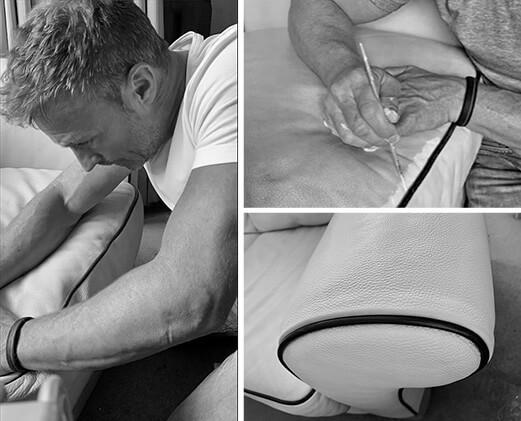
Cracked leather car seats can be restored in the great majority of cases, and the repair is usually done on your driveway or in the office car park rather than at a garage. Cracking is a surface problem to begin with: the finish has dried out and split, while the hide underneath is still perfectly sound. Caught at that stage, our leather car seat repair service can rebuild the surface, restore the colour and leave the seat looking and feeling as it should. Left for a few more years, the cracks go through the hide itself, and the options narrow.
Why car leather cracks in the first place
A car interior is a harsh place for leather. In summer a black seat behind a windscreen in a Southend-on-Sea car park can reach temperatures that would be uncomfortable to touch. In winter the heated seat is on full for the commute up the A127. Between the two, the natural oils that keep the finish flexible are slowly baked out, and the pigment coating stiffens until it can no longer follow the movement of the hide beneath. The first fine lines appear on the driver’s seat base and the outer bolster, where the leather flexes every time someone gets in and out.
Sunlight makes it worse. Ultraviolet light breaks down both the top coat and the dyes, which is why cracked seats are so often faded seats as well. The Met Office publishes UV forecasts through the summer, and anyone who has left a car in an uncovered space in Essex through July will know how much heat and light comes through the glass.
Dirt plays a part too. Grit in the creases of a seat acts like fine sandpaper every time the leather flexes, and body oils, sun cream and hand sanitiser soften the finish so it wears through faster. A seat that is regularly cleaned and protected will crack far later than one that is not.
The stages of cracked leather car seats
Jon, our founder, tends to describe cracking in three stages, because the stage decides the repair.
Surface crazing
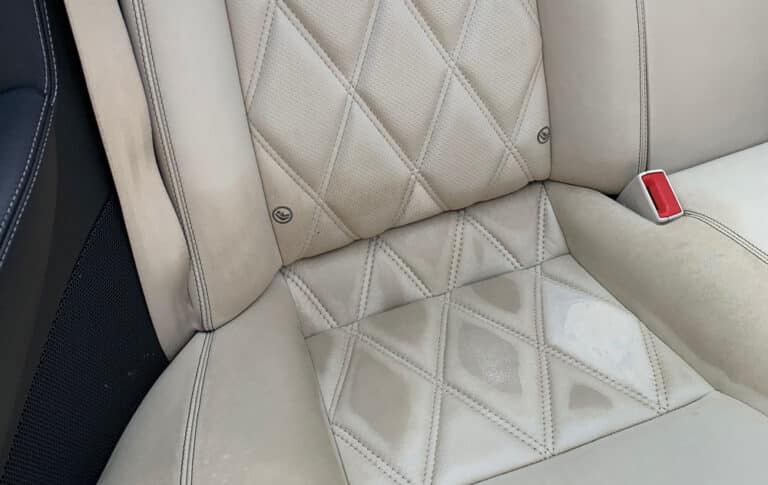
Fine lines across the finish, mostly on the seat base and bolsters, that you can feel with a fingertip but that have not opened up. The hide is intact. This is the easiest and cheapest to deal with, and it is the stage where most people first notice something is wrong.
Open cracks
The lines have opened into small channels, the colour has worn off along the edges and the leather looks grey or pale in the cracks. Dirt collects in them. The hide is still sound but the finish has gone completely in those areas, and the leather beneath is beginning to dry out.
Cracks through the hide
The cracks have gone through the leather itself, often on the driver’s bolster or the front edge of the seat base. The edges are hard and papery, and small pieces may be breaking away. At this point a straightforward refinish will not hold, and we are looking at a more involved repair or a new panel.
Why the kits and quick fixes do not work
The internet is full of “leather repair kits” aimed at car owners, and we see the results of them every week. The filler in the kit is applied over the cracks without the surface being properly prepared, so it lifts within weeks. The colour comes from a chart of a few generic shades, so a “black” that is actually a slightly warm charcoal ends up with a patch of cold blue-black on the bolster. The sealant is either missing or wrong, so the repair goes sticky in warm weather and picks up dirt.
Worse are the household ideas. Shoe polish clogs the cracks and transfers to clothes. Olive oil and other kitchen oils soak in, go rancid and darken the leather unevenly. Silicone dashboard sprays leave a film that stops any proper finish from bonding later. And spray dyes from the motor factors sit on the surface like paint, then crack and peel in sheets, taking what remained of the original finish with them.
We are not going to describe how to attempt any of this, because we do not want you to. Each one of these products makes the eventual professional repair harder, and sometimes turns a simple refinish into a panel replacement. If your seats are cracking, the cheapest thing you can do is leave them alone and call us.
How we restore cracked leather car seats
The process depends on the stage, but the principles are the same whether it is a five-year-old Audi in Basildon or a twenty-year-old Jaguar in Leigh-on-Sea.
We start with a thorough clean, because nothing bonds to grime and old conditioner. Then the cracked area is prepared so that the old, failed finish is removed where it needs to be and the surface is smooth. Open cracks are filled with a flexible filler designed for automotive leather, built up in thin layers and levelled so the texture matches the surrounding grain. Where the hide has begun to dry out, it is softened and fed before anything goes on top.
Colour is matched to your seats, not to a chart. Car manufacturers use hundreds of shades of black, grey, cream and tan, and a repair that is “nearly right” shows up in daylight. Jon mixes the pigment to match the seat in front of him, applies it in layers so the grain still shows through, and finishes with a sealant and lacquer that match the original sheen. The result is a seat that flexes, feels right and stands up to daily use.
For seats where cracks have gone through the hide, we can reinforce from behind, rebuild the damaged section and then refinish. In the worst cases we replace the panel, cutting new leather to match and fitting it so the seam is where the manufacturer put it. That is workshop work, but it is still a far smaller undertaking than replacing the seat.

Restoring the rest of the interior at the same time
Cracked seats rarely arrive alone. The steering wheel is often shiny and worn where hands sit at ten and two. The gear knob has lost its colour. The door cards are scuffed from shoes and shopping bags, and the rear seats have the marks of a child seat and a dog. Because we are already at the car with the colour mixed, it makes sense to deal with all of it in one visit, and we will quote for that if you want it.
The same goes for faded leather. A sun-bleached driver’s seat in a car that has lived outside is a common sight on the coast around Canvey Island and Southend, and the fix is closely related to the crack repair: clean, prepare, and recolour so the whole interior is one even shade again. It is the same skill we use on furniture, applied to a smaller and more awkward space.
What affects the time and cost
Every job is quoted individually, and quotes are free, but a few things move the price. Surface crazing on one seat is a small job that can be done in a couple of hours. Open cracks across the driver’s seat and bolster take longer because of the preparation and layering involved. Cracks through the hide, or a full interior refresh, are larger jobs.
Leather type matters as well. Most modern cars use pigmented leather, which repairs and recolours very well. Some prestige cars use semi-aniline hides that need a different approach and a lighter touch. Perforated seats with heating and ventilation need care so the holes are not filled in. None of this is a problem, but it is why we ask for photos before we quote.
When a seat is beyond repair
Occasionally it is. If the hide has cracked through across most of the seat, the foam beneath has collapsed and the stitching has failed as well, a full refinish is not worth doing on a car with modest value. We will tell you that honestly, and we can talk through whether a replacement panel or a full leather restoration makes sense for the car you have. On a classic, a prestige model or simply a car you love and intend to keep, restoration is almost always worthwhile.
Get a quote for your cracked leather car seats
If you are in Essex, London or the surrounding area and your car seats have started to crack, send us a couple of photos in daylight: one close up of the worst area and one showing the whole seat. Tell us the make and model, and roughly where the car is kept. That is usually enough for us to tell you which stage you are at and what the repair will involve.
Call Jon directly on 07967 216250 or fill in the enquiry form below this post. You can read more about our leather car seat repair service first. Every quote is free, and most repairs are done at your home or workplace.