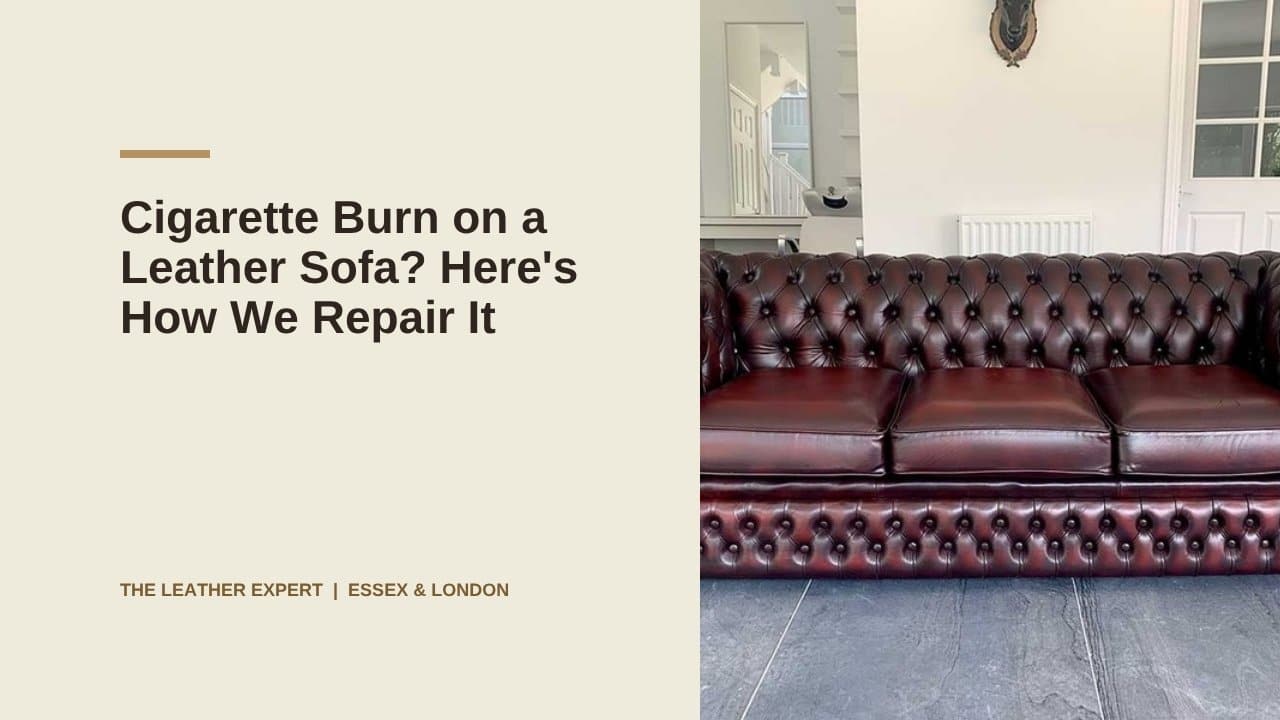
A cigarette burn on a leather sofa is small, dark, hard-edged and impossible to stop looking at, but it is also one of the most satisfying repairs we do, because a burn that has not gone through the hide can usually be made to disappear completely. A hot ash mark on a cushion, a cigar burn on the arm of a Chesterfield, a scorch from a dropped lighter, or a melted spot from an e-cigarette coil all fall into the same category. This post explains what a burn does to leather, why picking at it or filling it yourself makes things worse, and how Jon repairs it so you cannot find the spot afterwards.
What a cigarette burn does to leather
Leather does not catch fire easily, which is one reason it has always been a good material for sofas. What a cigarette does instead is scorch and shrink it. The heat destroys the pigmented finish at the point of contact, then hardens and contracts the hide fibres beneath, leaving a small crater with a raised, brittle rim. The centre is usually black or dark brown, and on a pale sofa there is often a yellow-brown halo of heat damage around it.
How deep it goes depends on how long the contact lasted. A glowing ember that rolls off a cushion straight away might only mark the finish. A cigarette that was left resting on the arm while someone answered the door can burn through the hide and into the foam. The two look similar from a distance but need different repairs, which is why we always ask for a close-up photo.
A cigarette burn on a leather sofa turns up in the same places time after time: the arm on the side where the ashtray used to be, the front edge of the seat cushion, the back cushion where a cigarette was held over the shoulder, and on furniture that has come from a pub, club or a smoker’s house in Thurrock or Romford and been passed on to a family member who does not smoke.
Types of burn damage we see

Surface scorches
The finish has been discoloured or blistered but the leather beneath is intact and still flexible. Run a fingertip over it and it feels rough but there is no hole. These are the easiest to repair and the result is usually invisible.
Shallow craters
The most common type. The burn has gone into the hide, leaving a small pit with hardened edges, but the leather has not been breached. This needs the burnt material removing, the crater filling and levelling, and the colour and grain rebuilding over the top.
Through burns
The cigarette has gone all the way through the leather and you can see foam or lining underneath. These need a backing patch inserted behind the hole before it can be filled, in the same way as a puncture or small tear. Our leather burn marks repair service covers all three types, and the approach is decided at the assessment stage.
Multiple burns and old pub furniture
Sofas and armchairs that have come out of pubs, clubs and smoking rooms often carry a dozen or more burns of different ages, along with nicotine staining that has yellowed the whole piece. On those, individual repairs are combined with a full clean and, usually, a recolour of the affected panels so everything ends up the same shade.
Why home repairs of a cigarette burn on a leather sofa go wrong
The first thing many people do is pick at the burn with a fingernail to remove the black bit. That takes the crater from a few millimetres across to a centimetre, and pulls hardened fibres out of the surrounding leather, which makes the eventual repair larger and harder to blend. If you do nothing else, please do not pick at it.
The next stop is usually a leather repair kit from the internet. The filler in these kits is often quite rigid and is applied straight into an unprepared crater, so it either sinks and cracks or sits proud as a hard bump. The colour is a generic shade from a chart, applied over the filler with a little brush or sponge, and the result is a dot that is a slightly different colour, texture and sheen to everything around it. The eye finds it just as quickly as it found the burn. Jon has removed a great many of these kit repairs from sofas in Chelmsford and Colchester before starting the proper job.
Marker pens, shoe polish, nail varnish and superglue all get used as well. The pen colours bleed and rub off. Polish and nail varnish sit on the surface and look glossy. Superglue goes white, goes hard and takes some of the surrounding finish with it when it is eventually removed. None of these are helping, and all of them make the professional repair longer.
How we repair a cigarette burn professionally
Every cigarette burn on a leather sofa gets the same first step: Jon looks at the burn, the leather type, the finish and the surrounding area. He checks whether the hide has been breached, how hard the rim of the burn is, and whether the colour and grain around the burn will be easy or difficult to match. Deep-grained, two-tone or antiqued leathers, such as many Chesterfields, take more work to blend than a plain flat colour.
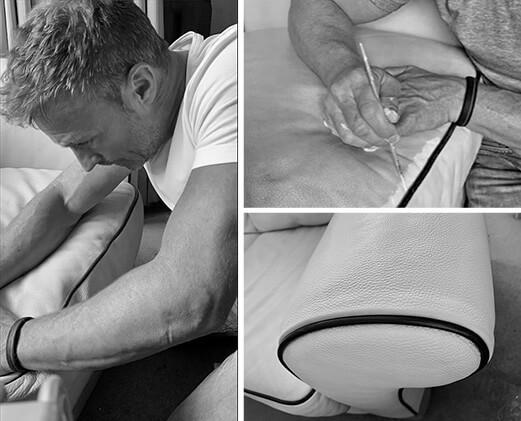
The burnt material is carefully removed and the hardened rim is dealt with so the edges of the crater are sound and flexible again. If the burn has gone through, a sub-patch is inserted behind the hole to give the repair something to bond to. The crater is then built up in thin layers of flexible filler, each one levelled, so the surface ends up flush with the leather around it rather than domed or dished.
Grain is the detail that separates a good repair from a visible one. The filled area is textured to match the pattern of the surrounding leather, because a perfectly smooth dot on a grained sofa shows up as clearly as the burn did. The colour is then mixed by eye to match the leather as it is now, feathered out beyond the repair so there is no hard edge, and sealed with a top coat that matches the sheen of the rest of the sofa. On a well-executed repair, even the customer struggles to find the spot afterwards.
If there are several burns across the same cushion or arm, or if the surrounding area has nicotine staining or fading as well, we will often suggest a wider leather restoration of that panel. It usually gives a more even result than a cluster of separate spot repairs.
When a burn is too big to repair
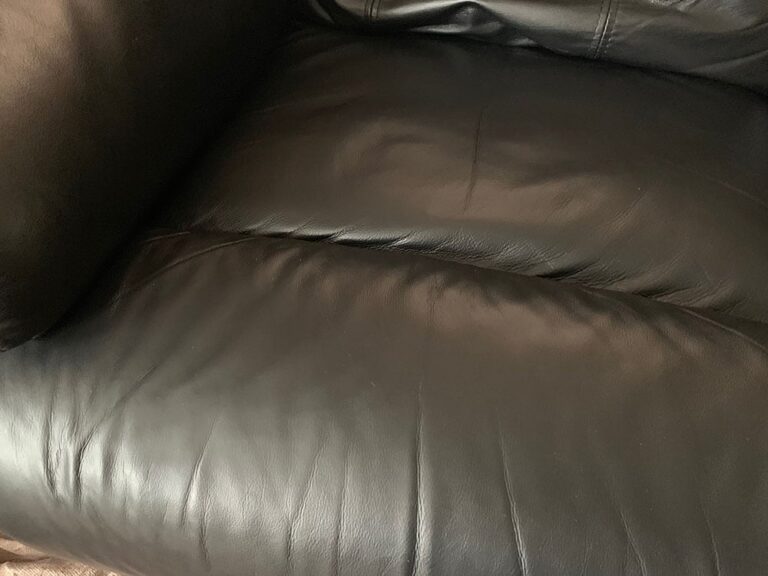
There is a size beyond which a filled repair stops being the right answer. A single cigarette burn on a leather sofa is well within range. A burn from a dropped cigar or a hot coal from a fire, a scorch from a fallen candle, or a melted patch from a heater that was too close to the arm can be several inches across, and at that size a filled and textured repair on a seat that flexes constantly will not hold indefinitely.
For those, we look at fitting a new piece of matching leather. Our replacement leather panels service replaces just the affected section, whether that is an arm facing, a cushion top or a seat front, and the rest of the sofa stays as it is. It is a bigger job than a spot repair but far cheaper than a new sofa, and it is the honest solution for large heat damage.
Modern upholstered furniture sold in the UK has to meet fire safety requirements, including a cigarette resistance test, and you can read about the regulations on GOV.UK. That is why a dropped cigarette usually leaves a small mark rather than starting a fire, but it is also a reminder that no sofa is fireproof and a burn that has reached the foam is worth dealing with promptly.
Get a quote to repair a cigarette burn on your leather sofa
If you have a cigarette burn on a leather sofa that you would like to see the back of, send us a close-up photo of it with something for scale, such as a coin, along with a photo of the whole sofa so we can see the leather and colour. Let us know roughly where you are. We cover Essex, London and the surrounding area from South Benfleet, and burn repairs are almost always done in your home in a single visit.
Call Jon on 07967 216250 or fill in the enquiry form below this post. You can see more examples on our leather burn marks repair page, and every quote is free and without obligation.