You can change the colour of a leather sofa, and there are three ways to do it: have the existing leather professionally recoloured, have the worst panels replaced in new leather of the colour you want, or have the whole sofa reupholstered. Each suits a different sofa and a different budget. Recolouring is the right answer for most people, because it keeps the original leather and costs the least, but it is not the only option and it is not always the best one. This post compares the three so you can decide which fits your sofa.
We are The Leather Expert, based in South Benfleet in Essex and working across Essex and London. Jon, our founder, has been changing the colour of leather furniture for 26 years, for homes and for retailers including John Lewis and Natuzzi. Our leather sofa dyeing service is the first of those three options, and we offer the other two as well, so the advice you get from us is not tied to selling one of them.
Option One: Professional Recolouring
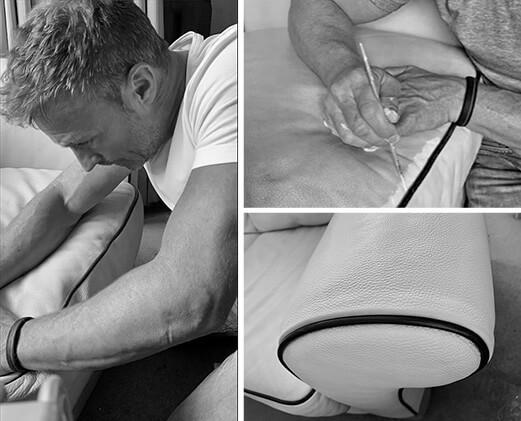
This is what most people mean when they ask about changing the colour. The existing leather stays on the sofa. It is deep cleaned and prepared so the old finish will accept new colour, any damage is repaired, and a new pigmented colour is built up in thin layers across every panel before being sealed with a top coat that gives the sheen and protection the sofa had when new.
The advantages are obvious. The sofa never leaves the house in most cases, the job takes a day or two, and it is by far the cheapest of the three options. The result on a pigmented leather sofa is very convincing; people who visit afterwards assume it is a new sofa. Going darker is straightforward. Going lighter is possible but takes more work, and very light colours over very dark leather are the hardest change to do well.
The limits are the leather itself. Recolouring needs a sound surface to bond to. Cracks and worn patches are repaired first, but leather that has dried out and crumbles, or bonded leather that is peeling, will not hold a new colour for long. Aniline leather can be recoloured, but it loses its natural, open look and becomes a solid pigmented finish, which some owners love and some do not. If you want to see the finish before you decide, our recolouring overview shows examples across sofas, chairs and Chesterfields.

Option Two: Replacement Panels
Sometimes the sofa is a mix of good and bad. The seat cushions on a sofa in a busy family home in Brentwood have worn through, but the back and arms are barely touched. Or a bonded leather sofa has peeled on the seats while the sides are intact. In those cases, replacing the damaged panels in new leather and recolouring the rest to match can make sense.
This is a middle option in cost and effort. New leather has to be sourced, cut and fitted, so the sofa or the cushions usually come to our workshop for a period. The new leather can be any colour you like, and the remaining original panels are recoloured to match it, so the sofa changes colour as a whole. It is a good route for sofas where one part has failed badly and the rest is sound, and it is the only realistic option for bonded leather seats that have started to peel. You can read more on our replacement leather panels page.
Option Three: Full Reupholstery
Reupholstery means stripping the old leather off completely and re-covering the frame in new hide. It is the most expensive way to change the colour of a leather sofa, and it is also the most complete. You choose the leather, the colour and the finish from scratch, the cushions and springs can be renewed at the same time, and the result is effectively a new sofa on a frame you already know is comfortable.
It is the right answer for a small group of sofas: antique and vintage pieces, high quality Chesterfields and designer sofas with hardwood frames, and heirloom furniture where the frame matters more than the covering. For a mid-range sofa from a high street retailer, reupholstery usually costs more than the sofa is worth, and recolouring gives most of the result for a fraction of the price. Our leather sofa reupholstery page explains what is involved.
How to Change the Colour of a Leather Sofa the Right Way
Whichever option you choose, a few things make the difference between a sofa that looks made that way and one that looks done.
Match the colour in your room, not a showroom
Jon mixes colour by hand and checks it in the light of the room the sofa lives in. Greys go blue under north light and warm under lamps. A tan that looks rich in a bright conservatory in Leigh-on-Sea can look orange in a dark lounge in Romford. Getting this right is a skill, and it is the main reason home dye kits disappoint.
Deal with the damage first
New colour highlights old damage. Cracks, scratches, worn seat fronts and stains are repaired and levelled before any colour goes on, otherwise the fresh finish simply draws the eye to them. We treat a colour change as a restoration with a new colour at the end, not as a paint job.
Do the whole sofa
Backs, sides, the base rail and the reverse of cushions all need doing. A sofa that is a new colour on the front and the old colour on the back looks exactly that.
Use the right finish
The top coat decides how the sofa looks in the light and how it wears. Matt, satin and gloss all have their place, and matching the original sheen (or the sheen you want) is part of the job. A sofa with the wrong sheen looks plasticky even if the colour is perfect.
Why Not Just Buy a Dye Kit?
Because the results are poor, and Jon has seen the evidence hundreds of times. Kits are applied over a surface that has not been properly prepared, so the colour does not bond, wears through on the arms within weeks and transfers onto clothes. The colours are generic and cannot be matched to your room. Sponges and brushes leave streaks that show in daylight, and spray products overspray onto carpets and walls. When the sofa then comes to us, the failed product has to be stripped off before we can start, which makes the professional job more expensive than it would have been.
There is a fairness point too. If your sofa is fairly new and the colour is failing on its own, that may be a fault rather than wear, and the retailer might be responsible. The guidance on faulty goods from Which? is worth ten minutes of your time before you buy any product or book any repair.
Which Option Is Right for Your Sofa?
If the sofa is real leather in reasonable condition and you simply want a different colour, recolouring is almost certainly the answer. If one part has failed badly or you have bonded leather that is peeling on the seats, replacement panels are worth discussing. If the sofa is a genuinely fine piece with a frame worth keeping for another few decades, reupholstery is the route. If the sofa was inexpensive and the frame and cushions are tired, we will tell you honestly that new furniture may be the better use of your money.
The only way to be sure is to have someone who does all three look at it, which is what we offer. However you decide to change the colour of a leather sofa, every job is quoted individually, and quotes are free.
Get a Free Quote to Change the Colour of Your Leather Sofa
Send us a couple of photos of the sofa in daylight, a photo or description of the colour you are after, and a note of any damage. Tell us roughly where you are, whether that is Southend-on-Sea, Billericay, Chelmsford, Colchester or anywhere in east and central London.
Call Jon on 07967 216250 or fill in the enquiry form below this post, and he will tell you which of the three options suits your sofa and what it will cost. There is more on the process on our leather sofa dyeing page.