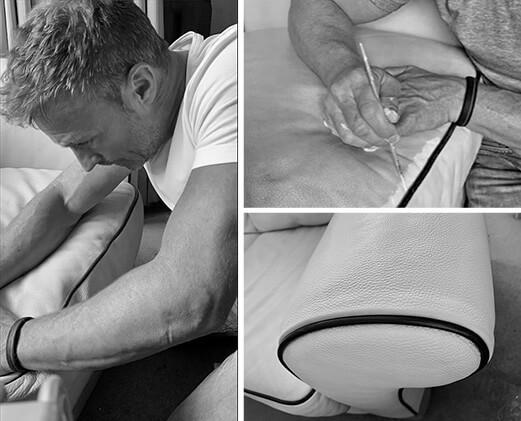
Can you recover a leather sofa? Yes. A leather sofa with a sound frame can be recovered in new leather, or in fabric if you fancy a change, and the result is effectively a new sofa built on the bones of one you already know is comfortable. It is a bigger job than a repair or a recolour, and it is not the right answer for every sofa, so this post walks through when recovering makes sense, what the process involves, the choice between leather and fabric, and the cheaper alternatives that are sometimes a better fit.
Recovering, reupholstering and recolouring: what is the difference?
People use these words loosely, so it is worth being clear. Recovering or reupholstering a sofa means stripping off the existing leather covers and fitting new ones, made to measure, over the original frame. It usually includes checking and refreshing whatever is underneath: webbing, springs, padding and cushion foam.
Recolouring, by contrast, keeps the existing leather and rebuilds the colour and finish on top of it. It is far less invasive and considerably cheaper, and for a sofa that is faded, scuffed or simply the wrong colour it is often all that is needed. We cover it in detail on our leather sofa recolouring page, and it is the first thing Jon considers before suggesting a full recover.
Repair sits in between: replacing a single worn panel or cushion cover while leaving the rest of the sofa alone. So when someone asks can you recover a leather sofa, the first job is working out which of the three they actually need, because that saves money, and it is one of the main things we help customers work out.
Can you recover a leather sofa that is worn out?

The decision rests almost entirely on the frame. A good sofa, the kind sold by John Lewis, Natuzzi or a traditional Chesterfield maker, has a hardwood or good quality engineered frame that is glued, screwed and dowelled. Those frames outlast the leather on them several times over. If the frame is solid, does not creak or rock, and the arms do not wobble, then recovering it is a sensible investment.
A cheap sofa with a stapled softwood or chipboard frame is a different story. The leather may well have failed at the same time as the frame, and there is not much point putting new covers on a sofa that will sag or crack within a couple of years. Jon will tell you honestly when a sofa is not worth recovering, and he turns down jobs on that basis fairly regularly.
The other signs that point towards a full recover rather than a repair are widespread damage across several panels, leather that has become thin or brittle all over, previous poor-quality repairs or home dye jobs that would take longer to strip than to replace, and a wish to change the material entirely.
New leather or fabric?
Because the old covers come off completely, the question of can you recover a leather sofa in something other than leather has a simple answer: you are free to choose what goes back on. Most of our customers stay with leather, often in a slightly different colour or a different type. Somebody with a tired brown pigmented sofa in a Brentwood family room might choose a softer, more natural semi-aniline in a warmer tan, for instance.
Fabric is a real option too. Velvet, linen blends and hard-wearing woven fabrics all suit the shape of most leather sofas, and on a Chesterfield the deep buttoning looks striking in a rich velvet. The main things to bear in mind are that fabric wears differently from leather, stains more readily unless it is treated, and needs a different approach to cleaning. If the sofa is in a household with young children or a large dog, leather remains the more forgiving choice in the long run.
Whatever material you choose for the home, it needs to meet the UK’s furniture fire safety rules. Upholstery fabric and fillings used on domestic furniture must comply with the regulations set out on GOV.UK, and we only use compliant materials and foams.
What recovering a leather sofa involves
Our leather sofa reupholstery service starts with a survey. Jon looks at the frame, the springing, the condition of the cushions and the way the original covers were cut and fitted. Some sofas are straightforward, with simple loose covers and plain panels. Others, particularly buttoned Chesterfields and curved corner suites, are complex pieces of pattern-cutting, and the time involved reflects that.
Stripping and inspection
The old leather is removed panel by panel. This is the point at which any hidden problems show themselves: broken springs, tired webbing, foam that has collapsed on one side because that is where everyone sits. All of that is put right before anything new goes on, because there is no sense fitting a beautiful new cover over a sagging seat.
Cushions and padding
Seat cushions are very often replaced at the same time. Foam has a working life of perhaps ten to fifteen years depending on quality and use, and if the leather has worn out, the foam is usually not far behind. Our new foam cushions service cuts replacement cores to the exact size and firmness required, and doing it as part of a recover is the most economical time to do it.
Cutting and fitting the new covers
The new leather or fabric is cut using the old covers as templates, adjusted where the originals had stretched or where a better fit is possible. The covers are sewn, fitted, stretched and fixed to the frame in the traditional way, with piping, buttoning and any decorative detail reproduced to match. On a leather recover, hides are selected so that the grain and colour are consistent across the whole sofa.
Finishing
The finished sofa is checked, cleaned and, in the case of leather, given a protective treatment before it goes back into the room. The end result is a sofa that is new in every respect except the frame, which is the one part that was worth keeping.

Home or workshop?
Most of our repair and recolouring work is done in the customer’s home. Recovering is different. Stripping a sofa back to the frame and rebuilding it is workshop work, so the sofa is collected from your home, recovered at our workshop near South Benfleet and returned when it is finished. For customers in Southend-on-Sea, Rayleigh, Canvey Island and across Essex and London, this is straightforward to arrange, and we will talk you through timings when we quote.
If only one or two panels have failed, or a single cushion cover has split, the job can often be done as a panel replacement without the whole sofa leaving the house. It is worth asking, because it is a much smaller undertaking.
Is recovering good value?
Can you recover a leather sofa without spending more than it is worth? Usually, but we are not going to quote prices here because every sofa is different: size, shape, the amount of leather needed, the complexity of the pattern, the state of the frame and cushions, and the material you choose all move the figure. What we can say is that recovering a good quality sofa is normally a fraction of the cost of buying an equivalent new one, and you keep a sofa you know fits your room and suits your back. For a cheap sofa it rarely makes sense, and we will say so rather than talk you into it.
It also helps to remember that recovering is not the only route. A great many sofas that customers assume need new leather are actually candidates for recolouring or a couple of replacement panels, which cost far less. Jon has 26 years of looking at worn sofas and will point you to the cheapest option that will genuinely last. Every job is quoted individually, and quotes are free.
Get a quote to recover your leather sofa
If you are still wondering can you recover a leather sofa like yours, send us a few photos of it in daylight, including any damaged areas, the underside if you can manage it, and a shot of the whole piece so we can see the shape. Let us know where you are and whether you are thinking of leather or fabric. We cover Essex, London and the surrounding area.
Call Jon on 07967 216250 or fill in the enquiry form below this post. There is more detail and examples of finished work on our leather sofa reupholstery page, and every quote is free and without obligation.