Can you paint a leather sofa? Technically, yes. There are leather paints, chalk paints, acrylics and spray kits that will all go onto a sofa and change its colour for a while. The problem is what happens afterwards. Paint sits on top of leather, and leather moves. Within weeks or months the paint cracks along the creases, flakes off the seats and the arms, transfers onto clothing and leaves the sofa looking worse than the tired original ever did. We know this because a fair proportion of the sofas we recolour in Essex and London arrive with somebody’s paint job already on them.
This post is an honest comparison between painting a sofa and having it professionally recoloured. They sound similar. They are not. If you have a good sofa in the wrong colour, or a sofa whose colour has worn and faded, our leather sofa recolouring service will give you a result that lasts, and we would like to explain why.
Why people want to paint a sofa in the first place
The reasons are all perfectly sensible. A cream sofa has gone grubby and the owner wants it darker. A tan sofa clashes with a newly decorated living room in Billericay. A black sofa inherited with a flat in Stratford does not suit the new owner. The seats and arms have worn pale and patchy on an otherwise sound ten year old suite. Or a sofa bought second hand is the right shape and the wrong colour.
In every one of those cases, changing the colour is a reasonable idea. The sofa is structurally fine, the leather is real, and replacing it would cost thousands. Where it goes wrong is the assumption that colour on leather works like colour on a wall, where anything that covers the surface will do.
So, can you paint a leather sofa and expect it to last?
No, and the reason comes down to what leather is and how it was finished in the first place.
Most sofa leather has a thin coloured finish bonded to the surface of the hide at the tannery. That finish is designed to stretch, compress and recover thousands of times a day without cracking, because that is what leather does when it is sat on. It is also formulated to bond to the leather and to itself, layer to layer, so it moves as one skin.

Household paints are designed for surfaces that stay still. Chalk paint, emulsion, acrylic and most spray paints dry to a film that is far stiffer than leather. It looks fine on the back of the sofa, where nothing flexes, and it fails on the seats, the front edge of the cushions and the tops of the arms, which is precisely where everybody looks. The film cracks along the creases, the cracks widen, and the paint starts to flake. On a dark colour over a pale sofa the flakes expose the old colour in a network of pale lines that no touch up will hide.
Even the products sold as leather paint suffer from a version of this. Applied thickly with a brush or a sponge, without proper preparation of the surface and without a compatible sealer, they build up in the grain, lose adhesion where the old finish was still intact, and go tacky in warm weather. The results are variable and, in our experience, short lived.
The preparation problem
The other reason home painting fails is that the old finish is rarely dealt with properly. Leather that has been conditioned, polished or wiped with silicone products has a surface that nothing will stick to. Leather that has body oils in the headrests and arms has the same problem in the worst places. Paint applied over that will peel from those areas first, which is why a painted sofa so often has a perfectly good back and shedding arms.
What professional recolouring does differently
Recolouring is not painting with better paint. It is a process of rebuilding the leather’s own type of finish, in a matched colour, so that the sofa ends up with the same kind of flexible, bonded surface it left the factory with.
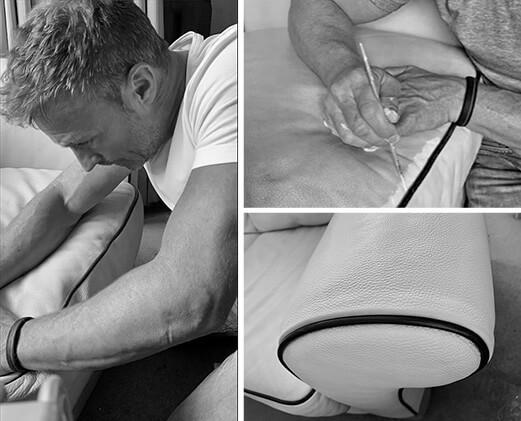
Jon, our founder, starts by identifying the leather and its existing finish, because a pigmented hide, a semi aniline and a waxed pull up leather each need a different approach. The sofa is then cleaned deeply and the surface is prepared so that every trace of old conditioner, silicone, body oil and loose finish is removed. This stage takes longer than most people expect and it is the part that home kits skip entirely.
Any damage is repaired before colour goes anywhere near the sofa. Cracks are filled with flexible compounds, worn patches are stabilised, scratches and scuffs are levelled. Then the colour is mixed by eye. For a like for like recolour that means matching the original shade exactly. For a colour change, going from cream to a dark grey for instance, it means building the new colour in a way that will cover fully without going on too thick.
The colour is applied in several fine, even coats using pigments made for leather, which stay flexible when they cure and bond to the prepared surface. A protective top coat is then applied in the correct sheen, matt, satin or gloss to suit the sofa, which seals the colour and gives it the same wipe clean, wear resistant surface as a new sofa. The whole thing flexes as one, which is why it does not crack on the seats the way paint does.

Recolouring, dyeing and colour changes
People use the words interchangeably, but they describe different things. Recolouring rebuilds a pigmented finish on top of the hide, and it is the right approach for the vast majority of sofas. Leather sofa dyeing puts colour into the hide itself and is used on aniline and waxed leathers where a surface coating would spoil the natural look. A full colour change from light to dark is straightforward with recolouring. Going from dark to light is possible but takes more coats and more skill, and Jon will be honest about which changes will look natural on your particular sofa.
Can a painted sofa be rescued?
Usually, yes. If you asked “can you paint a leather sofa” a year ago and went ahead, all is not lost, but the rescue costs more than it would have done to recolour the sofa in the first place, because the paint has to come off before anything else can happen. Stripping a painted sofa is slow, and if a solvent based paint has been used it can have damaged the finish and the hide underneath. Once it is off we assess what is left, repair any damage and recolour as normal. Where the paint has soaked into an unprotected leather it may not all come out, and in a few cases we have had to replace panels. Our broader leather restoration service covers that kind of work.
If you have already painted a sofa and it is starting to fail, the most useful thing you can do is stop adding coats. Every extra layer is another layer to strip.
Is recolouring worth it on your sofa?
Recolouring makes sense when the leather is real and the sofa is worth keeping: a good quality frame, sound cushions, a design you like. It restores a worn, faded or patchy sofa to a uniform colour and it can change the colour altogether. It is a much smaller outlay than replacing a decent sofa, and the result, done properly, is a sofa that looks new rather than a sofa that looks painted.
It is not the answer for bonded leather or coated fabrics that are peeling, because there is nothing sound to bond to, and it will not fix leather that has dried out so badly it is cracking through. Jon will tell you if your sofa falls into either category. He would also point you to the trade body Leather UK if you want to understand what kind of leather you have and how it was finished, because the answer to “can you paint a leather sofa” is really the answer to “what is my sofa’s finish made of”.
Get a quote to recolour your sofa properly
Send us two or three photos in daylight showing the whole sofa and the worst of the wear, tell us what colour you want (a photo of a swatch or a cushion you are trying to match is ideal), and let us know roughly where you are. We recolour sofas across Essex and London, from South Benfleet, Rayleigh and Leigh-on-Sea to Chelmsford, Brentwood, Romford and central London, and most recolouring is done in your home.
Call Jon on 07967 216250 or fill in the enquiry form below this post. You can see examples of colour changes and refreshes on our leather sofa recolouring page. Every job is quoted individually, and quotes are free.