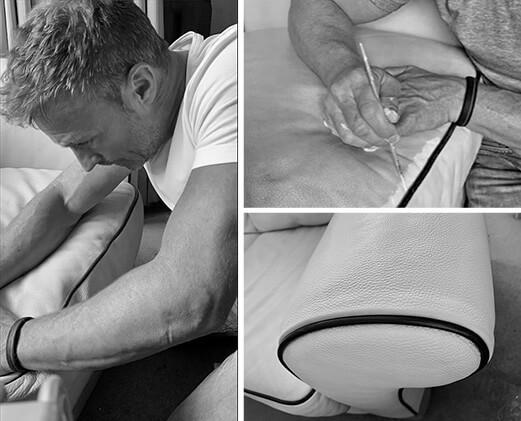
Yes, in nearly every case the answer to can sofa cushions be refilled is a straightforward yes, and it is one of the best-value jobs we do. The leather cover on a seat cushion very often outlasts the foam inside it by years, so when a seat goes flat, lumpy or tips you towards the middle of the sofa, the fix is usually new foam cut to shape and fitted into the existing cover rather than a new sofa. Our new foam cushions service does exactly that for customers across Essex and London.
Here we explain why cushions sag, what your options are for refilling them, why the cheap fixes people try rarely work, and how to tell whether the cushions or the sofa underneath them are the real problem.
Why Sofa Cushions Sag in the First Place
Foam is a network of tiny air cells. Every time someone sits down those cells compress, and every time they get up they spring back. Over thousands of cycles the cell walls weaken and stop springing back fully. That is what you feel when a seat that used to be firm now bottoms out against the frame.
How quickly it happens depends on the grade of foam the maker used, how many people sit on that particular seat, and how heavily. On most family sofas the middle or the end nearest the television goes first because that is where everyone sits. It is very common for us to see a three-seater in a house in Basildon or Billericay where one cushion is fine and the other two are half the height they were.
Heat speeds the process up. Foam next to a radiator or in a conservatory dries out and goes crumbly. Moisture does the opposite and makes it soft and heavy. Fibre-filled and feather-filled cushions do not so much sag as flatten and migrate, so you get a lump at one end and nothing at the other.

Can Sofa Cushions Be Refilled on Any Type of Sofa?
Almost all of them. The main thing we need is a cushion cover that comes off, or that can be opened along a seam and closed again. Loose seat and back cushions with a zip are the easiest. Cushions that are sewn shut can still be done; we open a seam, fit the new filling and re-sew it, and our leather sofa stitching work means the closed seam looks like it did from the factory.
Fixed seats, where the leather is stapled to the frame over the foam, take more work but are still refillable. The leather has to be released, the old foam replaced, and the cover pulled back over and refixed. That is a workshop job rather than a visit, but it is a normal part of what we do.
The one thing that occasionally stops a refill is a cover that is itself worn out. If the leather on the seat is cracked right through or torn along the piping, new foam will show every flaw as it pushes the cover back into shape. In that case we would talk about replacing the panel or, on a good frame, full leather sofa reupholstery at the same time.
Your Options for Refilling
New foam cut to size
This is the option most people want. A block of upholstery-grade foam is cut to the exact dimensions of the original, usually a touch oversized so it fills the cover properly and gives a crisp, plump edge. We choose the density and firmness to suit the sofa and the people using it. A young family who want a seat to bounce back after the children have jumped on it needs something different from a couple in their seventies who want an easy seat to rise from.
Foam with a fibre wrap
Wrapping the foam core in a layer of polyester fibre gives a softer, more rounded look and a gentler first sit, without the total collapse you get from an all-fibre cushion. It is a good match for sofas that had a soft feel from new and where the owner does not want a hard, boxy seat.
Feather and down
Some higher-end sofas came with feather-wrapped or feather-filled cushions, and the owners love the look. Those can be replenished or replaced with new feather pads, though it is worth knowing that feather always needs plumping and will always settle. We will tell you honestly if a foam core with a feather wrap would give you the look you like with less maintenance.
Back cushions
Back cushions are usually fibre and go flat and lumpy rather than collapsing. They can be refilled with new fibre, or with a fibre-wrapped foam insert if you want them to hold their shape better. Doing the backs at the same time as the seats keeps the whole sofa looking consistent.
Why the Quick Fixes Do Not Work
The internet is full of suggestions: stuff the cover with old pillows, slide a piece of plywood underneath, buy a cheap foam topper and cut it with a bread knife. Jon, our founder, has opened a good many cushions in Essex living rooms and found pillows, cut-up duvets, bubble wrap and in one memorable case a folded yoga mat inside.
The trouble with all of these is that they are the wrong shape and the wrong density. Pillows make a lumpy seat that migrates every time you sit. Plywood under a cushion stops it bottoming out but gives you a hard, dead sit and puts strain on the frame and the springs underneath. A cheap topper cut by hand is never square, so the cover puckers and the cushion twists.
Cheap foam bought online is the most common disappointment. Much of it is low-density packaging-grade material that feels fine for a week and then collapses faster than the original. It is also worth remembering that upholstery foam in the UK has to meet fire safety standards; the GOV.UK guidance on furniture fire regulations is clear about this, and foam of unknown origin may not comply. We only use foam that meets the required standard.
What Happens When We Refill Your Cushions
We start by measuring the cushions and covers accurately, checking the condition of the leather and the closures, and talking to you about how the sofa is used and how firm you want it. Jon will often press an old and a new sample side by side so you can feel the difference before committing.
The old fillings come out, the covers are checked and any weak seams or zips are dealt with while they are empty. The new foam is cut to the pattern, wrapped where needed, and fitted into the cover. Getting a firm, oversized cushion into a leather cover without creasing the leather is a knack; done properly it fills every corner and the seat looks like new. Most loose-cushion jobs are done in your home in a single visit, and fixed-seat jobs come to our workshop in South Benfleet and are returned.

Is It the Cushions or the Sofa Underneath?
Sometimes a seat feels saggy and the foam is actually fine. The problem is the springs or the webbing in the base, which have stretched or snapped and let the whole cushion drop. You can usually tell because the cushion looks full when you lift it off but the seat still dips when you sit down.
We check the base on every cushion job. If the support underneath has gone, refilling the cushions alone will not fix the sit, and we will say so before you spend any money. Replacing webbing or springs is a bigger job but is often still well worth doing on a quality frame, especially alongside leather restoration of a tired cover, and the finished result is a sofa that feels the way it did when it was delivered.
Is Refilling Worth It?
For a well-made sofa, nearly always. New foam is a fraction of the cost of a comparable new sofa and takes a fraction of the time, with no waiting weeks for delivery and no disposal of the old one. It also keeps a piece you have chosen and grown used to, which matters more than people expect. Where we think the sofa is not worth it, because the frame is flimsy or the leather is bonded and peeling, we will tell you straight.
Get a Quote for New Foam Cushions
If you are wondering can sofa cushions be refilled on your own sofa, send us a couple of photos: one of the sofa as a whole and one with a cushion lifted so we can see the cover and the base. Add a rough idea of where you are. We cover Essex and east and central London, from Southend-on-Sea and Canvey Island up through Chelmsford and Brentwood and into Romford and the City.
Call Jon on 07967 216250 or fill in the enquiry form below this post. There is more on our new foam cushions page, and every job is quoted individually with no obligation.