Can scuffed leather be repaired? In nearly every case, yes, and a scuff is one of the more satisfying jobs we do because the result is usually invisible. A scuff is surface damage: the protective finish and colour have been dragged or abraded off, but the leather underneath is still sound. That makes it very different from a tear or a deep cut, and it means the repair is about rebuilding the finish rather than the hide.
We repair scuffed leather on sofas, armchairs, dining chairs, car seats and headboards across Essex and London from our workshop in South Benfleet. Jon, our founder, has been at this for 26 years. In this post he explains what a scuff actually is, why the home fixes tend to make it more obvious, and what a proper repair involves.
Scuffs, Scrapes and Marks: What Is the Difference?
People use the word scuff for a range of damage, and it helps to separate them because the answer to can scuffed leather be repaired, and how, changes with each one.
A true scuff
This is a rubbed or dragged area where the colour has been worn or knocked off but the leather surface is intact. Think of a suitcase wheeled along the front of a sofa, a dining chair pushed against a table leg for years, or the corner of an armchair where a vacuum cleaner has caught it every week. On pigmented leather the scuff shows as a lighter, matt patch. On dark sofas it can look almost white.
A scrape or abrasion
Here the surface of the leather itself has been roughened or partly lifted, not just the colour. A dog’s claws skidding on a seat, a cat dragging its claws down an arm, a metal buckle scraped across a cushion or a removal trolley catching the back all tend to do this. The area feels rough and the fibres may be raised. It still repairs well but needs more preparation than a simple scuff.
Marks and transfer
Some “scuffs” are not damage at all but colour that has transferred onto the leather: black rubber from shoe heels on the base of a sofa, dye from new jeans on a cream seat, or a grey smear from a wall. These are cleaned rather than repaired, although if the cleaning has already been attempted with something harsh, the colour underneath may need attention too. Our leather stain removal page covers that side of things.
Where Scuffs Usually Turn Up
Jon sees the same locations again and again. The front base rail of a sofa, where feet and hoovers hit it. The outside arm nearest the door, where people brush past. The seat edge on the side someone always sits. The backs of dining chairs where they are tucked under the table. Car seat bolsters on the driver’s side, worn by getting in and out on the daily run from Rayleigh into London. Headboards where a bedside lamp has been knocked against them.
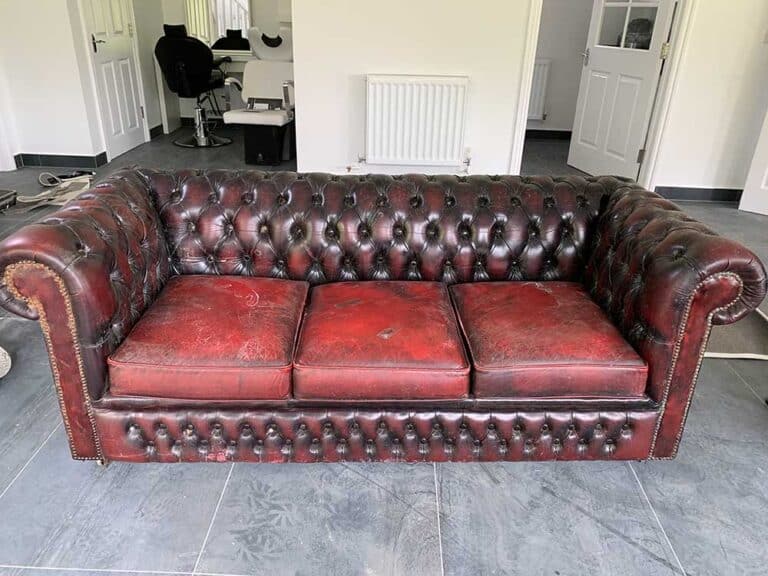
Pets and children are responsible for a fair share. A dog that jumps up onto the same cushion every day, a toddler with a toy car, a cat that treats the corner of a Chesterfield as a scratching post. None of these are unusual, and if you are asking can scuffed leather be repaired after one of them, the answer is almost always yes.
Why Home Fixes Make Scuffs More Visible
A scuff is often small, and that tempts people into trying something quick. The trouble is that a scuff sits in a highly visible spot on a smooth, uniform surface, so anything that is not an exact match stands out more than the original damage.
Shoe polish is the most common attempt. It is the wrong colour, it never fully dries on a sealed leather topcoat, and it rubs off on clothing. Leather colour pens and touch-up markers from online shops are a close second: the shades are generic, the finish is glossy where the sofa is matt, and they tend to sit as a dark blob rather than feathering into the surrounding leather. Olive oil and coconut oil darken the patch and go sticky. Nail varnish and hairspray, both suggested on forums, contain solvents that dissolve the finish around the scuff and make the damaged area larger.
On scrapes where the fibres are raised, people sometimes try to sand or shave the area smooth. That removes more of the surface than the original damage did and leaves a depression that has to be filled before any colour will look right.
The other issue is that whatever has been applied has to be cleaned off before we can do anything, and some of these products soak into the leather in a way that makes bonding new colour harder. If you have already had a go, do not worry, it is fixable; just tell us what was used.
So, Can Scuffed Leather Be Repaired Properly?
Yes. Here is what that involves in broad terms, so you know what you are paying for.
First, Jon assesses the leather type. Pigmented leather with a sealed topcoat, which covers most sofas from the big retailers and most car seats, is the simplest to repair. Aniline and semi-aniline leather, which has little or no surface coating, absorbs colour differently and needs a more careful approach. The trade body Leather UK has useful background on the different finishes if you are curious about what your sofa is made of.
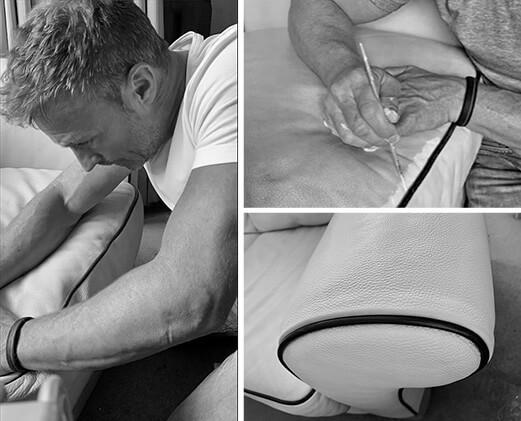
The area is cleaned to remove dirt, silicone, polish and anything else that has been applied. On scrapes with raised fibres, the surface is prepared and any roughness is levelled with a flexible filler so the texture matches the leather around it. Colour is then matched by eye to the sofa as it is now, not as it was new, and applied in fine coats that feather out into the surrounding panel. Finally a sealant and topcoat are applied to match the sheen, whether that is matt, satin or gloss, and to protect the repair against the same rubbing that caused the scuff.
Where a scuff sits in an area that is generally worn, such as an arm that has faded along with the scuff, we will usually suggest recolouring the whole panel so that the repair does not sit as a fresh island in tired leather. Our leather sofa recolouring page explains how that works. For sofas with scuffs, fading and wear across several areas, it may make sense to treat the whole piece as a leather restoration job, which usually gives a better and more even result than a series of spot repairs.

What Affects How Long a Scuff Repair Takes
A single scuff on pigmented leather is typically done in one visit to your home, with the leather ready to use once the topcoat has cured. Several scuffs, scrapes with lifted fibres, or unusual colours all take longer. Two-tone and antiqued finishes need the effect rebuilt by hand rather than sprayed. Very light colours, particularly cream and white, are unforgiving because any slight difference in tone shows, so they take more time to match.
Cars are their own category, and can scuffed leather be repaired on a car seat is a question we hear weekly. Scuffed driver’s seat bolsters are one of the most common repairs we do, and they follow the same principles, though the leather and the wear pattern are different from a sofa.
When a Scuff Is Actually Something Else
Occasionally what looks like a scuff is a symptom of a bigger problem. If the finish is lifting or peeling around the scuff, the topcoat may be failing across the whole panel, which is common on sofas kept near radiators or in conservatories. If the leather itself is cracking rather than just losing colour, it may have dried out over years and need more than a surface repair. And if the sofa is bonded leather rather than genuine hide, the coating can flake around any damage, which changes what is realistic.
We will tell you honestly which of these applies. A scuff on a good quality leather sofa in Southend-on-Sea, Chelmsford, Colchester or anywhere in London is almost always a straightforward fix. A scuff on a peeling bonded leather sofa is a different conversation, and we would rather have it before you spend money.
Get a Free Quote to Repair Your Scuffed Leather
If you are still wondering can scuffed leather be repaired on your own sofa or chair, send us a couple of photographs of the scuff in daylight: one close-up so we can see the surface, and one of the whole piece so we can judge the leather and colour around it. Mention if anything has been applied to it and roughly where you are. Essex and London are our patch, and we come to you for most scuff repairs.
Call Jon on 07967 216250 or fill in the enquiry form below this post. There is more on our approach on the leather restoration page. Quotes are free, and Jon will tell you straight what your scuff needs.