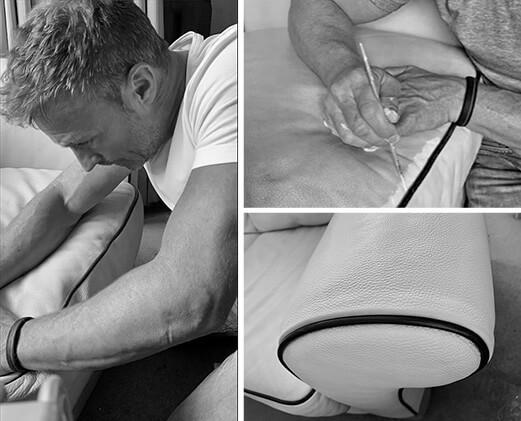
Can nubuck be restored? In most cases, yes. Nubuck sofas and armchairs that look flat, shiny, patchy or stained can usually be brought back to a soft, even finish, provided the leather itself is still sound. What makes nubuck different from ordinary leather is that the surface is the finish, so the method matters far more than it does with a pigmented sofa. This post explains what nubuck and suede actually are, why they go wrong, what people try at home, and what we do differently as part of our leather restoration work across Essex and London.
What nubuck and suede actually are
Nubuck is full grain leather that has been lightly sanded on the outside, the side where the hair used to be. That sanding raises a very fine velvet nap, which is why nubuck feels soft and looks slightly matte. Suede is the reverse. It is made from the underside of the hide, or from a split layer, and the nap is coarser and more open.
The important point for a sofa owner is that neither has a protective coating. A standard pigmented leather sofa has a layer of colour and a clear lacquer sitting on top of the hide, and that layer takes the wear. Nubuck has nothing on top. Every hand, every head, every spilt drink lands directly on the fibres. That is what gives it that lovely feel, and it is also why it shows its age sooner than the sofa next to it in the showroom.
We see a lot of nubuck in newer homes around Chelmsford, Brentwood and Billericay, often in taupe, stone or soft grey, bought because it looks calm and modern. It suits those rooms. It just needs a different kind of care, and when owners ask can nubuck be restored after it goes wrong, the answer depends on getting a different kind of restorer.
Can nubuck be restored, and what does it usually need?
The honest answer is that most nubuck furniture we are asked about can be restored, but the extent depends on what has happened to it. The most common problems fall into three groups.
Flattened, shiny nap
The nap on nubuck is made of tiny loose fibres. Sit in the same seat every evening and those fibres get pressed flat, then polished by clothing and skin until the patch looks glossy and darker than the rest. On a pale sofa this shows as a shiny oval on each seat and a darker band across the arm. The leather underneath is fine. The surface just needs to be cleaned and the nap brought back up with the right tools.
Grease, hair oil and hand marks
Because there is no coating, natural oils sink straight in. Headrests, the tops of arms and the front edge of seat cushions darken first. On an open-fibre surface these marks cannot be wiped off, they have to be drawn out. That is a job in its own right and it overlaps with the head area work we do on ordinary leather, but the technique for nubuck is gentler and slower.
Spills and stains
Coffee, red wine, ink and pet accidents behave very differently on nubuck than on a sealed leather. The liquid spreads through the fibres and leaves a tide mark with a hard edge. The stain itself is often lighter than the ring around it. Some of these come out well, some leave a faint shadow, and a few (bleach, some hair dyes, strong solvents) permanently change the colour of the fibre. We will tell you which is which before any work starts.

Why home products and repair kits go wrong on nubuck
This is the part where we have to be blunt, because whether or not nubuck can be restored often comes down to what has already been tried, and nubuck is the leather that suffers most from well-meaning attempts at home. Jon, our founder, has spent 26 years looking at sofas, and the nubuck ones that arrive in the worst state are almost always the ones somebody has already tried to fix.
Ordinary leather cleaners and conditioners are designed for a coated surface. On nubuck they soak in, darken the fibres and leave a stiff, blotchy patch that is far more obvious than the original mark. Baby wipes do the same and add a layer of residue that attracts more dirt. Water on its own leaves tide marks. Suede sprays from the shoe shop are made for a small area of a boot, not a three-seater, and they change the colour and feel in a way that cannot be undone.
The “nubuck repair kits” sold online usually contain a pigment or a tinted spray. Pigment on nubuck fills the nap and turns it into something closer to painted leather. It looks acceptable for a few weeks, then it wears through in the seat and you are left with a sofa that is part velvet, part plastic. At that point the only real options are to strip everything back, which is a big job, or accept it.
Sanding or using an abrasive block over a large area is another one we see. It can lift a small mark on a shoe. On a sofa arm it thins the hide, changes the colour and leaves a patch that catches the light differently from everything around it. None of this is to make anyone feel foolish. These products are sold as the answer, and the packaging rarely says “not for furniture”.
What professional nubuck restoration involves
We treat nubuck as a cleaning and finishing job first and a colour job only if we have to. That order matters. The aim is to keep the surface as natural as possible for as long as possible.
The first step is always an assessment. We look at the whole piece in daylight, check the fibre in the worst areas, and test a hidden spot to see how the leather responds. From that we can tell you honestly whether the problem is surface soiling, ingrained grease, a colour change in the fibre itself, or a mixture, and so whether this particular piece of nubuck can be restored fully or in part.
The deep cleaning stage is where most of the improvement happens. We use products made specifically for open-fibre leathers, worked in carefully and lifted out with the soiling rather than left in the nap. Grease and hair oil in headrests and arms are drawn out over more than one pass. Stains are treated individually, because a red wine tide mark and a pen mark need different approaches, and rushing either one sets it permanently.
Once the surface is clean and dry, the nap is restored. This is a skilled part of the job. Flattened, glazed areas are lifted back to velvet so that the seat matches the back and the arms, and the whole piece is brushed to an even direction so it reads as one surface again.
Where the fibre itself has lost colour, for example a bleached patch from sunlight in a conservatory or a dye stain that has changed the tone, we can apply a specialist nubuck colour that penetrates the fibre rather than sitting on top of it. It is very different from the pigment used on a normal sofa and it keeps the soft hand. We then finish with a protector designed for nubuck, which slows down the next round of hand marks and makes future spills easier to deal with.
When nubuck restoration is not the right answer
We would rather tell you now than after you have paid for a visit. Can nubuck be restored in every case? No. There are a few situations where it is not worth it, or not possible.
If the hide has worn through, so that the seat has gone thin and you can see the weave of the split underneath, cleaning will not bring it back. That is a panel replacement or reupholstery question, and it depends on the value of the sofa. If a previous “repair” has coated the whole piece in pigment, the choice is between accepting a painted finish, which can be tidied and recoloured properly, or a full strip back, which is a workshop job and only makes sense on a good quality piece.
Very heavy bleach damage, and some strong hair dye or fake tan marks, alter the fibre permanently. We can often reduce them and blend the colour, but we will not promise that they vanish. And if the cushions have collapsed at the same time as the surface has worn, it is sometimes better to look at the piece as a whole rather than restore the leather on top of foam that has gone.
The trade body Leather UK is a useful place to read about how different leather types are made if you want to understand what you have bought. For most people, though, a couple of photos sent to us will answer the question faster.
Cost, timing and where the work is done
Most nubuck cleaning and nap restoration is done at your home. A typical three-seater in an average state takes a day, sometimes with a short return visit if a stubborn stain needs a second pass once it has dried. Heavier jobs, or anything that needs colour work across the whole piece, tend to come into the workshop in South Benfleet so the drying and finishing can be controlled properly.
What affects the price is the size of the piece, how ingrained the grease is, how many separate stains there are, and whether any colour correction is needed. A pair of armchairs from Leigh-on-Sea with flattened seats is a very different job from a corner sofa in Romford with three years of hand marks and a dog. We quote each piece on its own, and the quote is free.
Get a Quote to Restore Your Nubuck Sofa or Chair
If you have been searching for can nubuck be restored, the quickest way to find out is to send us two or three photos: one of the whole piece in normal room light, one close up of the worst area, and one of the label or any care tag if you still have it. Tell us roughly where you are, whether that is Southend-on-Sea, Basildon, Colchester or central London, and whether the sofa can be reached easily.
Call Jon directly on 07967 216250 or fill in the enquiry form below this post. You can read more about our leather restoration service and our approach to stain removal on those pages, and Jon will come back to you with an honest answer to can nubuck be restored in your case, and what it will need.