Can faux leather be repaired? Sometimes, and it depends a great deal on what kind of faux leather you have and how it has failed. A small cut or scuff in a good quality PU or vinyl sofa can often be repaired so it is barely visible. Widespread peeling and flaking, on the other hand, is the material itself breaking down, and no repair product will reverse that. In this post we explain the difference between the common types of faux leather, what can and cannot be done with each, and when it makes more sense to replace a panel, reupholster or, occasionally, let the sofa go.
What faux leather actually is
“Faux leather” is a catch-all term for several quite different materials, and the answer to can faux leather be repaired changes with each one.
Polyurethane, usually labelled PU, is the most common on modern sofas. It is a thin plastic coating bonded to a fabric backing, embossed with a leather-style grain. It is soft, looks convincing when new, and is what most budget and mid-range “leather look” sofas are made from. PVC or vinyl is the older, tougher version, often used on pub seating, caravan upholstery and older three-piece suites. It is more durable than PU but can go stiff and crack with age and cold.
Then there is bonded leather, which sits somewhere in between. It is made from leftover leather fibres ground up, mixed with a binder and rolled onto a backing with a PU coating over the top. It is sold as leather, and technically contains some, but it behaves like a plastic-coated fabric and fails in the same way. A surprising number of the “leather” sofas Jon is asked to look at in Basildon, Thurrock and Romford turn out to be bonded.
If you are unsure which you have, look at the underside of a cushion or the back of the sofa. Real leather usually has a suede-like reverse; faux leather has a woven or knitted fabric backing. The Leather UK trade association has useful material on how genuine leather is defined and labelled, which is worth reading before buying your next sofa.
Can faux leather be repaired? It depends on the damage
Cuts, tears and punctures
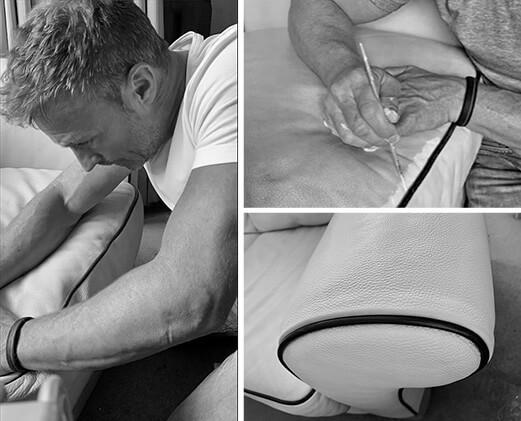
A clean cut from a dropped pair of scissors, a cat claw puncture or a tear at a seam is the most repairable kind of faux leather damage. Provided the material around the damage is still sound and flexible, it can be backed from behind, filled, textured to match the grain and recoloured. On vinyl this holds up well. On PU the result is good but the repaired spot will always be a little more delicate than the original, because PU is thin to begin with.
Scuffs and colour loss
Scuffs where the coloured top layer has been rubbed off, for instance on the front edge of a seat or where a belt buckle has caught the arm, can usually be recoloured. The key is whether the coating underneath is still intact and bonded. If it is, colour can be rebuilt and sealed. If the scuff has gone through to the fabric, it is treated more like a tear.
Peeling and flaking
This is the big one, and the honest answer is that peeling faux leather cannot be repaired in any lasting way. When PU or bonded leather starts to flake, the coating has reached the end of its life. It has lost its bond to the backing and is coming away in sheets. You can pick off the flakes and paint over the fabric, and people do, but the paint has nothing sound to hold on to and the flaking simply continues around the edge of the repair. Within weeks it looks worse than before.
We get calls every week asking can faux leather be repaired once it has started to peel, and we would rather tell people straight than take on a job that will not last. Peeling is a replacement problem, not a repair problem.
Cracking and stiffness
Vinyl that has gone hard and cracked, often in caravans, conservatories and unheated rooms, is in a similar position. Fine surface cracks on an otherwise flexible piece can sometimes be filled and refinished. Deep cracks in brittle vinyl mean the plasticisers have gone and the material will keep cracking whatever is done to the surface.
Why faux leather repair kits disappoint
The kits sold online for faux leather are usually the same as those sold for real leather: a filler, some colour, sometimes a heat tool and a grain paper. On a tiny cut in a sound piece of vinyl they can work after a fashion. The problems come with everything else.
The colours in a kit are generic, and faux leather comes in an enormous range of shades and sheens, so the patch rarely matches. The filler is often too rigid for thin PU, so it cracks or lifts as soon as the sofa is sat on. Heat tools in inexperienced hands melt the surrounding PU, which is a plastic after all, and turn a small tear into a shiny, distorted patch. And on peeling material the kit simply has nothing to grip. Jon has had many customers in Chelmsford and Colchester send photos of a kit repair that has made things noticeably worse, at which point the original damage has become a bigger job.
Superglue deserves its own mention. It goes hard, it goes white, it does not flex, and it is very difficult to remove from a plastic surface without damaging it further.
What a professional can do with a faux leather sofa
Our first job is always an honest assessment of whether this particular faux leather can be repaired. Jon will identify the material, check how well the coating is bonded across the whole sofa (not just at the damaged spot), and tell you whether a repair is going to last. On sound PU and vinyl, localised repairs are carried out much as they are on real leather: the damage is cleaned and prepared, backed where necessary, filled in thin flexible layers, textured to match the surrounding grain, and colour matched and sealed. This work is part of our wider leather restoration service and the finish is chosen to suit a synthetic surface rather than a hide.
Where one area has failed but the rest of the sofa is fine, the best answer is often a new panel. We can replace a seat cushion cover, an arm panel or a back panel using new material matched as closely as possible to the original, which is what our replacement leather panels service is for. On a sofa with a good frame this is usually far cheaper than replacing the whole thing, and it deals with peeling properly because the failed material is removed rather than covered.
Where the peeling is across most of the sofa, but the frame, springs and cushions are still good, full leather sofa reupholstery is worth considering. Many customers take the opportunity to move from faux leather to real leather at this point, so that the next twenty years are not spent watching the surface flake.

Is it worth repairing a faux leather sofa at all?
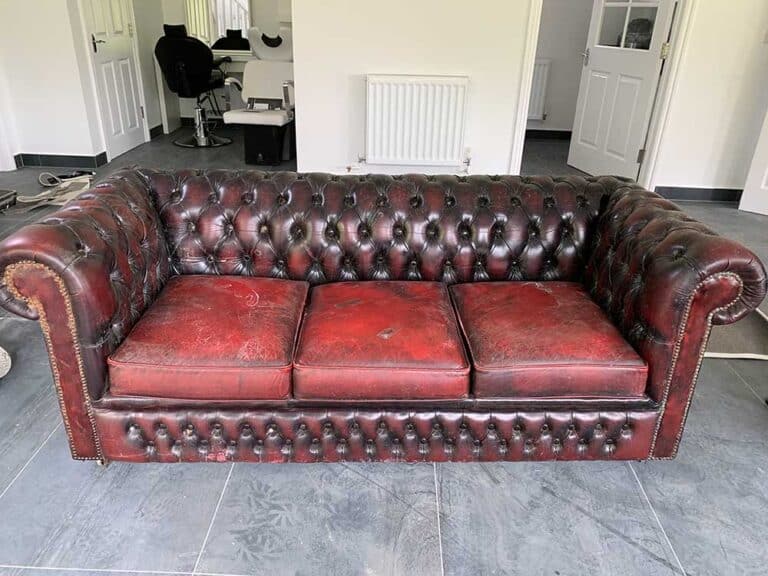
This is a fair question, and it is really the practical side of can faux leather be repaired: the answer comes down to what the sofa is worth to you. A budget PU sofa that cost a few hundred pounds and has started peeling at three years old is unlikely to justify professional work, and we will say so. A good vinyl Chesterfield-style sofa in a Southend-on-Sea bar, a well-made PU corner suite that still fits the room perfectly, or a piece with sentimental value is a different matter, and a repair or panel replacement can be very worthwhile.
Jon’s general rule is that the material around the damage has to be sound. If it flexes without cracking, does not flake when rubbed firmly, and the coating is still bonded to the backing, there is something to work with. If not, the money is better spent on a panel, on reupholstery, or on the next sofa.
Get a quote for your faux leather sofa
Send us two or three photos in daylight: one close up of the damage, one of the whole sofa, and if possible one of the underside of a cushion so we can see the backing. Tell us roughly where you are. We cover Essex, London and the surrounding area from our base in South Benfleet, and we will tell you honestly whether your faux leather can be repaired and whether it is worth doing.
Call Jon on 07967 216250 or fill in the enquiry form below this post. You can read more about what we do on our leather restoration page, and every quote is free and without obligation.