Can faded leather be restored? In almost every case we see, yes. A sofa that has gone from rich chestnut to a washed-out orange on the side facing the patio doors, an armchair with a pale, chalky back where the afternoon sun hits it, or a whole suite that has lost its depth after years in a bright conservatory can all be brought back to a proper, even colour. Fading is a finish problem rather than a structural one, and finishes can be rebuilt. This post explains what fading actually is, why the pens and creams sold online rarely work, and what a professional restoration involves.
What fading does to leather
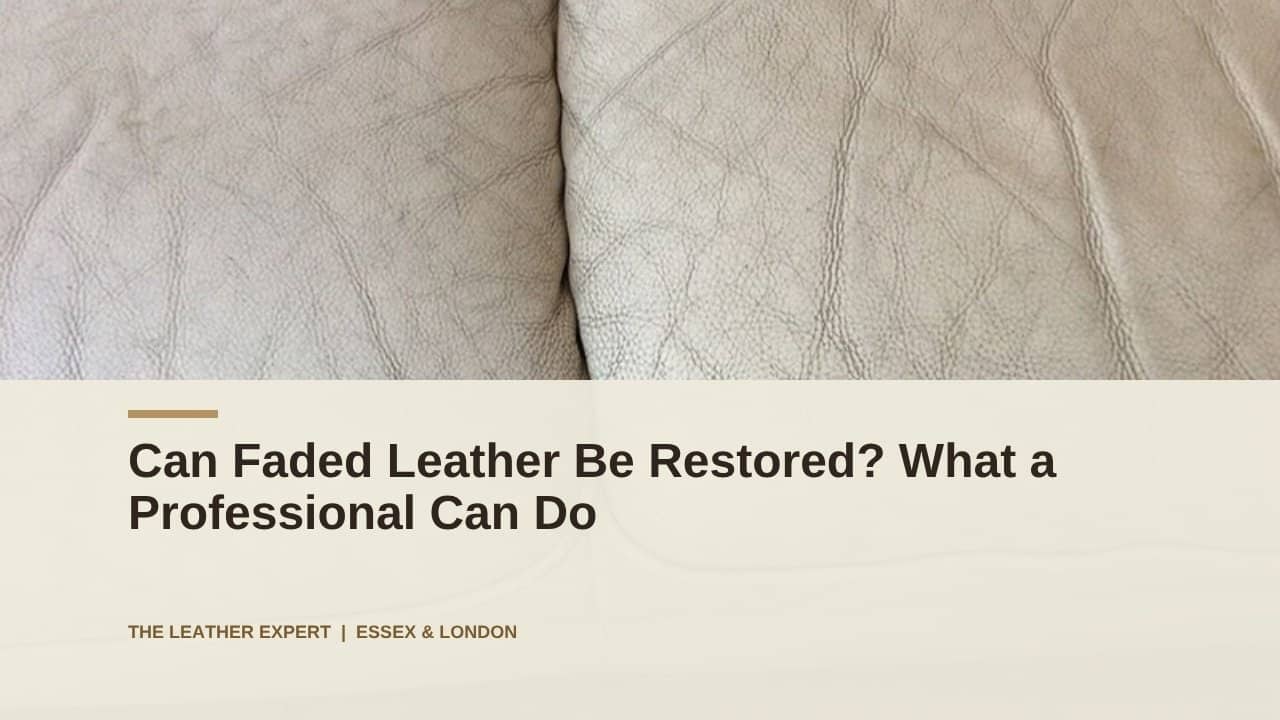
Most leather furniture sold in the UK is finished with a pigmented coating. The colour you see is not the colour of the hide; it is a layer of pigment bonded to the surface and sealed with a clear top coat. Ultraviolet light breaks down that pigment over time, and it also dries out the oils in the hide beneath, which is why faded leather often feels stiffer and looks slightly dull as well as lighter.
The effect is rarely even. One arm of a sofa in a Leigh-on-Sea front room might be almost untouched while the other has lost half its colour. Cushions that get flipped fade less than the fixed back panels. Headrests fade faster than seats because they catch light at a steeper angle. That patchiness is what makes fading so noticeable, and it is also why a good restoration has to treat the whole piece rather than just the lightest spot.
Darker colours show fading most obviously. Deep brown turns orange, black goes grey, burgundy drifts towards pink. Lighter leathers fade too, but the change is softer and people often only realise when they move a cushion and see the original shade underneath.
So, can faded leather be restored at home?
This is the question most people are really asking, and the honest answer is that home products tend to disappoint. Leather conditioners and balms are the first thing people reach for. They can make dry leather feel softer, which is worthwhile, but they do not put colour back. A conditioned faded sofa is a soft faded sofa.
Colour restoration creams and “leather recolouring balms” are the next step up. These are essentially a thin coloured wax or cream that sits on the surface. They can darken the leather slightly for a while, but the colour is a generic shade from a catalogue, not a match to your sofa, so the treated area often ends up a different tone to the rest. The cream also transfers onto clothing, wears off the seat within weeks, and leaves a residue that makes a proper repair harder later on.
Spray dyes and paint are the ones that worry us most. Applied over an unprepared, faded finish, they do not bond properly. The result looks acceptable for a month and then begins to crack and flake along the seams and creases, at which point the sofa looks far worse than it did faded. Jon has stripped many sofas in Chelmsford and Romford that had been sprayed at home, and the stripping is usually the most time-consuming part of the whole job.
We are not saying this to be gloomy. When customers ask can faded leather be restored, the answer is far more often yes when the finish has been left alone, because a faded sofa with an untouched finish is a much better starting point than a faded sofa with three layers of mismatched cream and spray on it.
How we restore faded leather professionally
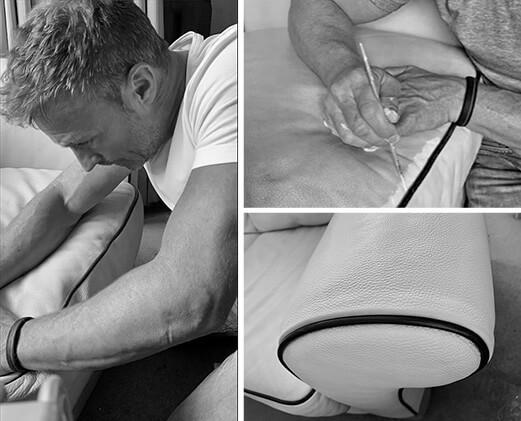
Our sun bleached and faded leather repair service follows a process that Jon has refined over 26 years. The details vary with the leather, but the stages are broadly the same on every job.
Assessment
Jon looks at what type of leather it is, how it was finished, how far the fading has gone and whether the hide underneath has dried, cracked or gone stiff. He checks for any previous treatments and for other damage that should be dealt with at the same time, such as scuffs, small tears or worn piping. This is also when he takes colour references from protected areas, under cushions or on the back, so the restored colour matches what the sofa was meant to look like.
Deep cleaning and preparation
Years of body oils, dust, conditioner and household polish have to come off before anything else happens. The surface is then prepared so the new finish can bond properly. On badly dried leather, this stage also includes feeding the hide so it regains some flexibility, because colour applied over brittle leather will crack as soon as the leather flexes.
Colour matching and application
The pigment is mixed by eye against the original colour and tested on a hidden area. On a piece that has faded unevenly, the aim is to bring the whole sofa back to one consistent shade rather than simply darkening the pale bits. The colour is built up in thin coats so the grain and natural texture of the leather remain visible, which is the difference between a restored sofa and one that looks painted.
Sealing and finishing
Once the colour is right, a clear top coat is applied to protect it and to give the correct sheen, whether that is the soft matt of an aniline-look finish or the gentle gloss of a classic Chesterfield. The finish is what gives the restoration its durability, and it is the part that home kits almost always skip.
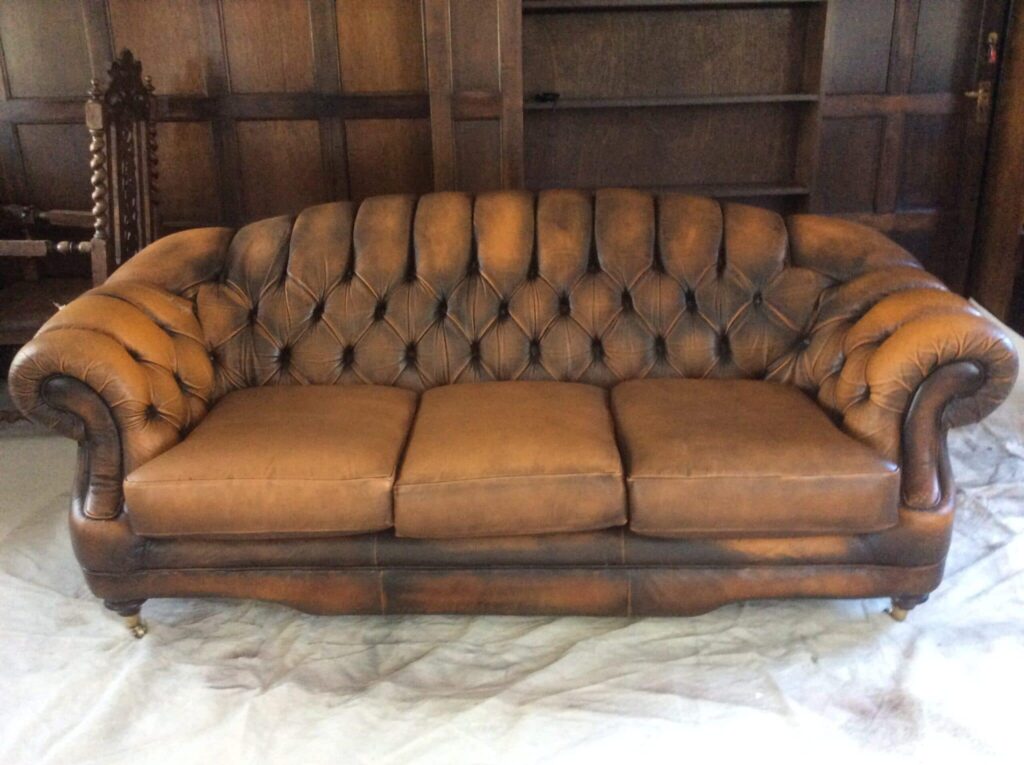
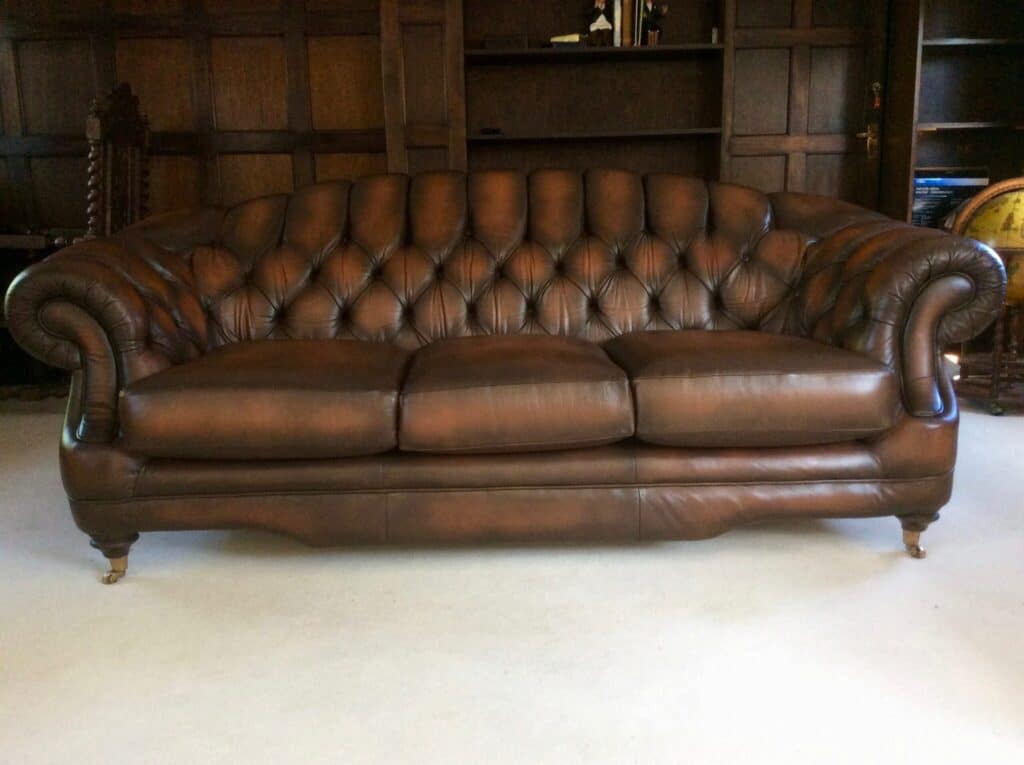
If you would like to see what this looks like in practice, we wrote up a sun faded sofa restoration from start to finish.
Restoring the original colour or choosing a new one
Because the finish is being rebuilt anyway, fading is often a good moment to think about colour. Many customers want their sofa back exactly as it was, and that is what we do most often. Others take the opportunity to go a shade darker, or to change colour entirely to suit a redecorated room. Full leather sofa recolouring uses the same core process, so the cost difference between restoring the original shade and choosing a new one is usually modest.
There are limits. Going from a dark colour to a very pale one is harder and needs more coats to cover evenly, and some very heavily textured or waxed leathers behave differently. Jon will tell you straight if a colour change is not going to look right on your particular sofa.
Restoring faded leather that has also cracked or dried
Sun rarely just fades leather. It dries it out as well, and dried leather cracks, especially along the front edge of seat cushions and across the tops of arms. When the fading has been left for years, we often find the surface has developed a fine network of cracks, or the finish has started to lift.
These cases need a fuller leather restoration rather than a straightforward colour refresh. Cracks are filled and smoothed, the hide is fed to restore flexibility, and only then does the colour work begin. It takes longer, but it is still a fraction of the cost of replacing a good quality suite, and the result lasts. So even here, can faded leather be restored? Usually, yes.
The one situation where we advise against restoration is when the hide itself has rotted or gone paper-thin from decades of direct sun. You can feel this: the leather tears with light finger pressure. At that point the honest answer is a replacement panel rather than colour.
Reducing fading after the restoration
Once the colour is back, the question shifts from can faded leather be restored to how you keep it that way, and it makes sense to slow down the process that caused the fading. The Met Office publishes UV forecasts, and it is worth remembering that UV comes through glass; a sofa does not have to be outdoors to fade. Turning the sofa slightly, using a blind on the sunniest afternoons, or rotating and flipping cushions all help, and the protective finish we apply includes UV resistance that the original factory coating may have lost years ago.
We can also apply a leather protection treatment across the whole suite at the end of the job, which helps with spills and general wear as well as sunlight.
Get a quote to restore your faded leather
If you are still asking can faded leather be restored in your own home, send us two or three photos of the sofa or chair taken in daylight: one of the faded area, one of an unfaded area such as under a cushion, and one of the whole piece. Let us know roughly where you are. We work across Essex and London from our base in South Benfleet, and most colour restorations are done in your home.
Call Jon on 07967 216250 or fill in the enquiry form below this post. Our sun bleached and faded leather repair page has more before-and-after examples, and every quote is free and without obligation.