Can a Chesterfield sofa be restored? In nearly every case, yes, and it is usually worth doing. A Chesterfield is built on a hardwood frame with coil springs and a lot of hand work, which is exactly why they last for decades and why they are worth saving when the leather has cracked, the buttons have popped or the seat has gone. The question is really about which parts need attention and how far you want to take it. This post walks through what typically goes wrong, what a proper Chesterfield sofa repair involves, and what is not worth doing, based on the ones we have restored for customers across Essex and London.
Why Chesterfields age differently from other sofas
A Chesterfield is not a typical sofa. The deep buttoning pulls the leather into hundreds of small pleats, each one a point of tension. The rolled arms and back are the same height, so the leather over them takes constant hand and head contact. The studs around the edges are driven through the leather into the frame. And most of them, especially the older ones and the better new ones, sit on a hand-tied coil spring seat rather than foam and webbing.
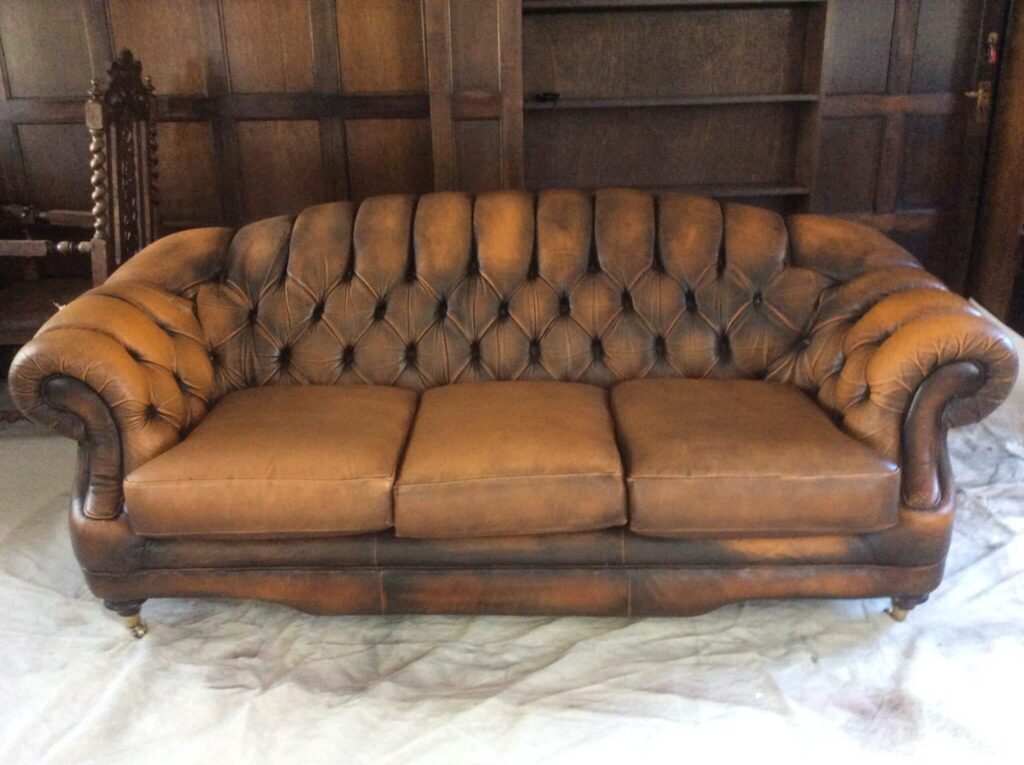
All of that means the wear shows in particular places. The buttons and the pleats around them crack first, because the leather is stretched tightest there. The tops of the arms and the front edge of the seat go pale and dull, then split. Studs work loose where the wood behind them has softened. And the seat, which felt like sitting on a drum when new, gradually becomes a hammock.
None of this is a sign of a bad sofa, and none of it changes the answer to can a Chesterfield sofa be restored. It is a sign of a sofa that has been sat on for thirty years. We see Chesterfields from Brentwood, Chelmsford and the older houses around Leigh-on-Sea that were bought in the 1980s and are still on their original frames and springs. The leather is the part that needs help.
Can a Chesterfield sofa be restored when the buttons have gone?
Missing and popped buttons are the most common thing we are asked about, and they are the easiest to fix. A Chesterfield button is a metal or plastic form covered in the same leather as the sofa, held in place by a strong twine that runs through the padding and is tied off at the back. When a button “pops”, it is usually the twine that has broken or the button form that has rusted through. The leather around the hole is normally fine.
We make new buttons covered in matching leather, colour them to blend with the aged surface around them, and re-tie them through the original holes to the same depth as their neighbours. Getting the depth right matters. A button pulled too tight looks like a dimple; too loose and the pleats around it go slack. On an older sofa we will often re-tension a few of the surrounding buttons at the same time so the whole panel reads evenly.
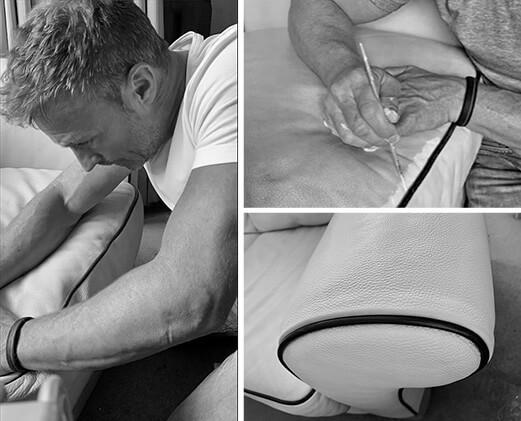
Where the leather around a button has torn, which happens when someone has tried to pull the button back through by hand, the tear is repaired first, usually with a sub-patch behind the hole, before a new button goes in. Jon, our founder, has re-buttoned everything from a single armchair in Rayleigh to a full three-piece suite for a hotel bar in central London, and the process is the same each time.
Studs, pleats and the arms
Loose or missing studs
Brass and antique-finish studs come loose when the wood behind them dries out or splits, or when they have been knocked. Missing ones are replaced with matching studs and the spacing is kept even, which is fiddly but important because an uneven run of studs is the first thing your eye notices. Where the timber has crumbled, the edge is built back up so the new studs have something to bite into.
Cracked pleats and worn buttoning
The leather in the pleats between the buttons is under constant strain. It cracks along the fold, the colour rubs off the high points, and on a pale sofa the creases fill with dirt. Restoring this is careful, close work: the pleats are cleaned out, the cracked finish is stabilised and filled where it has split, and the colour is rebuilt across the whole panel so that the high points and the folds match again. It is done pleat by pleat, and it is what makes a restored Chesterfield look like a restored Chesterfield rather than a sofa that has been painted over.
Arms and seat fronts
The arm tops and the front edge of the seat fade, dry out and split. These panels are usually restored with the same clean, repair, recolour and seal process we use in our wider leather restoration work. Where a split has gone right through the hide, it is sub-patched and filled before recolouring. On a badly worn arm the honest fix is sometimes a replacement panel in matching leather, colour blended into the rest of the sofa.
The seat and the springs
Can a Chesterfield sofa be restored when the seat has sagged? Yes, because a sagging Chesterfield seat is usually a spring problem, not a foam problem. On a hand-tied coil sprung seat, the twine that holds the springs in position breaks over time and the springs lean, or the webbing under them stretches and the whole platform drops. Serpentine sprung seats on more modern pieces can have a spring that has come unhooked.
Restoring the seat means going in from underneath: removing the base cloth, replacing or re-tensioning the webbing, re-tying the springs so they stand square, and replacing the hessian and stuffing over the top where it has compacted. Once the platform is right the seat leather is put back over it and re-studded. It is proper upholstery work and it is done in the workshop in South Benfleet rather than in your living room, but it is what gives a Chesterfield back that firm, springy feel it had when it was new.
Recolouring a Chesterfield
Many customers take the opportunity to change the colour while the sofa is being restored. A faded tan going back to a deep oxblood, a green library Chesterfield going to a dark brown to suit a new room, or a scuffed black sofa being brought back to a rich, even black. Chesterfields recolour very well because the pigmented leather they are usually made from takes new colour cleanly, and the buttoning gives the finish depth. The process is described on our leather sofa recolouring page. The one caution is that antique Chesterfields with a genuine aniline hide and a natural patina should be treated more gently, and we will say so if that is what you have.
When restoring a Chesterfield is not the right call
So can a Chesterfield sofa be restored in every case? Not quite, and there are a few situations where we would advise against it. Cheap reproduction Chesterfields, often bonded leather on a softwood frame with foam seats, do not have the bones to justify a full restoration. The bonded leather peels rather than wears and the frame will not take re-springing. If the frame itself has broken, with split rails or joints that have come apart, that has to be repaired first, and on a valuable antique it may be a job for a specialist furniture restorer. The British Antique Furniture Restorers’ Association is the place to find one for period pieces where the frame and joinery need conserving.
For the vast majority of Chesterfields, including every good quality one from the last fifty years, the frame is fine, the springs can be sorted and the leather can be restored. The cost of doing so is usually a fraction of what a comparable new Chesterfield costs, and you keep the sofa that already fits your room.
Timing, where the work is done and what affects the price
Small jobs, such as a handful of buttons, a run of studs or a single worn arm, are often done at your home in a visit. A full restoration with re-springing, panel repairs and recolouring comes into the workshop and takes longer, partly because the colour work needs proper drying time between coats. The price depends on how many buttons and studs need attention, how much of the leather has cracked or split, whether the seat needs re-springing, and whether you are recolouring the whole piece. A single armchair is a different job from a three-seater and two chairs. Every job is quoted individually, and quotes are free.
Get a Quote to Restore Your Chesterfield
If you are still wondering can a Chesterfield sofa be restored when it looks as tired as yours, send us a photo of the whole sofa, a close up of the buttoning and any worn arms, and a photo of the seat with any loose cushions removed. Let us know roughly where you are, whether that is Southend-on-Sea, Billericay, Colchester, Romford or across London, and whether the sofa can be collected if workshop work is needed.
Call Jon directly on 07967 216250 or fill in the enquiry form below this post. You can see the full range of what we do on our Chesterfield sofa repair page, and Jon will tell you honestly what your sofa needs and what it will cost.